
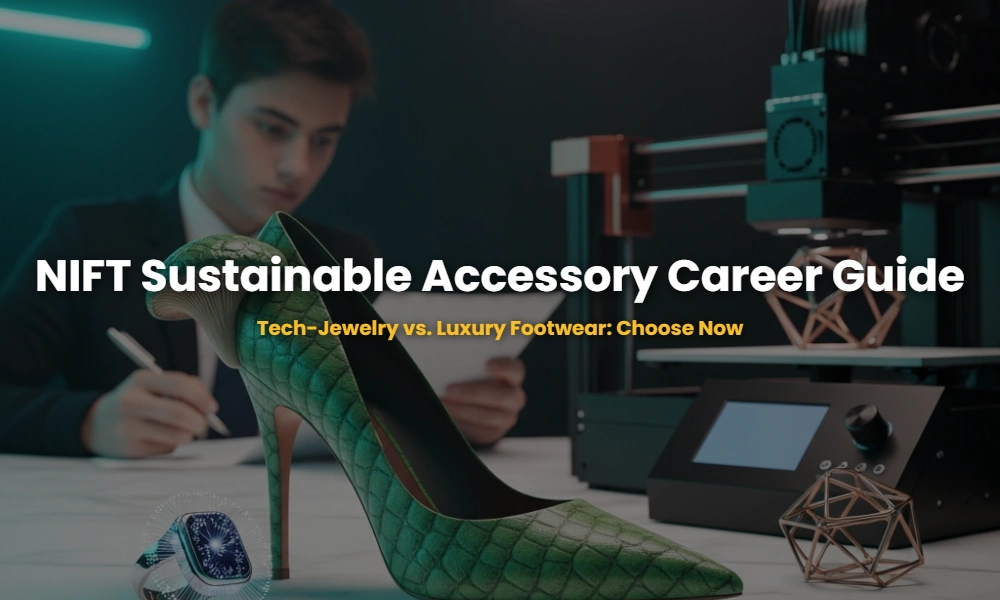
Is NIFT Sustainable Accessory Design Your Secret Weapon?
Sustainable accessory design is the fastest-growing niche in the global fashion industry, offering NIFT aspirants a unique opportunity to merge ethical consciousness with high-end craftsmanship. As the industry pivots toward circularity, professionals specialized in eco-materials and ethical production are seeing a 40% surge in demand compared to traditional roles. Whether it’s bio-fabricated jewelry or low-carbon luxury shoes, this field is where the future of fashion resides.
🚀 Key Takeaways
- ✅ Tech-Integrated Jewelry: Merges IoT with aesthetic appeal for health and connectivity.
- ✅ Luxury Footwear Sustainability: Focuses on biomaterials like mushroom leather and recycled ocean plastics.
- ✅ NIFT Advantage: The Accessory Design (AD) department is now integrating 3D printing and smart wearables into its core curriculum.
- ✅ Market Growth: The sustainable luxury market is projected to hit $50 billion by 2030, creating massive career vacancies.
Table of Contents
The Hidden Goldmine in Tech-Integrated Jewelry?
Tech-integrated jewelry represents the convergence of high-fashion aesthetics and functional technology, often referred to as ‘Smart Jewelry.’ This sector utilizes IoT (Internet of Things) sensors, NFC chips, and biometric monitoring housed in precious metals or recycled e-waste. For NIFT graduates, this means moving beyond simple sketches to designing interactive interfaces that track health metrics or enable contactless payments without sacrificing luxury appeal.
The rise of the “Quantified Self” movement has pushed jewelry designers to rethink their medium. We are no longer just looking at gold and diamonds; we are looking at conductive polymers, flexible PCBs, and lab-grown gemstones that double as capacitive touch surfaces. As an aspirant, mastering fashion technology fundamentals is no longer optional—it is a survival skill. Companies like Oura, Bellabeat, and even legacy houses like Cartier are scouting for designers who understand both Ergonomics and Silicon.
💡 Insider Tip: The “E-Waste” Trend
Top NIFT scorers often include portfolio projects that use recycled motherboard components or silver salvaged from old electronics. This demonstrates a deep understanding of the circular economy—a major grading criterion in the NIFT Situation Test.
Luxury Footwear: Are You Ignoring This Elite Career?
Luxury footwear design focusing on sustainability is the ultimate blend of engineering and high-art, prioritizing regenerative materials and artisan longevity over fast-fashion cycles. This career path involves mastering biomimicry, 3D knitting technology, and plant-based leathers like Piñatex or Mylo. Designers in this space are tasked with creating shoes that are not only red-carpet ready but also fully compostable or infinitely recyclable.
The modern luxury consumer demands transparency. They want to know the carbon footprint of their soles and the ethical status of the tannery. This has opened doors for specialized roles like Footwear Material Scientists and Sustainable Supply Chain Managers within luxury conglomerates like LVMH and Kering. If you are aiming for Accessory Design at NIFT, you must understand that footwear is no longer just about ‘the look’; it’s about the molecular structure of the material and the disassembly process at the end of the product’s life.
Key skills for this domain include CAD (Computer-Aided Design), knowledge of foot morphology, and an obsession with sustainable sourcing. Brands are moving away from toxic glues toward 3D-printed interlocking structures that require zero adhesives—this is where your technical expertise will shine.
🔥 Don’t Risk Your NIFT Rank!
Thousands are preparing for Accessory Design. Will you be in the top 1%? Access the most rigorous, industry-aligned NIFT mock tests designed by ex-NIFTians.
🚀 Take Premium Mock Test NowTech vs. Tradition: Which Path Guarantees Your Success?
Choosing between tech-integrated jewelry and luxury footwear depends on your affinity for hardware integration versus structural engineering. Tech jewelry offers a faster track into the Silicon Valley-Fashion hybrid market, while luxury footwear provides a more traditional yet highly lucrative path within European and Indian heritage houses. Both fields currently report entry-level salaries 25% higher than generic fashion design roles due to their specialized nature.
| Feature | Tech-Integrated Jewelry | Sustainable Luxury Footwear |
|---|---|---|
| Core Tech | IoT, NFC, Biometrics | 3D Knitting, Bio-leathers |
| Sustainability Angle | Recycled e-waste, Lab-gems | Biodegradable soles, Zero-waste |
| Key Employers | Apple, Fitbit, Titan, Tanishq | Hermès, Adidas (Parley), Veja |
| Design Focus | Miniaturization & Interface | Ergonomics & Structural Integrity |
The NIFT Strategy: Cracking the Accessory Design Exam
To secure a seat in NIFT’s Accessory Design program, you must demonstrate a multi-disciplinary approach in your NIFT Situation Test and GAT/CAT papers. This means showing sensitivity to material properties and a clear logic for how components fit together. For the CAT (Creative Ability Test), don’t just draw a pretty earring; draw a modular wearable that solves a problem while looking exquisite.
Examiners are tired of seeing the same traditional patterns. They are looking for candidates who understand Industry 4.0. Mentioning terms like ‘generative design’ or ‘circularity’ in your design descriptions can give you a massive psychological edge. In the GAT (General Ability Test), stay updated on global sustainability treaties and tech innovations in the fashion sector, as these frequently appear in the GK section.
💡 Critical Quiz: Test Your Sustainability IQ
Question: What is ‘Piñatex’ and why is it revolutionary for NIFT AD students?
Answer: Piñatex is a natural, non-woven material made from pineapple leaf fibers. It is a byproduct of agriculture, requiring no additional land or water, making it the perfect ‘vegan leather’ for sustainable footwear and bags.
Everything You Must Know: Accessory Design FAQ
1. Which NIFT campus is best for Accessory Design?
While NIFT Delhi and Mumbai are historically top-tier, NIFT Bengaluru and Gandhinagar have recently surged ahead due to their proximity to tech hubs, making them ideal for tech-integrated jewelry specializations.
2. Is there a lot of math in Accessory Design?
While you don’t need advanced calculus, you do need a strong grasp of Geometry and Mensuration for technical drawings and 3D modeling. This is crucial for both footwear patterns and jewelry settings.
3. Can I shift from Accessory Design to Product Design later?
Yes! The foundational skills taught at NIFT—like material studies and CAD—are highly transferable. Many AD graduates work in consumer electronics, furniture design, and automotive interiors.
Pro-tip: The NIFT 2025 cycle will place a heavier weightage on “Design for Social Impact.” Make sure your portfolio reflects ethical sourcing and community-based manufacturing models.
💬 Chat with our Experts on WhatsApp (+91 9526806124)




