
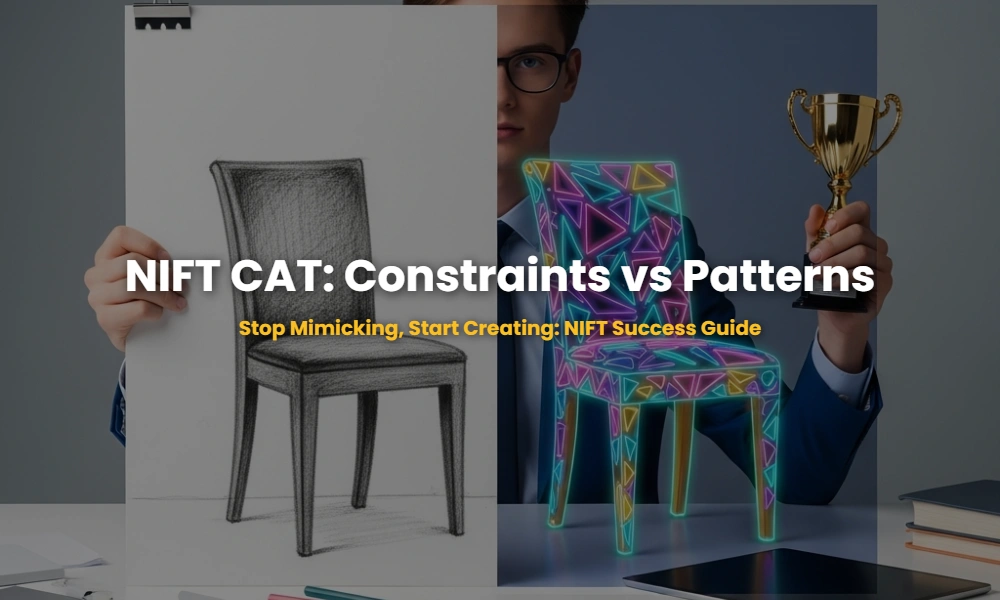
The PYQ Trap: Why Patterns Aren’t Enough for NIFT CAT
Relying solely on past years question patterns for the NIFT CAT leads to failure because it trains your brain for ‘recognition’ rather than ‘innovation.’ When NIFT introduces unexpected creative constraints—like restricted shapes or abstract themes—pattern-reliant students experience cognitive freeze and fail to adapt.
Listen, Exam Warrior, we’ve all been there. It’s 2 AM, your desk is littered with charcoal dust, and you’ve just finished sketching your 50th “Railway Station Scene” from the 2015 paper. You feel prepared. But here is the brutal truth: NIFT isn’t looking for a copycat; they are looking for a designer.
Recent trends in the 2024 and 2025 NIFT Creative Ability Test (CAT) show a deliberate departure from predictable prompts. The examiners are now layering questions with unexpected creative constraints. If you’ve only practiced the ‘what’ (a scene) and not the ‘how’ (under specific restrictions), you are walking into a trap.
Understanding Unexpected Creative Constraints
Creative constraints are specific limitations imposed on a design task—such as using only three geometric shapes or a monochromatic palette—to test a candidate’s ability to innovate within boundaries and solve complex visual problems under pressure.
Think of constraints as the “rules of the game.” In a design studio, you never have infinite resources. You have a budget, a specific fabric, or a rigid brand guideline. NIFT simulates this by adding layers to their questions:
- Material Constraints: Visualizing a product using only 2D shapes to imply 3D depth.
- Color Constraints: Depicting an emotion using only ‘Cool Colors’ or a ‘Split-Complementary’ scheme.
- Narrative Constraints: Designing a garment for a character from a specific historical era but for a futuristic environment.
| Traditional PYQ Approach | The Constraint-Based Reality |
|---|---|
| Draw a poster on Save Water. | Design a postage stamp for 2050 where water is the global currency. |
| Sketch a household appliance. | Re-design a toaster using only the principles of ‘Bio-mimicry’ (inspired by a turtle). |
| Focus on beautiful rendering. | Focus on conceptual depth and problem-solving. |
Why Rigid Preparation Leads to ‘Exam Hall Paralysis’
Failure occurs when an aspirant’s mental model is too rigid to pivot. When faced with a non-traditional question, the brain searches for a familiar ‘template’ that doesn’t exist, leading to time wastage, panic-induced sketching, and a breakdown in creative logic.
We see it every year. Talented artists walk into the NIFT hall, see a question that doesn’t fit the “Scene-Poster-Logo” trifecta, and crumble. This happens for three reasons:
- Over-reliance on Muscle Memory: You’ve practiced drawing a human figure so much that you can’t distort it when a question asks for an ‘abstracted humanoid.’
- The Fear of the Blank Page: Without a pre-set pattern, you spend 45 minutes just thinking, while the clock ticks.
- Ignoring the ‘Why’: You know how to draw a chair, but you don’t understand the ergonomics or the semiotics of a chair.
Mentorship Hack: The “Constraint Drill” for Your Daily Routine
To master the NIFT CAT, integrate a ‘Constraint Drill’ into your daily practice: take any simple object and redesign it five times, each time adding a new, difficult limitation (e.g., no straight lines, use only triangles, or express it through sound-waves).
Exam Warrior, don’t just solve papers. Hack your imagination. Here is a realistic 30-minute daily routine to build ‘Constraint Immunity’:
- Days 1-2 (Shape Lock): Draw your breakfast table using only circles and squares. No other shapes allowed.
- Days 3-4 (Medium Lock): Illustrate ‘Chaos’ using only a single thick marker—no pencils, no erasers. This forces you to commit to your lines.
- Days 5-6 (Logic Lock): Design a footwear for an alien with three feet. Think about the utility before the beauty.
💡 Pro-Tip: The ‘Concept Note’ Secret
In NIFT CAT, your written explanation is often as important as the drawing. When you practice with constraints, write a 2-sentence ‘Concept Note’ explaining how you solved the problem. If you can’t explain it, the design isn’t working!
Conclusion: Evolve or Fail
The NIFT CAT is an audition for the future of fashion and design. While past papers provide the alphabet, creative constraints are the poetry. Mastering both is the only way to ensure your seat in the top NIFT campuses.
Don’t let the anxiety of “unpredictable papers” get to you. Embrace the chaos. The more you restrict yourself during practice, the more free you will feel in the exam hall. You are not just a student; you are a problem-solver in training. Now, pick up that pencil, set a timer, and give yourself a constraint you’ve never tried before.
💬 Chat with our Experts on WhatsApp (+91 9526806124)




