
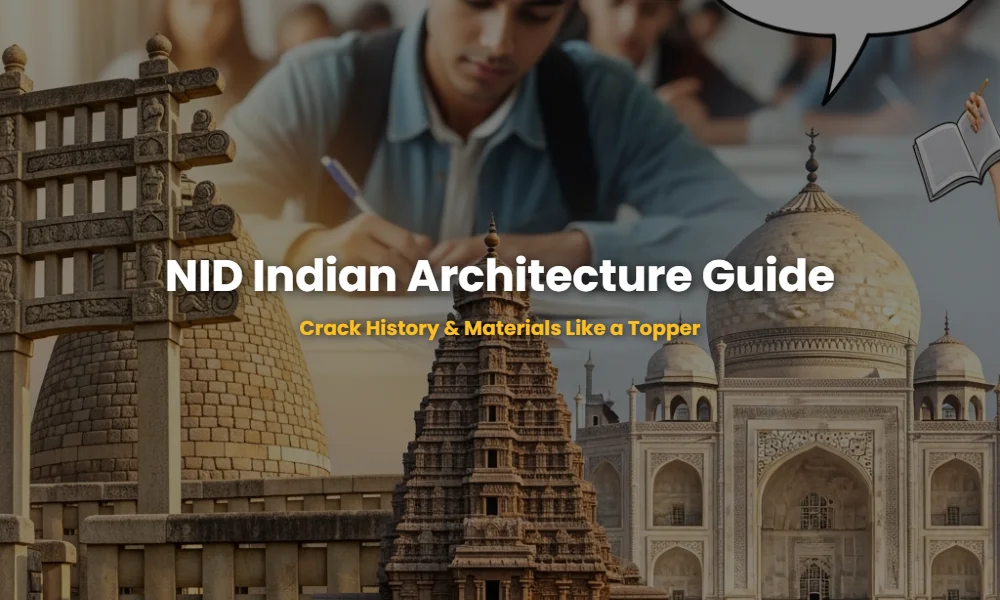
Quick Navigation: Jump to Success
The Deadly Trap: Why NID Obsesses Over Ancient Architectural Evolution
To master the evolution of Indian architectural styles for NID, you must understand the transition from organic materials like wood and bamboo to permanent mediums like sandstone, granite, and marble. This progression reflects shifting socio-political power and advanced structural engineering that defined India’s visual identity for centuries.
🚀 Key Takeaways for High Rankers:
- Material Shift: Wood → Rock-cut → Structural Stone → Composite Masonry.
- Structural Logic: Corbelled Arches vs. True Arches (Indo-Islamic).
- Symbolism: The transition of the Stupa from a burial mound to a complex cosmic diagram.
- Visual Weight: How materials like red sandstone vs. white marble change the ‘feel’ of a monument.
The Mauryan Secret: Is Polished Stone the Key to Early NID Success?
The Mauryan period introduced high-gloss ‘Mauryan Polish’ on chunar sandstone, marking the first major transition from timber architecture to sophisticated stone masonry. This era represents the birth of monumental Indian art, using monoliths to project imperial authority and spiritual ideologies during the Buddhist expansion.
When studying for NID, look at the visual language of Ashokan Pillars. The transition from wood to stone wasn’t just about durability; it was about visual legacy. The rock-cut caves of Barabar show the earliest attempts to mimic wooden carpentry in stone—a recurring theme in design history.
💡 Pro-Tip: The ‘Lomas Rishi’ Mystery
The Lomas Rishi cave entrance mimics a wooden arched doorway. Examiners love to ask about this ‘imitation’ stage where materials change but form remains traditional.
Dravida vs Nagara: The Deadly Distinction Every Topper Knows!
The distinction between Nagara (North) and Dravida (South) styles lies in their vertical profiles and enclosure logic: Nagara features curvilinear Shikharas without massive boundary walls, while Dravida uses tiered Vimanas and towering Gopurams (gateways). Understanding these structural silhouettes is vital for visual spatial questions in NID.
As structural materials evolved from early Gupta-era flat-roofed temples to the massive granite blocks of the Cholas, the engineering moved from simple post-and-lintel to complex interlocking stone mechanisms. Granite, being incredibly hard, led to the minimalist yet powerful aesthetic of the Brihadisvara Temple.
| Feature | Nagara (North) | Dravida (South) |
|---|---|---|
| Tower Shape | Curvilinear (Shikhara) | Pyramidal/Tiered (Vimana) |
| Gateways | Subtle | Grand (Gopuram) |
| Water Tank | Rarely prominent | Temple Tank is mandatory |
Why Ignoring the True Arcuate Style Could Cost You Your NID Admission
The Indo-Islamic architectural style revolutionized Indian structural engineering by introducing the ‘True Arch’ and ‘Dome,’ replacing the traditional ‘Trabeate’ (corbelled) method. This shift allowed for vast, pillar-less internal spaces and grander scale, using materials like lime-mortar to bind stones more effectively than ever before.
For NID, focus on how material palettes changed the vibe. Red sandstone (Mughal early phase) provided a rugged, martial feel, while white marble (Shah Jahan era) introduced luminosity and intricate Pietra Dura work. This is a classic ‘Material and Texture’ question favorite.
💡 Click to Reveal: The Material Mastery Secret
Medieval architects used ‘double domes’ (like at Humayun’s Tomb) to create an imposing height externally while maintaining a human-scale ceiling internally. This is a brilliant example of functional design!
The Elite 5: Previous Year Simulated Questions & Ninja Shortcuts
Mastering these Indian art history concepts will give you an unfair advantage in the DAT Prelims.
Q1. Identify the structural difference between Sanchi Stupa and the Taj Mahal.
30-Second Ninja Shortcut: Look at the ‘Arch’. Stupas use Trabeate (post-lintel) in gateways, whereas the Taj uses Arcuate (true arches). If it’s a curve made of wedges, it’s Islamic; if it’s horizontal slabs, it’s Ancient.
Q2. Why did the materials shift from wood to stone in the 3rd Century BCE?
30-Second Ninja Shortcut: Keywords: Permanence and Prestige. Wood is perishable; Stone is imperial. The material change is a direct result of wanting to immortalize political and religious messages.
Q3. What defines the ‘Vesara’ style seen in Karnataka?
30-Second Ninja Shortcut: Vesara = Hybrid. It blends the Shikhara (North) with the Vimana (South). Think of it as the ‘Fusion’ genre of temple architecture.
Q4. What is ‘Pietra Dura’ frequently seen in Mughal monuments?
30-Second Ninja Shortcut: It’s not just painting; it’s Inlay. Semi-precious stones are cut and fitted into marble. It’s like a high-end stone jigsaw puzzle.
Q5. How does a ‘Corbelled Arch’ differ from a ‘True Arch’?
30-Second Ninja Shortcut: Corbelled = Slabs overlapping inward like a staircase. True Arch = Wedge-shaped stones (Voussoirs) with a central Keystone. True arches can carry much heavier loads.
Lost in the Maze of Design History?
Don’t let the vastness of Indian architecture overwhelm your NID prep. Our experts are here to simplify every pillar, dome, and material for you.
💬 Chat with our Experts on WhatsApp (+91 9526806124)




