
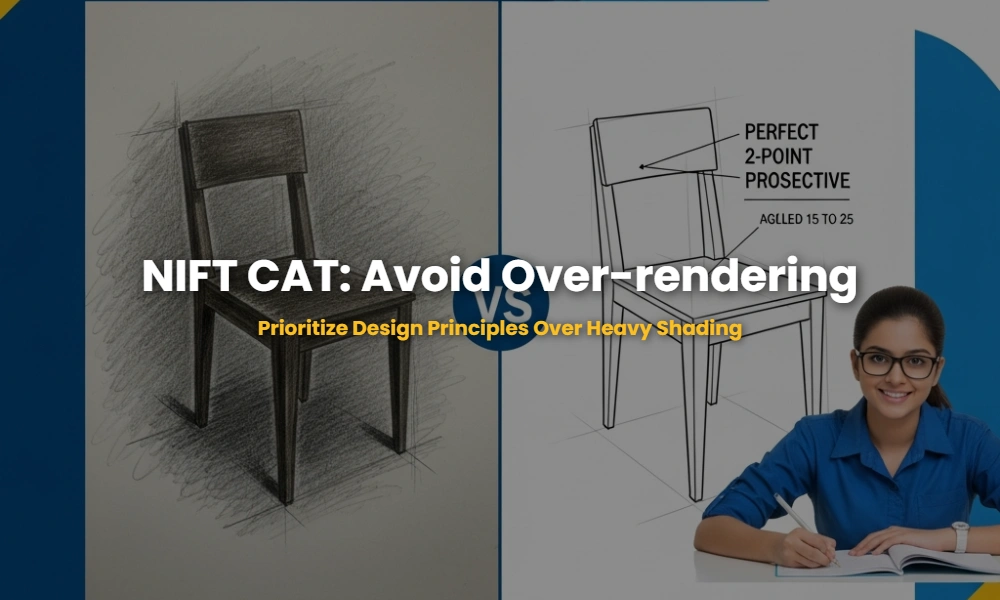
Is Your NIFT Strategy Failing? Why Over-rendering CAT Sketches is a Silent Rank-Killer
Hey there, Exam Warrior. I know exactly how you feel. It’s 2:00 AM, your fingers are stained with 4B graphite, and you’re obsessing over the perfect gradient on a poster design. You’re exhausted, burnt out, and terrified that your sketch isn’t “realistic” enough. But here is the hard truth from a mentor who has seen thousands of portfolios: Over-rendering is the fastest way to lose marks in the NIFT Creative Ability Test (CAT).
NIFT isn’t looking for a fine artist; they are looking for a designer. When you spend 90 minutes shading a single object, you sacrifice the perspective, composition, and storytelling that actually fetch marks. Let’s break down why you need to put that blending stump down and focus on the basics.
The Rendering Trap: Why Less is More in NIFT CAT
Direct Answer: Over-rendering hides structural flaws and consumes precious time meant for ideation. NIFT examiners prioritize design principles—like proportion, perspective, and balance—over artistic finish. A perfectly shaded sketch with incorrect perspective scores lower than a clean line drawing with brilliant composition.
In the high-pressure environment of the CAT, time is your most valuable currency. You have roughly 3 hours to solve 3 to 4 complex design problems. If you spend 70% of your time on shading (rendering), you are essentially leaving 70% of your marks on the table.
- ✅ Clarity over Complexity: A clean sketch communicates an idea better than a muddy, over-rendered one.
- ✅ Ideation is King: NIFT wants to see how you think, not just how you hold a pencil.
- ✅ The Completion Penalty: Leaving a question incomplete because you ran out of time is a guaranteed way to drop out of the top ranks.
💡 Pro-Tip: The 20-Minute Rule
Never spend more than 20 minutes on the final coloring or shading of a question. Use the first 10 minutes for brainstorming, 30 minutes for the structural layout, and keep rendering as the final, optional ‘polish’.
Design Elements vs. Artistic Rendering: The Comparative Analysis
Direct Answer: Design elements (line, shape, form) and principles (balance, contrast, rhythm) form the skeleton of your sketch. Rendering is merely the skin. Without a strong skeleton, the skin sags. Evaluators check for spatial intelligence and conceptual depth before aesthetics.
| Feature | Artistic Rendering (The Trap) | Design Principles (The Goal) |
|---|---|---|
| Primary Focus | Texture, Light/Shadow, Realism | Composition, Proportion, Scale |
| Time Allocation | Excessive (45+ mins per sketch) | Efficient (Balanced across tasks) |
| Examiner Impression | Technically skilled but unimaginative | Analytical, Creative, Solution-oriented |
| Risk Factor | High: Smudging, messy finish, incomplete paper | Low: Communicates the concept clearly |
The 3 Pillars of a High-Scoring NIFT Sketch
Direct Answer: To secure a top rank, candidates must master three foundational pillars: Correct Perspective (1D, 2D, or 3D), Human Anatomy/Proportion (logical sizing), and Compositional Balance. These three pillars carry 80% of the weightage, while coloring and shading carry only 20%.
1. Perspective: The Foundation of Reality
If you draw a beautiful, shaded chair but its legs don’t vanish to the same horizon point, the sketch is a failure. Focus on eye-level and vanishing points before reaching for your colors.
2. Proportion and Scale
NIFT often asks for “Scene Drawing” (e.g., a railway station or a busy market). If your human figures are larger than the train doors, no amount of shading will save you. Practice 8-head theory and relative scaling.
3. Elements and Principles of Design (E&P)
Are you using Emphasis to guide the viewer’s eye? Is there Rhythm in your pattern? These are the keywords examiners look for in your written explanation and your visual execution.
💡 Click to Reveal: The ‘Quick Shading’ Hack
Instead of slow circular shading, use hatching or cross-hatching. It is faster, looks professional, and shows that you understand form and light without wasting 30 minutes on blending.
Daily Routine Hacks for the NIFT Warrior
Direct Answer: Integrate rapid sketching into your daily life by setting 10-minute timers for live observation. Avoid using erasers during practice to build confidence in line quality. Prioritize understanding the ‘Why’ of a design over the ‘How’ of its beauty.
- The Morning 5: Sketch 5 random objects in your room every morning using only basic shapes (circles, cubes, cylinders). Do not shade them. Focus on overlap and depth.
- The “Anti-Eraser” Challenge: Practice for one hour daily without an eraser. This forces you to get your basic design elements right the first time, saving massive amounts of time during the actual NIFT CAT.
- Concept Mapping: Before sketching, spend 2 minutes writing down which design principle you will use. (e.g., “I will use Contrast by making the central object darker than the background”).
Don’t let the fear of a “simple” drawing stop you from becoming a great designer. Master the principles, trust your vision, and keep your pencils sharp—but use them wisely!
💬 Chat with our Experts on WhatsApp (+91 9526806124)




