
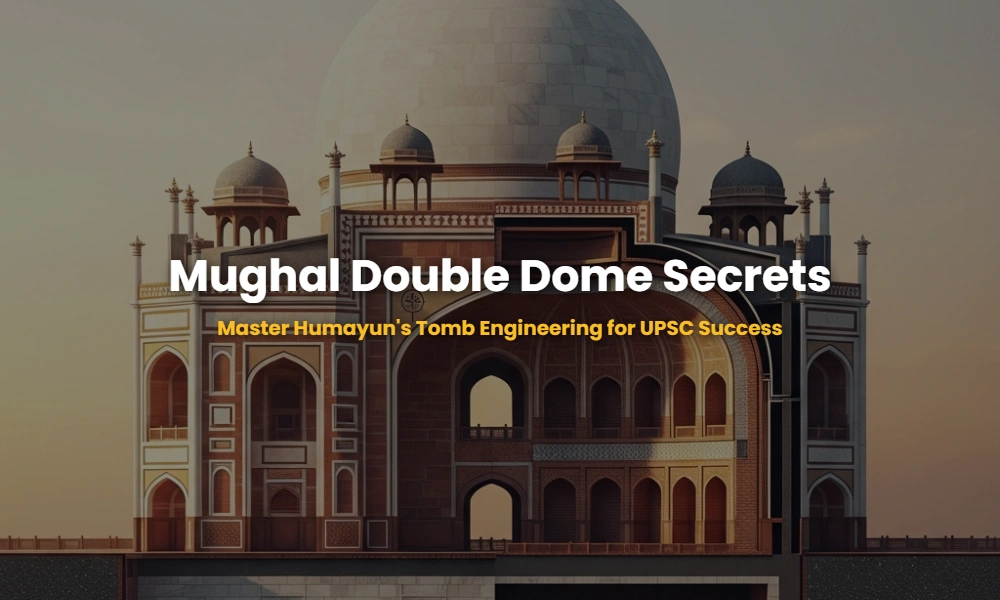
🚀 Key Takeaways: The Double Dome Essentials
- Origin: Introduced in India via Humayun’s Tomb (1560s-70s) by architect Mirak Mirza Ghiyas.
- Structural Purpose: Resolves the conflict between internal ceiling height and external monumental scale.
- Persian Influence: Derived from Timurid architecture (Samarkand style).
- LSI Entities: Indo-Islamic Architecture, bulbous dome, white marble veneer, structural aesthetics, architectural symmetry.
The Double Dome feature is an architectural innovation where two shells comprise the dome instead of one. In Mughal architecture, particularly starting with Humayun’s Tomb, this allowed the exterior to be tall and imposing for visual grandeur while keeping the interior ceiling at a proportional height for acoustic and aesthetic harmony.
The Secret Persian Tech UPSC Toppers Use to Explain Mughal Grandeur
The Double Dome feature originated in the Timurid architecture of Central Asia and Persia, specifically seen in structures like the Gur-e-Amir in Samarkand. It was brought to the Indian subcontinent by Mirak Mirza Ghiyas, the Persian architect commissioned by Bega Begum for Humayun’s Tomb.
Aspirants often overlook that before this, the Sultanate period architecture (like the Lodi tombs) struggled with the ‘inner volume’ problem. A single high dome made the interior feel like a hollow, echoing chimney. By adopting the Persian double-shell method, Mughal builders created a revolution in Indo-Islamic architecture that eventually culminated in the Taj Mahal. This technique is not just about beauty; it’s a masterclass in weight distribution and spatial management.
💡 Insider Examiner Tip: The ‘Drum’ Factor
When writing about the Double Dome, always mention the ‘high drum’. The outer shell is elevated on a cylindrical base called a drum, which provides the towering height visible from miles away, while the inner shell sits lower to maintain the sanctity of the tomb chamber.
Why Your Competitors Misunderstand Double Dome Engineering
The engineering significance of the Double Dome feature lies in its ability to support massive structural loads without compromising the aesthetic proportions of the interior. The hollow space between the two shells acts as a structural buffer, allowing the outer dome to be bulbous and high without adding crushing weight to the internal arches.
In the context of Mughal art and culture, this was a leap forward. The outer shell is typically made of white marble veneer, while the inner shell provides the structural core. This separation meant that moisture and thermal expansion of the outer marble did not directly affect the decorated interior ceiling. This is why Humayun’s Tomb has survived centuries with minimal structural degradation compared to its predecessors.
| Feature | Single Dome (Lodi Era) | Double Dome (Mughal Era) |
|---|---|---|
| Internal Height | Disproportionately high | Harmonious and low |
| External Appearance | Squat/Flat | Bulbous and towering |
| Weight Distribution | Heavy on walls | Distributed via two shells |
| Material Efficiency | Thick masonry needed | Lighter outer veneer |
The Visual Illusion You Must Mention in Your Mains Answer
The aesthetic significance of the Double Dome feature is rooted in the concept of symmetry and scale. By decoupling the internal and external heights, architects could ensure the tomb looked like a celestial mountain from the outside (the ‘bulbous’ Persian aesthetic) while maintaining an intimate, prayer-focused atmosphere inside.
This feature allowed for the introduction of the Chhatris (small domed pavilions) around the main dome without making the roof look cluttered. In Humayun’s Tomb, the white marble of the outer dome creates a stark, beautiful contrast with the red sandstone of the main building—a hallmark of early Mughal architecture. If you fail to mention the ‘transition from Lodi to Mughal’ using the double dome as the bridge, your UPSC Mains answer will lack the technical depth required for high marks.
🎴 Interactive 3D Flashcard Challenge
Hover over the cards below to test your knowledge of Double Dome engineering!
Will You Miss the 2 Marks Hidden in These Double Dome Details?
In the UPSC Prelims, questions often revolve around chronological architectural developments. The Double Dome feature is the specific marker that separates the Sultanate era from the Mughal Golden Age. Without this innovation, the monumental scale of the Mughal monuments would have been physically impossible or aesthetically hideous.
❓ Is Humayun’s Tomb the only example?
No. While it was the first, the Taj Mahal and the Safdarjung Tomb also utilize this feature. However, Humayun’s Tomb is the prototype that UPSC examiners love to target for ‘first-time’ occurrences.
❓ How does it affect acoustics?
By lowering the inner shell, builders reduced the ‘echo chamber’ effect, making the tomb space feel more tranquil and acoustically balanced for prayers and Quranic recitations.





