
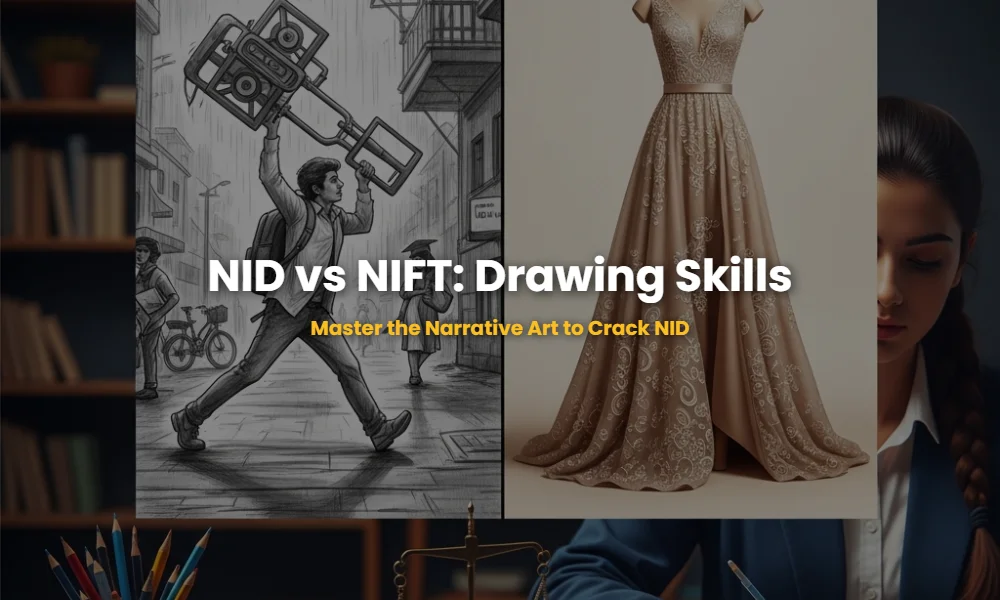
Why is NID’s focus on conceptual storytelling vs. NIFT’s focus on technical rendering the ultimate game-changer for your design career?
Every year, thousands of brilliant artists fail the NID DAT because they treat it like a technical drawing competition. While the NIFT CAT rewards your ability to render silk textures and perfect shadows, NID is hunting for the next great problem solver. Understanding the psychological rift between conceptual storytelling and technical rendering is the single most important factor in your preparation strategy.
🚀 Key Takeaways
- ✅ NID Philosophy: Focuses on empathy, ideation, and the ‘Why’ behind a design.
- ✅ NIFT Philosophy: Prioritizes aesthetic appeal, color theory, and the ‘How’ of technical execution.
- ✅ Evaluation Shift: NID examiners often overlook shaky lines if the narrative is groundbreaking.
- ✅ The Secret Sauce: Learning to weave human emotions into sketches is your ticket to NID Ahmedabad.
The Hidden Conceptual Gap: Are You Making the Fatal Mistake of Being ‘Too Good’ at Drawing?
The fatal mistake most aspirants make is assuming that NID is a test of fine arts; in reality, it is a test of cognitive empathy and narrative intelligence. While a technically perfect drawing might score high at NIFT, NID examiners often view ‘over-rendering’ as a lack of focus on the core solution or story.
In the context of the NID entrance, conceptual storytelling refers to the ability to communicate a complex idea, emotion, or sequence of events through a simple visual medium. It isn’t about how realistic your hand looks; it’s about what that hand is doing and why it matters to the user. On the other hand, NIFT drawing techniques prioritize the visual impact, proportions, and material representation of the subject.
💡 Pro Tip: The 70/30 Rule
For NID, dedicate 70% of your time to brainstorming the ‘idea’ and only 30% to the actual drawing. For NIFT, the ratio is often reversed to ensure visual perfection.
The Narrative War: Why Conceptual Storytelling is the Only Way to Survive NID Prelims
Conceptual storytelling at NID is the process of using visual elements to solve a problem or convey a specific message that resonates with human experience. It requires a deep understanding of perspective, but more importantly, an understanding of ‘User Experience’ (UX) before the term was even digital.
When NID asks you to draw “a scene from a rainy day in a busy market from a frog’s perspective,” they aren’t looking for perfect raindrops. They are looking for:
- Empathy: How does a frog feel? What does it see?
- Observation: The details of the market floor—puddles, discarded plastic, the giant soles of shoes.
- Story: Is the frog trying to cross? Is it scared? Is there a narrative arc in that single frame?
The Technical Trap: Is Your Obsession with Shading Ruining Your NID Rank?
Technical rendering is the skill of representing light, shadow, texture, and form with high fidelity to create a realistic or aesthetically pleasing image. While this is the backbone of the NIFT Creative Ability Test (CAT), relying on it for NID can be a trap because it often masks a lack of original thought.
NIFT seeks students who can eventually design garments or products that look stunning in a portfolio. Therefore, they reward high-quality rendering, sophisticated color palettes, and perfect human anatomy. If you spend 40 minutes shading a sphere for NID, you’ve likely missed the point of the question, which probably asked you how that sphere could revolutionize the way we store water in a drought-hit village.
💡 How to Balance?
Develop a ‘Speed Sketching’ style for NID. Use clean, bold lines and minimal shading to ensure your idea is visible instantly. Save the cross-hatching and stippling for your NIFT practice sessions.
The Ultimate Comparison: NID Storytelling vs. NIFT Rendering
To help you pivot your preparation strategy, here is a breakdown of how the two premier institutes evaluate your drawing skills differently.
| Feature | NID (Conceptual Storytelling) | NIFT (Technical Rendering) |
|---|---|---|
| Primary Focus | Problem-solving and narrative ideation. | Aesthetic finish and visual appeal. |
| Drawing Style | Illustrative, gesture-based, communicative. | Realistic, detailed, texture-focused. |
| Color Usage | Used to highlight focus or emotion. | Used to show color theory and harmony. |
| Human Figures | Needs movement and action (Stick-to-Action). | Needs perfect proportions (Crotchet style). |
| Evaluation Weight | Ideation: 60%, Drawing: 40% | Ideation: 40%, Drawing: 60% |
Insider Secrets: What the NID Examiner’s Red Pen is Looking For!
NID examiners have to look through thousands of sheets. They don’t have time to admire your shading; they are looking for ‘The Spark’. The spark is usually a clever detail that shows you’ve thought about the user’s pain point.
For instance, if asked to design a futuristic kitchen tool, a NIFT-oriented student might draw a sleek, chrome-finished blender. An NID-oriented student will draw a tool that considers the ergonomics for an elderly person with arthritis, using sketches to show the grip and the ease of use. That is conceptual storytelling in action. You aren’t just drawing a tool; you are telling the story of how that tool changes a life.
To really stand out, you should integrate Design Thinking for NID into your daily sketching routine. Ask yourself: “Who is this for?”, “What is the conflict?”, and “How does my design resolve it?”
Can You Really Afford to Ignore These Questions? (FAQs)
❓ Is bad drawing okay for NID if the idea is great?
Not entirely. While NID values the idea more, your drawing must be clear enough to communicate that idea effectively. You don’t need to be Leonardo da Vinci, but you do need to master basic perspective and proportions.
❓ Can I use the same sketching style for both NID and NIFT?
It is risky. A very technical, time-consuming style might leave you with unfinished questions in NID. A very loose, conceptual style might be seen as ‘messy’ or ‘lazy’ by NIFT examiners. Adapting your style is key.
❓ What are the best tools for NID storytelling?
A 2B pencil for light sketching, a dark 4B or 6B for bold outlines, and a set of 12-24 high-quality pencil colors. Avoid heavy markers or messy charcoals during the Prelims.
Ready to Master the NID Drawing Philosophy?
Don’t let your technical skills hold back your creative potential. Our mentors help you bridge the gap between ‘drawing’ and ‘designing’.
💬 Chat with our Experts on WhatsApp (+91 9526806124)




