
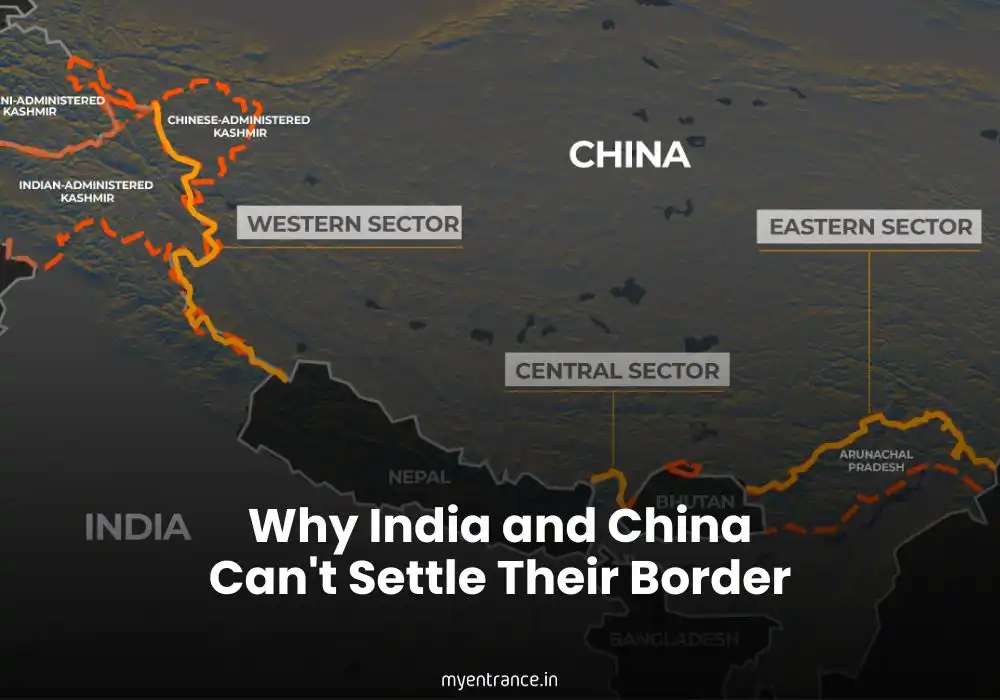
The complex relationship between India and China is often highlighted by one persistent and deeply rooted issue: their undefined and disputed shared border. For students preparing for major competitive examinations such as UPSC, SSC, PSC, and various government exams, understanding this geopolitical challenge is not just current affairs; it’s a critical component of international relations and static general knowledge. This intricate historical and strategic puzzle remains a significant point of contention, impacting regional stability and global dynamics.
At its core, the inability of these two Asian giants to definitively demarcate their frontier stems from differing interpretations of historical agreements and traditional boundaries. Decades of diplomatic discussions and numerous rounds of talks have yet to yield a conclusive resolution, primarily because both nations hold firm to their distinct claims over vast swathes of strategic territory. This fundamental disagreement on what constitutes the actual line between them is the primary “why” behind the ongoing stalemate.
Geographically, the dispute is broadly divided into three main sectors. In the Western Sector, the strategically vital Aksai Chin, currently administered by China but claimed by India, forms a major point of contention in the Ladakh region. The Eastern Sector sees China claiming the entirety of India’s Arunachal Pradesh as ‘South Tibet,’ while India firmly maintains it is an integral part of its territory, largely based on the McMahon Line, which China does not recognize. The relatively calmer Middle Sector also features some minor disputed areas, though these are far less contentious than the other two. These geographical claims form the “where” of the disagreement, each with profound historical and strategic implications. Take your daily dose of current affairs to stay informed and prepared.
The roots of the current situation stretch back into the early 20th century, but the issue escalated significantly following India’s independence and China’s establishment as a communist state. A pivotal moment, the 1962 Sino-Indian War, dramatically altered the perception of the border and cemented the Line of Actual Control (LAC) – an undemarcated line that serves as the de facto boundary – as a crucial, yet fluid, reality. Subsequent agreements in the 1990s and 2000s aimed to maintain peace and tranquility along the LAC, but recent flare-ups, such as the Doklam standoff in 2017 and the tragic Galwan Valley clashes in 2020, underscore the fragile nature of this peace. These events demonstrate the “when” of the ongoing tensions, reminding us that the issue is far from static. This curated static gk syllabus for all exams helps you focus on what truly matters.
So, “how” do these nations manage such a volatile frontier? Diplomatic channels, including special representative talks and various working mechanisms, are continuously employed to de-escalate tensions and seek common ground. Military-to-military engagements at the local level also play a critical role in managing face-offs and adhering to protocols designed to prevent accidental escalation. Both countries are also rapidly developing border infrastructure, which, while enhancing connectivity and security for their respective sides, can sometimes be perceived as escalatory by the other. For students, understanding these ongoing mechanisms and their effectiveness is vital for any analysis of India’s foreign policy and national security, making this a frequently asked topic in daily news quizzes and static general knowledge sections provided by platforms like myentrance.in. The persistent challenge lies in transforming these managing mechanisms into a definitive resolution that satisfies the historical, strategic, and national interests of both India and China.





