
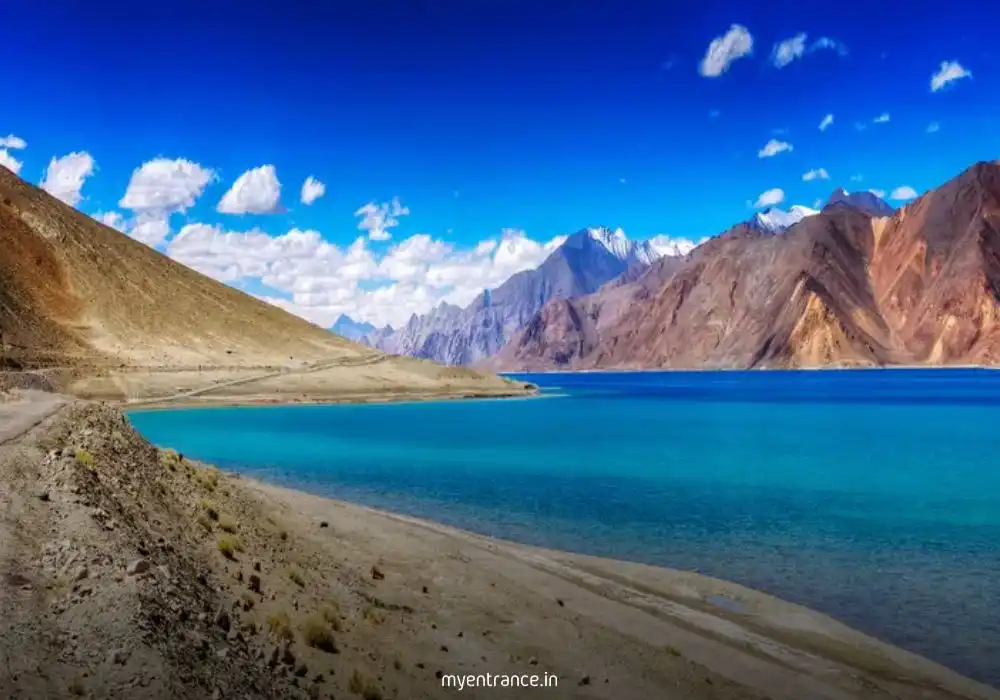
Nestled high in the majestic Himalayan ranges of Ladakh, a natural wonder captivates every eye that beholds it – Pangong Tso, famously known as Pangong Lake. This stunning body of water is not just a breathtaking vista; it’s a dynamic spectacle, celebrated globally for its incredible ability to shift its colours throughout the day. For aspirants preparing for competitive examinations such as SSC, UPSC, PSC, NID, NIFT, and other government-sector roles, understanding such unique geographical phenomena is crucial for excelling in static general knowledge and environmental studies sections. Let us delve deeper into the mysteries of this remarkable lake. Regular daily mcq practice on current events is key to scoring well in the gk section.
Where is this Natural Wonder Located?
Pangong Tso, translating to “high grassland lake” in the local Ladakhi dialect, is situated at an astounding elevation of approximately 4,225 meters (13,862 feet) above sea level. It stretches across a significant portion of the Changthang Plateau in the eastern part of Ladakh, a Union Territory of India. While a substantial part of the lake lies within Indian territory, approximately one-third of this elongated lake extends into the disputed Aksai Chin area, which is controlled by China. This trans-boundary characteristic adds another layer of geopolitical significance, often making it a point of interest in current affairs discussions. The lake itself is an endorheic basin, meaning it is a closed drainage system with no outlet, leading to its saline water composition despite being fed by glacial melt. Its remote, high-altitude location makes it a pristine and invaluable ecological zone, attracting various migratory bird species, especially during the warmer months.
Unraveling the Mystery: Why Does Pangong Lake Change Colour?
The most captivating feature of Pangong Lake is undoubtedly its dramatic shift in colours. Throughout the day, and even from one season to another, the lake transforms, displaying a mesmerizing palette that ranges from brilliant sapphire blue to deep turquoise, emerald green, and even subtle reddish-brown or greyish hues. This spectacular phenomenon is not due to any magical properties, but rather a fascinating interplay of several natural factors.
Firstly, the angle and intensity of sunlight play a significant role. As the sun traverses the sky, its rays hit the water at different angles, causing the reflection and refraction of light to change, much like a prism. Secondly, the depth of the lake varies considerably across its vast expanse, influencing how light penetrates and reflects from the bottom. Deeper sections tend to appear darker blue, while shallower areas might reflect more green. Thirdly, the mineral composition of the lakebed and the surrounding sediment contribute to the colour variations. Different minerals react with light differently, adding to the visual spectacle. Lastly, the presence of various algae and microorganisms within the lake’s ecosystem can also subtly alter its perceived colour. The reflection of the vast, open Ladakhi sky above, often a vibrant blue, also contributes to the lake’s dynamic appearance, making it a living canvas of nature’s artistry.
When Can You Witness This Spectacle?
The colour-changing magic of Pangong Lake can be observed throughout the day, with the most dramatic transformations typically occurring during sunrise and sunset, or when the weather conditions shift. The best time to visit and witness the full spectrum of its beauty is generally during the summer months, from May to September. During this period, the ice has melted, and the clear skies and abundant sunshine enhance the lake’s reflective qualities, allowing its diverse hues to shine most vividly. However, even in the colder months, when parts of the lake freeze over, the remaining open water can still display stunning, albeit more muted, colour variations. This curated static gk syllabus for all exams helps you focus on what truly matters.
How is Pangong Lake Relevant to Your Exam Preparation?
For serious contenders aiming for prestigious government positions, understanding geographical marvels like Pangong Lake is not merely about appreciating beauty; it’s a strategic part of your preparation. This topic directly feeds into several sections of competitive examinations:
* Static General Knowledge: Questions about famous lakes, high-altitude regions, or unique natural phenomena are common. Knowing the location, altitude, trans-boundary nature, and the scientific reasons behind its colour change are critical GK facts.
* Geography: Pangong Lake exemplifies concepts related to physical geography, including endorheic basins, high-altitude environments, glacial lakes, and the impact of light and mineralogy on water bodies.
* Environmental Studies: Discussions around fragile Himalayan ecosystems, saline lakes, migratory bird habitats, and the impact of tourism on such pristine environments are often included in this section.
* Current Affairs: Any recent developments concerning conservation efforts, infrastructure projects, or geopolitical discussions related to the India-China border near Pangong Lake could appear in current affairs quizzes.
* Interactive Examinations & Daily Quizzes: Our platform at myentrance.in frequently features questions on such topics in our interactive examination modules and daily news quizzes, helping you test your knowledge and refine your recall. Mastering such topics will give you an edge, allowing you to confidently tackle questions in your written exams and even impress in interview rounds.
By thoroughly grasping the multifaceted aspects of Pangong Lake – its location, the scientific reasons for its beauty, and its broader significance – you equip yourself with valuable knowledge that transcends mere facts and contributes to a holistic understanding required for competitive success.
Frequently Asked Questions (FAQs)
Q1: Where exactly is Pangong Lake situated?
A1: Pangong Lake, also known as Pangong Tso, is located in the Changthang Plateau of eastern Ladakh, which is a Union Territory in India, extending into the Aksai Chin region controlled by China.
Q2: What causes Pangong Lake to change colours?
A2: The lake’s colour changes due to a combination of factors including the angle and intensity of sunlight, varying depths of the water, the specific mineral composition of its bed, and the presence of microorganisms and algae within the lake.
Q3: Is Pangong Lake entirely within India’s territory?
A3: No, Pangong Lake is a trans-boundary lake. Approximately one-third of the lake’s length lies within Indian territory, while the remaining two-thirds extend into the Aksai Chin region, which is administered by China.
Q4: What is the local name for Pangong Lake?
A4: The local name for Pangong Lake is Pangong Tso, where “Tso” means “lake” in the Ladakhi language.
Q5: Why is understanding Pangong Lake important for competitive exams?
A5: Knowledge about Pangong Lake is crucial for competitive exams as it falls under static general knowledge (geography, natural phenomena), environmental studies (Himalayan ecosystem, saline lakes), and can sometimes feature in current affairs related to geopolitical developments or conservation efforts in the region.





