Translate Language
Which 10 Turning Points Shaped the Indian Freedom Struggle?
The Indian freedom struggle progressed through a series of pivotal incidents between 1857 and 1942 that changed politics, public opinion and the strategies of Indian leaders. For competitive-exam aspirants, understanding these events — their causes, leaders, and outcomes — is essential for answering both direct history questions and general-awareness items.
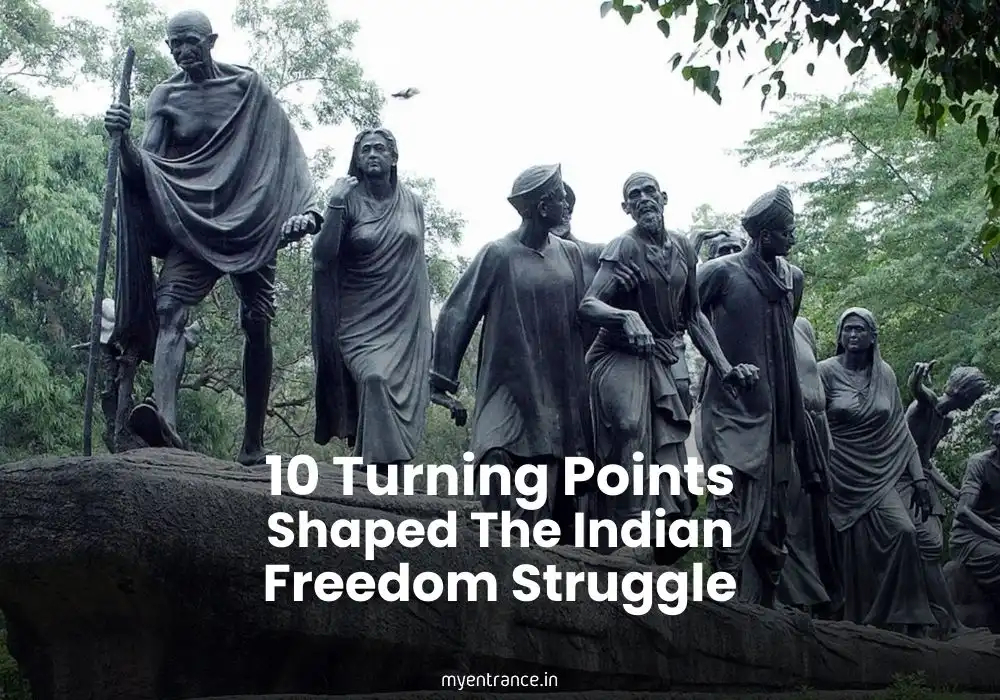
Indian Freedom Struggle — Major Incidents (1857–1942)
Below is a clear, chronological recap of the major incidents you must remember. Short paragraphs make it easy to revise and convert into flashcards for mock tests.
1. Revolt of 1857 (India’s First Major Uprising)
Beginning in Meerut on 10 May 1857, the revolt spread rapidly to Delhi, Kanpur, Lucknow and other places. Initially a military mutiny by sepoys, it soon drew in civilians and regional leaders. Although it failed to overthrow British power, the uprising exposed the vulnerabilities of the East India Company and led to the Crown taking direct control of India in 1858 — a major structural change in how India was governed.
2. Formation of Political Platforms — Indian National Congress (1885)
In the late 19th century, educated Indians formed political associations to press for civil rights and administrative representation. The Indian National Congress (est. 1885) began as a forum for dialogue but later became the central vehicle for mass nationalism under leaders such as Gandhi, Nehru and Patel.
3. Swadeshi and Boycott Movement (1905–1911)
Triggered by Lord Curzon’s 1905 partition of Bengal, the Swadeshi movement pushed for boycotting British goods and reviving local industries. Public meetings, indigenous goods promotion and sometimes violent protests underlined a shift toward economic resistance and mass participation.
4. Ghadar Movement and Komagata Maru (1914–1917)
The Ghadar party — formed mainly by Indian expatriates — challenged British rule from overseas. The Komagata Maru incident (1914), when Indian passengers were denied entry to Canada and faced violence on return, galvanised anger and highlighted racial discrimination abroad, linking diaspora activism to the home struggle.
5. Home Rule Movement (1916–1918)
Led by Bal Gangadhar Tilak and Annie Besant, the Home Rule Movement sought self-rule within the British Empire and aimed to politically mobilise urban middle classes. It prepared the ground for broader national campaigns by increasing political awareness and organisation.
6. Champaran Satyagraha (1917)
Mahatma Gandhi’s first major civil-resistance action in India, Champaran addressed the exploitation of indigo cultivators in Bihar. Using non-violent protest and grassroots fact-finding, Gandhi secured relief for peasants and introduced satyagraha (non-violent resistance) as a practical, mass political method.
7. Rowlatt Act and Jallianwala Bagh (1919)
The repressive Rowlatt Act (1919) extended wartime emergency powers, provoking nationwide protests led by Gandhi (Rowlatt Satyagraha). The protests culminated tragically in the Jallianwala Bagh massacre (13 April 1919), which radicalised public opinion and intensified demands for independence.
8. Khilafat Movement & Non-Cooperation (1920–1922)
The Khilafat agitation (by Indian Muslims) over the fate of the Ottoman Caliphate combined with Gandhi’s Non-Cooperation Movement to create the first truly mass national movement. Indians boycotted courts, schools and foreign goods. The movement was suspended after the Chauri Chaura incident (1922), where violence prompted Gandhi to call off non-cooperation.
9. Civil Disobedience Movement — Salt March (1930)
In 1930, Gandhi launched the Salt Satyagraha (Dandi March) to defy the colonial salt tax. The campaign spread nationwide, revived mass participation, and demonstrated the political power of non-violent civil disobedience. Tens of thousands were arrested and the movement pushed the British to negotiate (Gandhi–Irwin Pact).
10. Individual Satyagraha & August Offer (1940)
With Britain dragging India into World War II without consultation, the August Offer (1940) proposed limited post-war reforms. The Congress rejected this, and Gandhi launched Individual Satyagraha as a symbolic assertion of the right to free speech and opposition to imperial policy — a precursor to larger, coordinated campaigns.
11. Quit India Movement (1942)
When Cripps Mission failed to promise immediate independence, the Congress demanded “Quit India” in August 1942. Mass strikes and protests broke out across the country; the British arrested leaders and banned Congress activities. Although brutally suppressed, the movement made clear that only complete independence would satisfy the people, setting the stage for post-war negotiations and eventual freedom in 1947.
Stay ahead in your preparation with Daily Current Affairs & GK Updates tailored for competitive exams.
Quick revision checklist (convertible to flashcards)
1857: First major uprising — end of East India Company rule (1858).
1885: Indian National Congress formed — political platform.
1905: Bengal Partition → Swadeshi & Boycott.
1914–17: Ghadar movement & Komagata Maru (diaspora resistance).
1916: Home Rule Movement — Tilak & Annie Besant.
1917: Champaran Satyagraha — Gandhi’s first civil action in India.
1919: Rowlatt Act → Jallianwala Bagh massacre.
1920–22: Khilafat + Non-Cooperation → mass participation; ends after Chauri Chaura.
1930: Salt Satyagraha / Civil Disobedience — nationwide non-cooperation.
1940: Individual Satyagraha (against August Offer).
1942: Quit India Movement — mass call for British exit.
Build a strong foundation with our Comprehensive Static GK Guide that covers important topics for all exams.
10 Sample Questions & Answers (for practice)
Q: In which year did the Revolt of 1857 start and what immediate administrative change followed?
A: It started in 1857 (Meerut, May 10) and led to the end of East India Company rule; the British Crown assumed direct control in 1858.
Q: What was the main demand of the Swadeshi movement (1905)?
A: To boycott British goods and promote indigenous industries in response to the partition of Bengal.
Q: The Komagata Maru incident is associated with which movement?
A: The Ghadar movement and diaspora protests against racial immigration laws (1914).
Q: Name two leaders associated with the Home Rule Movement.
A: Bal Gangadhar Tilak and Annie Besant.
Q: Why is Champaran (1917) historically significant?
A: It was Gandhi’s first major satyagraha in India, which successfully challenged exploitation of indigo farmers and demonstrated non-violent mass action.
Q: What law did Gandhi oppose through the Rowlatt Satyagraha, and what tragic event followed?
A: He opposed the Rowlatt Act (1919); the protests were followed by the Jallianwala Bagh massacre on 13 April 1919.
Q: Which two movements merged to form a broad mass campaign in 1920–22?
A: The Khilafat Movement and the Non-Cooperation Movement.
Q: What was the immediate cause of the Salt March (1930)?
A: Opposition to the British salt tax and monopoly; Gandhi led the Dandi March to produce salt in violation of the law.
Q: What was the purpose of Individual Satyagraha in 1940?
A: To assert the right of free speech and protest against British wartime policies and the inadequate August Offer.
Q: What was the outcome of the Quit India Movement (1942) in terms of leadership?
A: Leaders were arrested and the movement suppressed, but it intensified demand for complete independence and weakened legitimacy of colonial rule.
Why this topic matters for exams
High-weightage area: Questions on dates, causes and consequences of major incidents routinely appear in general-awareness and history sections.
Direct & analytical questions: Exams test both factual recall (who/when/where) and analytical understanding (why incidents mattered, connections between events).
Cross-topic relevance: Knowledge of the freedom struggle supports answers in polity, social reform movements, and modern Indian history sections.
Useful for interviews: For UPSC mains and interviews, the ability to link incidents to themes (mass mobilisation, non-violence, communal unity, economic resistance) strengthens answers.
Mock test preparation: Practising timeline-based mock tests improves speed and accuracy — essential for competitive exams.
Read More Topics