Translate Language
What Were the Key Takeaways from PM Modi’s Red Fort Address on the 79th Independence Day?
India celebrated its 79th Independence Day with the Prime Minister addressing the nation from the Red Fort, emphasising recent defence action and national resolve. The speech combined ceremonial tradition with strategic messaging on security, treaties and domestic unity. For students preparing for SSC, PSC, UPSC and design-entrance exams, the speech and its surrounding events are important current-affairs material.
Overview of the day’s ceremony
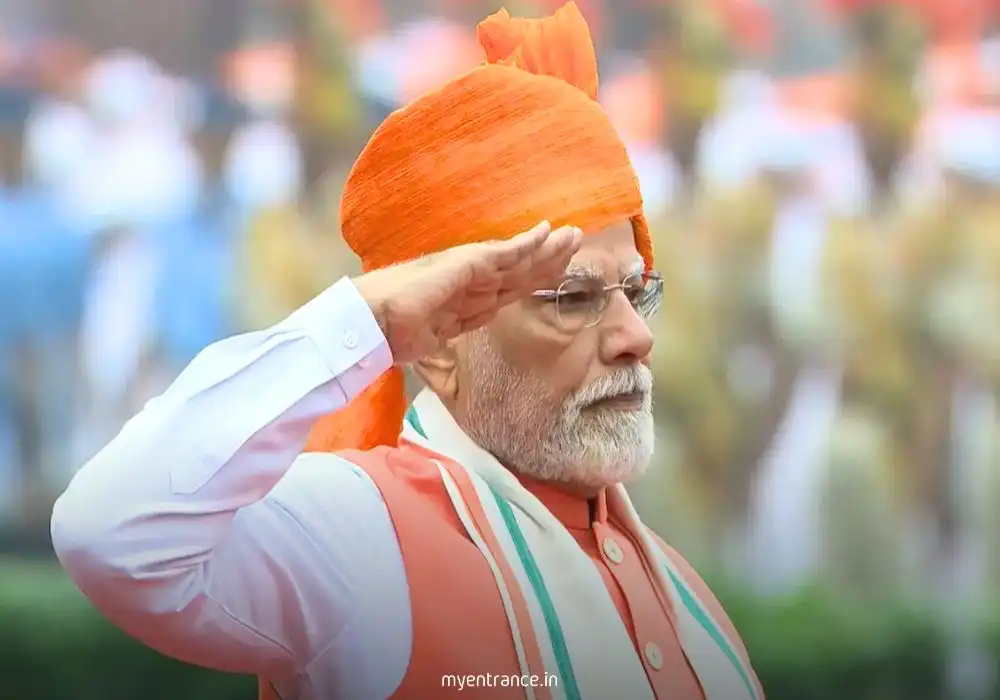
On the 79th Independence Day, the nation gathered to observe a ritual that blends symbolic continuity with contemporary context. The Prime Minister hoisted the National Flag at the Red Fort, followed by the traditional Guard of Honour and a display by the Indian Air Force. Such ceremonies are not only a demonstration of state ritual but also an occasion when policy positions and national priorities are communicated to a broad audience.
READ MORE: National Flag Etiquette: Essential Do’s and Don’ts Every Indian Must Know
Key messages from the Prime Minister’s address
In his address from the Red Fort ramparts, the Prime Minister highlighted several themes that carry both political and strategic significance. He praised the armed forces for their recent operation—described as a decisive, long-range action—and lauded the bravery and operational precision that, he said, demonstrated India’s capability to respond to cross-border threats. He framed the operation as a measured response that removed terrorist infrastructure and struck “deep” into hostile territory, thereby conveying deterrence to adversaries.
The Prime Minister also addressed long-standing water and treaty concerns, noting a shift in public perception about past agreements that are perceived as unfavourable. He emphatically signalled that India would not accept nuclear coercion and stressed the nation’s resolve to ensure its security and dignity. Additionally, he invoked constitutional unity by referencing steps taken in Jammu & Kashmir and hailed figures whose sacrifices shaped modern India.
READ MORE: How Pingali Venkayya Created India’s National Flag – A Must-Know for Competitive Exams
Ceremonial details and symbolism
The ceremony included notable visuals: after the flag hoisting, two Mi-17 helicopters of the Indian Air Force showered flower petals—an aerial salute emblematic of national celebration—while one helicopter bore the flag of the nation and the other displayed a banner associated with the recent operation. Prior to arriving at the Red Fort, the Prime Minister paid respects at Rajghat, a customary homage to Mahatma Gandhi. These acts combine to communicate continuity with India’s founding ideals alongside contemporary national priorities.
Disaster response and governance narrative
The Prime Minister acknowledged the recent spate of natural calamities—landslides, cloudbursts and similar events—and emphasised the coordinated efforts of central and state authorities in rescue, relief and rehabilitation. For aspirants of public-service examinations, this underscores two recurring themes in governance questions: disaster management frameworks and the cooperative responsibilities of state and central governments.
State-level celebrations: Arunachal Pradesh example
Alongside national-level observance, states performed their own ceremonies. Arunachal Pradesh, as an example, prepared for state-level celebrations at IG Park in Itanagar, where the Chief Minister officiated the hoisting and reviewed the ceremonial march-past. Such state observances often highlight regional participation in national rituals and are useful case studies for questions on federal structure and centre–state relations.
Why this matters for exam preparation
For students preparing for competitive exams, this Independence Day event is a compact source of current-affairs fodder: the prime minister’s statements on defence action, treaty perceptions, and nuclear policy will likely be referenced in editorial and objective-type questions. Record the key phrases and policy positions and link them to broader topics such as national security, foreign policy, river water treaties, and constitutional amendments. Use curated resources to consolidate these facts: follow the site’s Daily Current Affairs updates, practise with the Daily News Quiz, and review related background from the Static GK Guide.
If you are preparing for specific examinations, cross-reference the event with the relevant syllabus. Candidates appearing for SSC examinations or state public-service tests like Kerala PSC should note the administrative and policy implications, while aspirants in design entrance exams—such as NIFT GAT and NID DAT—can use the visuals and national narratives for portfolio inspiration or current-events questions where applicable.
Study strategy: convert the event into exam-ready notes
Treat the Independence Day address as a capsule: extract 6–8 one-line points (who, what, where, why, implications, institutional responses). Add contextual lines explaining treaties, disaster response mechanisms and constitutional references. Reinforce these notes by attempting quick quizzes from the Daily News Quiz and by revisiting the Daily Current Affairs posts to see how the facts are framed in standard exam language. For last-minute revision, use the Last Minute Exam Preparation Guide to convert this day’s events into high-yield pointers.
Concluding remarks
Independence Day remains both a ceremonial milestone and a platform for communicating policy direction. For the serious exam aspirant, every major national event is an opportunity: synthesise the facts, map them to syllabus topics, and practise recall with targeted quizzes and static-GK summaries. Regularly integrating such events into your revision will strengthen both factual recall and analytical insight—qualities prized in SSC, PSC, UPSC, NIFT, NID and other competitive examinations.
Read More Topics