Translate Language
What is the Speciality of Vrindavani Vastra?
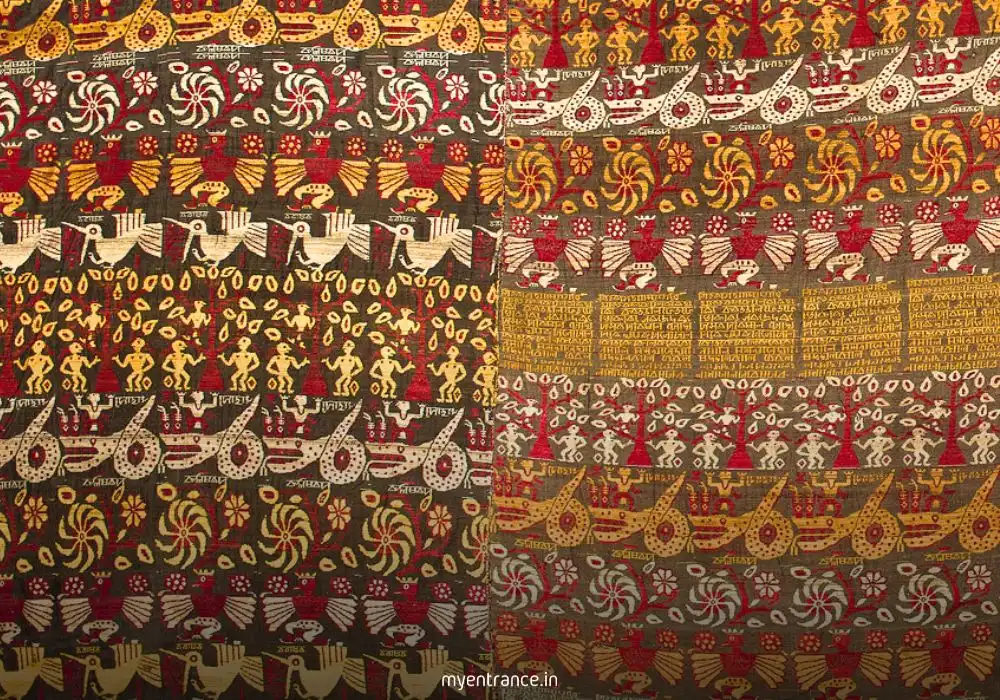
The revered Vrindavani Vastra, a 16th-century Assamese silk textile, is scheduled for a historic exhibition in Assam in 2027. This cultural treasure, currently housed in the British Museum, is returning to Indian soil under a special loan agreement. Its story is a vital piece of India’s artistic and religious heritage.
What is the Speciality of Vrindavani Vastra?
The Vrindavani Vastra isn’t just a piece of cloth; it’s a monumental chapter in India’s cultural history. Its speciality lies in several unique factors that set it apart:
Divine Narrative: This wasn’t merely decorative fabric. It was woven under the direct guidance of the great saint-reformer Srimanta Sankardeva to serve as a visual storytelling medium. It intricately depicts scenes from the life of Lord Krishna and includes texts from Sankardeva’s devotional play, Kaliyadamana, making it a sacred object of worship and art.
Technical Marvel: The fabric is a stunning example of the lampas weaving technique, one of the most complex methods known. This technique required two highly skilled weavers to work simultaneously on a single loom, using two sets of warps and wefts to create its rich, detailed patterns. This complexity highlights the advanced state of Assamese weaving in the 16th century.
Rare Survival: Time has been harsh on the Vrindavani Vastra. What remains today are around 20 fragments. The largest piece, held by the British Museum, is a breathtaking assemblage of 12 silk strips stitched together, measuring over 9 metres in length. Its survival makes it an exceedingly rare artifact.
Cross-Cultural Journey: The fabric’s history is a tale of travel. Pieces were taken to Tibet centuries ago, later collected by British explorers, and eventually found a home in the British Museum. This journey itself is a subject of historical interest.
Questions and Answers on Vrindavani Vastra:
1. Q: Who is credited with guiding the creation of the Vrindavani Vastra?
A: The saint-reformer Srimanta Sankardeva.
2. Q: Which weaving technique was used to create the Vrindavani Vastra, and what makes it special?
A: The lampas technique, which is special because it requires two sets of warps and wefts and two weavers working simultaneously on a single loom.
3. Q: From which museum is the Vrindavani Vastra being loaned to Assam?
A: The British Museum in London.
4. Q: What are the primary themes depicted on the Vrindavani Vastra?
A: Scenes from the life of Lord Krishna and the avataras of Lord Vishnu, along with devotional verses.
5. Q: What is one major precondition set by the British Museum for the loan?
A: Assam must build a new museum that meets strict international standards of environmental control and security to preserve the fragile textile.
Why is this Important for Exams?
Current affairs intertwined with India’s art, culture, and history are a staple in the syllabus of most competitive exams.
UPSC: Highly relevant for the Art & Culture segment of the Prelims and Mains (GS Paper I). Questions can be asked on Sankardeva’s contributions, classical weaving techniques of India, or the significance of this repatriation.
SSC CGL/CHSL: Often includes questions on cultural landmarks, historical figures, and recent news of national importance in the General Awareness section.
Kerala PSC, Assam PSC, and Other State Exams: This news is particularly significant for state-level exams, especially those with a focus on cultural heritage, history, and current events of specific regions.
NID/NIFT: For design entrance exams, understanding traditional Indian textiles, their motifs, and complex techniques like lampas weaving is fundamental knowledge.
Keeping this information at your fingertips will not only help you answer direct questions but also enrich your answers in descriptive papers, showing a well-rounded understanding of India’s cultural legacy.
Read More Topics