Translate Language
What is the Significance of ISRO’s Integrated Air Drop Test for India’s Astronauts?
The Indian Space Research Organisation has taken a giant leap towards securing the safe return of our nation’s first astronauts. The successful Integrated Air Drop Test (IADT-1) conducted on August 24, 2025, represents a cornerstone achievement for the Gaganyaan mission. This critical test brings India closer to human-rating its spaceflight systems, ensuring astronaut safety during the most perilous phase of the journey—the descent back to Earth.
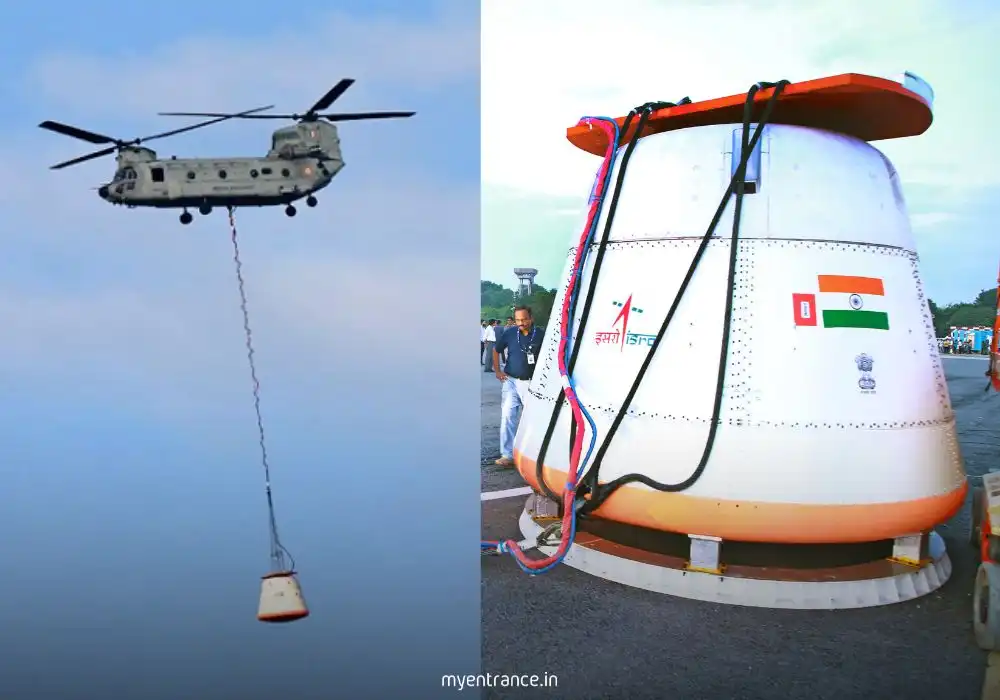
Decoding the Integrated Air Drop Test (IADT-1): A Faculty’s Perspective
The Integrated Air Drop Test, or IADT-1, was far more than a simple demonstration; it was a rigorous validation of a system upon which human lives will depend. The core function of this test was to prove the absolute reliability of the parachute-based deceleration system. In practical terms, a simulated crew module, mirroring the weight of an actual capsule at approximately five tonnes, was airlifted to a significant altitude by an Indian Air Force Chinook helicopter and released. The subsequent flawless deployment of a complex sequence of parachutes was engineered to slow the massive capsule from a high-speed freefall to a gentle, survivable splashdown velocity in the ocean, perfectly simulating the final minutes of a crewed mission’s return.
LEARN MORE: Why Is ISRO Building Its Heaviest Rocket Yet for the 2040 Moon Mission?
The Paramount Significance of a Controlled Descent
For any aspirant understanding the intricacies of space missions, it is crucial to recognize that the phases of ascent and descent present the highest risk profile. The IADT-1 directly addresses this critical vulnerability. Its primary significance lies in building an irrefutable confidence in the systems designed to protect our astronauts. By successfully demonstrating that the parachute system can function reliably under real-world conditions, ISRO has effectively crossed a major hurdle in the “human-rating” process. This term refers to the stringent certification that a system is safe and reliable enough for human travel, making this test a non-negotiable prerequisite for the Gaganyaan mission.
A Symphony of National Collaboration
A key takeaway for competitive exam students is the exemplary model of inter-agency collaboration showcased by this achievement. The IADT-1 was not an endeavor for ISRO alone. It was a unified national effort that synergized the capabilities of the Indian Air Force, the Defence Research and Development Organisation (DRDO), the Indian Navy, and the Indian Coast Guard. This coordination is fundamental, as the recovery of astronauts is a complex operation requiring military precision, advanced research, and seamless naval support. It stands as a testament to India’s growing indigenous capability to orchestrate and execute missions of extraordinary complexity involving human safety.
LEARN MORE: How Did ISRO Evolve from Bullock Carts to Building its Heaviest Rocket Ever?
Building on a Foundation of Preparedness
The success of IADT-1 is built upon a solid foundation of completed preparatory work. To appreciate the broader context of Gaganyaan’s progress, one must note that the propulsion systems for both the crew and service modules have been developed and tested. The engineering model for the Environmental Control and Life Support System (ECLSS), which will create a livable environment for astronauts, is ready. Furthermore, all five types of motors for the critical Crew Escape System (CES)—designed to pull the crew module to safety in case of a launch emergency—have been developed and statically tested. Supporting infrastructure, including new facilities for module preparation, mission control, crew training, and a modified launch pad, is already in place, underscoring the mission’s advanced stage.
The Road Ahead: From Tests to Triumph
The journey continues with a clear and ambitious roadmap. Following IADT-1, ISRO will conduct additional Test Vehicle flights (like TV-D2) and an uncrewed G1 mission. These upcoming tests will further validate the crew escape mechanisms, orbital propulsion, and integrated parachute and recovery operations. Importantly, the Gaganyaan program is the first step in a visionary national space roadmap that aims to establish the Bharatiya Antariksh Station (BAS) by 2035 and land an Indian on the Moon by 2040, making space technology a pivotal area for current affairs preparation.
Questions and Answers from this Article
1. What was the primary objective of ISRO’s IADT-1 test conducted in August 2025?
The primary objective of the Integrated Air Drop Test (IADT-1) was to demonstrate and validate the reliability of the parachute-based deceleration system designed to safely slow the Gaganyaan crew module to a safe splashdown speed during its return to Earth.
2. Why is the parachute system considered so vital for the Gaganyaan mission?
The parachute system is vital because the descent and splashdown phases pose the highest risks to astronauts. A controlled and safe landing is entirely dependent on this system functioning perfectly to decelerate the capsule after the intense heat of atmospheric re-entry.
3. How did the IADT-1 test simulate a real crew module return?
The test simulated a real return by dropping a dummy crew module weighing about five tonnes from a Chinook helicopter from a significant altitude. The module’s parachutes were then deployed in a precise sequence to slow its descent and achieve a safe splashdown, mimicking the final phase of an actual mission.
4. Which national agencies collaborated with ISRO for the IADT-1 test?
The test was a collaborative effort involving the Indian Air Force, the Defence Research and Development Organisation (DRDO), the Indian Navy, and the Indian Coast Guard, highlighting a unified national approach to human spaceflight.
5. What is meant by “human-rating” a spaceflight system?
“Human-rating” refers to the rigorous process of certifying that a spaceflight launch and recovery system meets the stringent standards of safety and reliability required to carry human astronauts, as opposed to unmanned payloads.
6. Name two critical systems developed for Gaganyaan besides the parachutes.
Two other critical systems developed are the five types of motors for the Crew Escape System (CES) and the Engineering Model for the Environmental Control and Life Support System (ECLSS).
7. What are the next major milestones for ISRO following the IADT-1 success?
The next major milestones include conducting additional Test Vehicle flights like TV-D2, followed by an uncrewed G1 mission to further validate the crew escape, propulsion, and recovery systems in orbit.
LEARN MORE: ISRO’s Next-Gen Satellite Brain: A Game-Changer in Space Technology
Read More Topics