
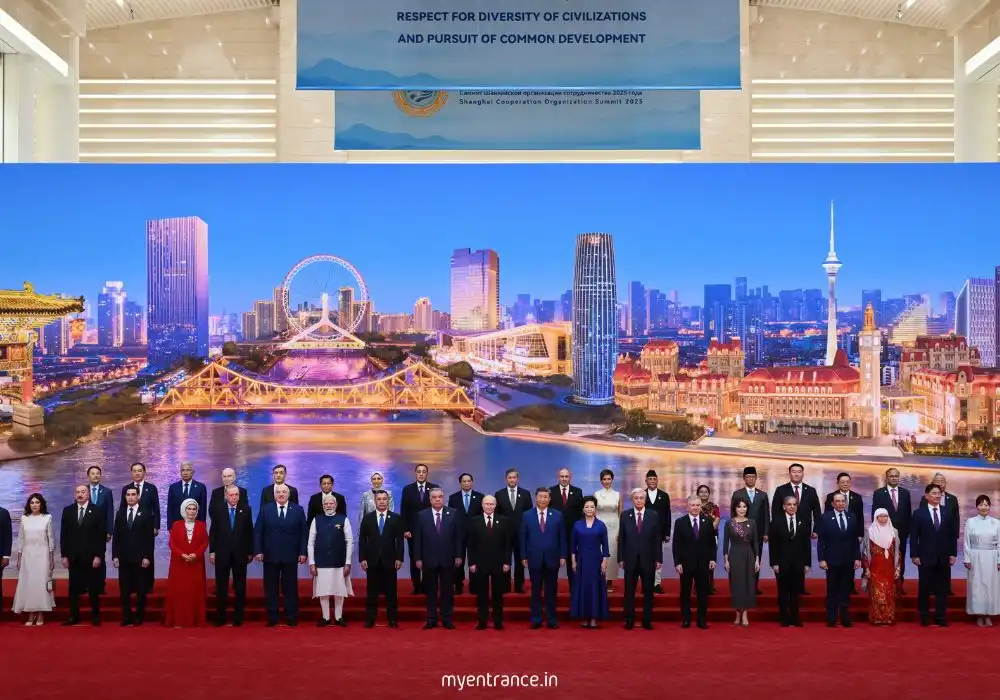
The recent Shanghai Cooperation Organisation (SCO) Summit has once again brought the dynamics of Eurasian geopolitics into sharp focus, making it a critical area of study for UPSC aspirants. Understanding the SCO is not just about a single event; it’s about dissecting a complex multilateral platform that significantly influences India’s foreign policy, security, and economic interests. This comprehensive analysis will equip you with the nuanced understanding required to tackle any question on this topic in both Prelims and Mains. Take your daily dose of current affairs to stay informed and prepared.
The Genesis and Evolution of the SCO
To truly grasp the SCO’s contemporary relevance, one must understand its origins in the geopolitical churn of the post-Cold War era. The organization’s precursor was the ‘Shanghai Five,’ formed in 1996, comprising China, Russia, Kazakhstan, Kyrgyzstan, and Tajikistan. Its initial mandate was narrowly focused on resolving border disputes, demilitarizing frontiers, and fostering regional stability in Central Asia following the dissolution of the Soviet Union. However, the security landscape evolved, and with the inclusion of Uzbekistan in 2001, the Shanghai Five was transformed into the Shanghai Cooperation Organisation. Its charter expanded significantly to address the “three evils” of terrorism, separatism, and extremism, a mission that gained further momentum in the global context post-9/11. The subsequent expansion to include India and Pakistan in 2017 marked a pivotal moment, transforming the SCO into a trans-regional organization covering a vast geographical and demographic expanse. Our platform offers reliable static general knowledge material that is fact-checked and accurate.
India’s Strategic Imperatives within the SCO
For India, membership in the SCO is a calculated strategic move driven by multiple foreign policy objectives. It provides a crucial platform to advance its ‘Connect Central Asia’ policy, fostering deeper engagement with a region that is vital for India’s energy security and economic aspirations. The SCO’s Regional Anti-Terrorist Structure (RATS), headquartered in Tashkent, offers a formal mechanism for India to collaborate on counter-terrorism intelligence and operations with countries in its extended neighbourhood. Furthermore, the SCO presents a unique forum where India can engage directly with both China and Pakistan, allowing for dialogue on the sidelines of multilateral summits. It also acts as a strategic counterweight, enabling India to articulate its vision for a free, open, and inclusive Indo-Pacific while participating in a major Eurasian grouping, thereby balancing its diplomatic engagements across different global power centres.
Key Outcomes and Declarations of the Latest Summit
The most recent summit concluded with the adoption of the Astana Declaration, which reinforced the members’ commitment to building a more representative and democratic world order. A central theme was the enhancement of economic and trade connectivity, with a renewed push for creating a unified framework for transport corridors and simplifying customs procedures across member states. Discussions prominently featured the need for cooperation in digital transformation, with an agreement to share best practices in e-governance and digital payment systems. On the security front, leaders unanimously condemned terrorism in all its forms and resolved to strengthen the operational capacity of RATS. A significant outcome was the consensus on developing a roadmap for transitioning to trade in local currencies, a step aimed at de-dollarizing regional trade and insulating member economies from external financial shocks. Don’t miss out on the essential key pointers from today’s news curated for exam relevance.
Why is the SCO a Crucial Topic for Civil Services Exams?
The Shanghai Cooperation Organisation is an indispensable topic for any serious civil services aspirant due to its direct relevance to multiple sections of the syllabus. For GS Paper 2 (International Relations), it is a cornerstone of India’s multilateral diplomacy and neighbourhood policy. Questions in the Mains examination often require an analytical approach, asking aspirants to evaluate India’s challenges and opportunities within the SCO or the organization’s role in the changing global order. For GS Paper 3 (Security), the SCO’s counter-terrorism framework under RATS is of immense importance. In the Preliminary examination, you can expect factual questions about the member states, observer nations, official languages, the location of its headquarters, and the key declarations of recent summits. A thorough understanding of the SCO is, therefore, not just beneficial but essential for scoring well.
Sample Questions and Answers for Practice
Question 1 (Prelims): Which of the following countries was the most recent to be admitted as a full member of the Shanghai Cooperation Organisation (SCO)?
a) Pakistan
b) India
c) Iran
d) Belarus
Answer: c) Iran. Iran was officially admitted as the ninth full member of the SCO during the virtual summit hosted by India in 2023.
Question 2 (Prelims): The Regional Anti-Terrorist Structure (RATS) is a permanent organ of the SCO. Where are its headquarters located?
a) Beijing, China
b) Moscow, Russia
c) Astana, Kazakhstan
d) Tashkent, Uzbekistan
Answer: d) Tashkent, Uzbekistan. The Executive Committee of RATS is based in Tashkent.
Question 3 (Mains): “While the SCO offers India a significant platform to engage with Central Asia, it also presents a complex set of geopolitical challenges.” Discuss. (150 words)
Answer: The SCO provides India with a crucial institutional link to Central Asian republics, vital for energy security, trade, and its ‘Connect Central Asia’ policy. The RATS framework also facilitates counter-terrorism cooperation. However, the platform is fraught with challenges. The growing strategic convergence between China and Russia, along with the presence of Pakistan, creates a difficult diplomatic environment for India. China’s Belt and Road Initiative (BRI), which is supported by most SCO members but opposed by India due to sovereignty concerns, often dominates the economic discourse. Therefore, India must perform a delicate balancing act, leveraging the SCO for regional access and security cooperation while skillfully navigating the inherent geopolitical rivalries to protect its core national interests.
Question 4 (Prelims): The “Samarkand Declaration,” a significant outcome of a recent SCO Summit, primarily focused on which of the following areas?
a) Climate change and environmental protection
b) Cybersecurity and digital threats
c) Global food security and connectivity
d) Nuclear non-proliferation
Answer: c) Global food security and connectivity. The Samarkand Declaration of the 2022 SCO Summit had a strong focus on ensuring regional and global food security, strengthening connectivity, and building resilient supply chains.
Question 5 (Mains): Critically evaluate the effectiveness of the SCO as a security-centric organization in Eurasia. Do you believe it can act as a counterweight to Western-led alliances? (250 words)
Answer: The Shanghai Cooperation Organisation has established itself as a significant security-centric body in Eurasia, primarily through its focus on combating terrorism, extremism, and separatism via its RATS mechanism. Joint military exercises, such as the “Peace Mission” series, have enhanced interoperability among member states’ forces. The SCO has been relatively effective in fostering a climate of stability in Central Asia and providing a platform for dialogue among members, which has helped manage regional tensions.
However, its effectiveness is constrained by several factors. The divergent strategic interests of its key members, particularly India and China, limit the depth of security cooperation. The organization’s principle of non-interference can also be a barrier to resolving bilateral disputes between members, such as those between India and Pakistan.
Regarding its role as a counterweight to Western alliances like NATO, the SCO is often portrayed as such, largely due to the dominance of China and Russia. It promotes a multipolar world order and resists what its members perceive as Western unilateralism. Yet, it is not a military alliance in the vein of NATO, as it lacks a collective security guarantee. Many members, including India, maintain strong partnerships with the West. Therefore, while the SCO serves as a powerful symbol of non-Western solidarity and provides a framework for Eurasian security cooperation, its internal contradictions prevent it from functioning as a cohesive military or political counter-alliance to the West. Its strength lies more in regional governance and security management than in global power projection.





