
In an era defined by relentless change, geopolitical strife, and a pervasive search for meaning, the ancient traditions of the East offer profound reservoirs of wisdom. Among the most majestic and intricate of these is the Kalachakra Empowerment Ceremony, a cornerstone of Tibetan Buddhist practice that transcends its religious origins to become a global phenomenon of cultural and philosophical significance. For aspirants preparing for competitive examinations like the UPSC, SSC, PSC, NID, NIFT, and other government roles, understanding the Kalachakra is not merely an exercise in religious studies. It is a master key that unlocks insights into international relations, cultural diplomacy, art and symbolism, philosophy, and current affairs, blending seamlessly into the interdisciplinary fabric of modern general knowledge.
What Exactly is the Kalachakra? The Wheel of Time Decoded
The term “Kalachakra” translates directly from Sanskrit to “Wheel of Time.” However, this simple translation belies a system of breathtaking complexity and depth. It is not merely a measure of chronological progression but a comprehensive tantric framework within Vajrayana Buddhism that posits a profound interconnectedness between the macrocosm (the external universe) and the microcosm (the internal universe of the human body and mind).
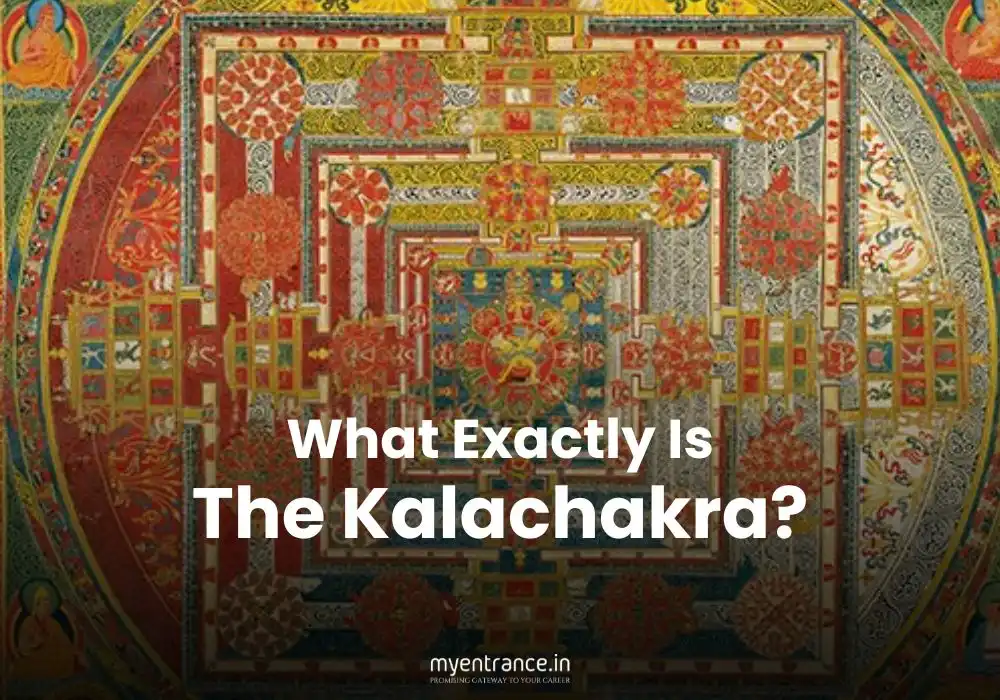
The Kalachakra Tantra is a detailed map of reality. It describes the cosmos’s structure, the cycles of planetary movements, and the passage of time, all while drawing precise parallels to the channels, energies, and drops within the human subtle body. This philosophy suggests that by understanding and mastering the inner “wheel of time”—the cycles of breath, thought, and energy—an individual can achieve harmony with the outer universe, ultimately leading to enlightenment, or Buddhahood. The empowerment ceremony is the sacred gateway into this profound system. It is not a casual observance but a rigorous initiation, where a qualified master, most notably His Holiness the Dalai Lama, grants participants the permission and spiritual transmission to engage in these advanced practices. The ultimate goal is twofold: individual liberation from suffering and the cultivation of a compassion so vast that it actively works for global peace and harmony.
Tracing the Roots: A Legacy from Shambhala to the Modern World
The origins of the Kalachakra are steeped in both history and legend. Scholars place its textual compilation in ancient India around the 10th or 11th century CE. Mythologically, however, its genesis is far more majestic. It is believed that the historical Buddha, Shakyamuni, manifested in the form of the Kalachakra deity to teach this tantra at the request of Suchandra, the King of the legendary kingdom of Shambhala. This narrative is crucial, as it positions the Kalachakra not just as a path to personal peace but as a teaching preserved for a future time when the world would be engulfed in conflict and materialism—a description that resonates deeply with our contemporary reality.
From India, the teachings traveled to the snowy Himalayas of Tibet, where they were preserved, translated, and practiced with unparalleled dedication. Tibetan masters became the custodians of this knowledge, ensuring its transmission through an unbroken lineage. The Dalai Lamas, in particular, have been instrumental in the modern propagation of the Kalachakra. The ceremony’s locations are chosen with great symbolic weight. While Bodh Gaya, India—the site of the Buddha’s enlightenment—is a perennial favorite, the empowerments have been held across the globe, from the capitals of Europe and North America to the serene landscapes of Bhutan. This global itinerary reflects a conscious effort to disseminate the message of peace beyond traditional Buddhist heartlands, making it a truly universal offering.
The Intricate How: A Ritual of Creation, Initiation, and Impermanence
The Kalachakra Empowerment is a spiritual marathon, typically spanning ten to twelve days. It is a symphony of rituals, each element rich with symbolic meaning. A central and visually stunning component is the creation of the Kalachakra sand mandala. For days, a team of ordained monks engages in a painstaking, meditative process, placing millions of grains of colored sand through metal funnels called chak-purs to construct a intricate, multi-colored diagram. This mandala is a blueprint of a purified universe, the celestial palace of the Kalachakra deity, representing the enlightened state of mind itself. Its creation is an act of profound concentration and artistry, a lesson in patience, precision, and the beauty of a harmoniously ordered world.
Parallel to this, participants engage in prayers, receive teachings, and undergo a series of initiations. These are not mere blessings but are considered to plant potent “seeds of enlightenment” within the participant’s mindstream, activating their potential for Buddhahood. The ceremony culminates in one of its most powerful and poignant acts: the dissolution of the sand mandala. In a vibrant ritual, the meticulously crafted masterpiece is swept away, its colorful sands poured into a flowing river or stream. This act is a profound teaching on anicca, or impermanence—the core Buddhist doctrine that all conditioned things are in a constant state of flux. The destruction of the beautiful mandala reminds practitioners to non-attachment, while the dispersal of the sand symbolizes the spreading of the ceremony’s blessings of peace and healing throughout the world.
Beyond Spirituality: Geopolitical Relevance and a Framework for Global Harmony
The Kalachakra’s significance extends far beyond the monastery walls into the complex arena of global politics and diplomacy. When world leaders, diplomats, and international media engage with the ceremony, it highlights the potent intersection of faith, culture, and statecraft. For a nation like India, hosting a Kalachakra, particularly one led by the Dalai Lama, is a powerful act of cultural diplomacy. It reinforces India’s identity as a sanctuary for diverse spiritual traditions and strengthens its soft power influence across the Buddhist world, from Southeast Asia to the Far East.
For nations like Bhutan, which bases its development philosophy on Gross National Happiness, the Kalachakra is a reaffirmation of its core cultural values. The ceremony’s emphasis on inner peace as the foundation for outer peace provides a compelling counter-narrative to purely materialistic models of progress. For government exam aspirants, this is a critical analytical point. Understanding how the Kalachakra functions as a tool of soft power, fosters cross-cultural dialogue, and promotes a universalist ethic is essential for tackling questions on international relations, current affairs, and ethics. It demonstrates how ancient wisdom can inform modern statecraft, offering a vision of global harmony built on compassion and mutual understanding, a theme increasingly relevant in a fragmented world.
Frequently Asked Questions (FAQs)
Q1: What is the literal meaning of “Kalachakra” and why is it significant?
A1: “Kalachakra” literally means “Wheel of Time.” Its profound significance lies in its holistic approach to enlightenment, which seamlessly integrates cosmology, astronomy, human physiology, and psychology into a single path. It teaches that by understanding the temporal cycles of the cosmos and our own inner biological and mental rhythms, we can transcend suffering and contribute to universal peace.
Q2: Who is traditionally responsible for leading the Kalachakra Empowerment Ceremony?
A2: The ceremony is traditionally led by a highly realized tantric master. In contemporary times, His Holiness the 14th Dalai Lama is the most prominent and frequent bestower of the Kalachakra Empowerment, having conferred it dozens of times across the globe. However, other senior Lamas in the Tibetan Buddhist tradition who hold the complete lineage transmission are also authorized to give this initiation.
Q3: What is the primary purpose of constructing the intricate Kalachakra sand mandala during the ceremony?
A3: The sand mandala serves multiple, layered purposes. It functions as a sacred geometric map for meditation, guiding the practitioner’s visualization of an enlightened universe. Its creation is itself a disciplined spiritual practice for the monks. Most powerfully, its ritual dissolution is a direct, visceral teaching on the impermanent nature of all constructed phenomena, encouraging non-attachment and the spirit of letting go.
Q4: Where have Kalachakra ceremonies historically been held, and why are these locations chosen?
A4: Historically, the ceremonies were held in the great monastic universities of Tibet and India. In the modern era, they have been hosted globally. Locations are chosen for their spiritual significance (e.g., Bodh Gaya), their ability to host large international gatherings, and as a strategic outreach to disseminate the teachings of peace and inter-religious understanding to new audiences, making it a truly global event.
Q5: How does the Kalachakra ceremony contribute to broader themes of global peace and diplomacy?
A5: The ceremony is a massive, live-action exercise in peace-building. By gathering thousands of people from diverse national, religious, and cultural backgrounds around a shared aspiration for world peace, it fosters grassroots-level intercultural understanding. Its core message of compassion and non-violence resonates as a universal diplomatic language. Furthermore, the high-profile nature of the event allows host countries to leverage cultural and spiritual heritage as a form of soft power, building bridges and promoting a shared vision for a more harmonious global community.





