
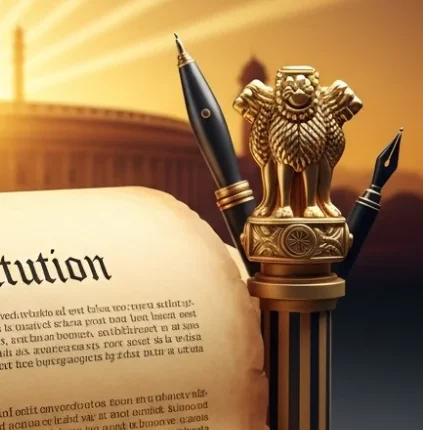
The Genesis of the Indian Constitution: A Comprehensive Guide for UPSC Aspirants
The formation of the Indian Constitution is not merely a historical event but the cornerstone of Indian democracy and a critical segment of the UPSC Civil Services Examination syllabus. Under the subject of Indian Polity, understanding how the world’s longest written constitution came into existence is essential for both Prelims and Mains. This journey, spanning several decades, reflects the aspirations, struggles, and intellectual rigor of the founding fathers of our nation. To master this topic, one must look beyond simple dates and delve into the political nuances, the colonial pressures, and the visionary debates that shaped the document. The Indian Constitution is often described as a ‘living document,’ and its evolution from the early demands of the 1930s to its final commencement in 1950 provides a fascinating study of legal and political transition. In this interactive guide, we provide a detailed vertical timeline and an in-depth analysis of the milestones that led to the birth of the Republic of India.
Before diving into the timeline, it is vital to acknowledge the historical context. The demand for a Constituent Assembly was a direct challenge to British parliamentary sovereignty over India. It was an assertion that the Indian people had the right to determine their own political destiny. This period was marked by significant diplomatic maneuvering, including the failure of the Cripps Mission and the eventual success of the Cabinet Mission Plan. Aspirants should pay close attention to the roles played by key figures like Dr. B.R. Ambedkar, Dr. Rajendra Prasad, B.N. Rau, and Jawaharlal Nehru, whose contributions ensured that our Constitution was not just a legal framework but a social document aimed at a revolution. Let us explore the chronological progression of these monumental events.
1934
The First Formal Proposal by M.N. Roy
The idea of a Constituent Assembly for India was put forward for the first time by M.N. Roy, a pioneer of the Communist movement in India and an advocate of radical democratism. Roy envisioned an assembly of the people’s representatives to frame a constitution that would reflect the social and economic needs of the masses. This was a landmark moment for UPSC students to note, as it shifted the political discourse from seeking concessions from the British to demanding the right to self-constitution.
1935
Official Demand by Indian National Congress
In 1935, the Indian National Congress (INC), for the first time, officially demanded a Constituent Assembly to frame the Constitution of India. This demand became a central plank of the nationalist movement. Following this, in 1938, Jawaharlal Nehru declared that the Constitution of free India must be framed, without outside interference, by a Constituent Assembly elected on the basis of adult franchise. This refined the demand to include democratic legitimacy and universal participation.
1940
The August Offer
The British Government finally accepted the demand in principle through what is known as the ‘August Offer’ of 1940. This offer, made by Viceroy Linlithgow during the heat of World War II, was an attempt to secure Indian cooperation in the war effort. While it promised a body to devise a new constitution after the war, it was rejected by the INC because it did not offer immediate independence or a clear path to a sovereign assembly, emphasizing instead the ‘veto’ of the minorities.
1942
The Cripps Mission
Sir Stafford Cripps, a member of the British Cabinet, came to India with a draft proposal on the framing of an independent constitution to be adopted after the war. The Cripps proposals were rejected by the Muslim League, which wanted India to be divided into two autonomous states with two separate Constituent Assemblies. Mahatma Gandhi famously called the offer a ‘post-dated cheque on a crashing bank.’ This failure led to the Quit India Movement, further intensifying the demand for self-rule.
1946
The Cabinet Mission Plan
Finally, the Cabinet Mission (Lord Pethick-Lawrence, Sir Stafford Cripps, and A.V. Alexander) arrived in India. While it rejected the idea of two Constituent Assemblies, it put forth a scheme for the Constituent Assembly which more or less satisfied the Muslim League. The Assembly was to be a partly elected and partly nominated body, with members indirectly elected by the provincial legislative assemblies. This plan formed the basis upon which the Constituent Assembly of India was finally constituted in November 1946.
Dec 9, 1946
The First Meeting of the Assembly
The Constituent Assembly held its first meeting on December 9, 1946. The meeting was boycotted by the Muslim League, which insisted on a separate state of Pakistan. Dr. Sachchidananda Sinha, the oldest member, was elected as the temporary President of the Assembly, following the French practice. Later, on December 11, 1946, Dr. Rajendra Prasad and H.C. Mukherjee were elected as the President and Vice-President of the Assembly respectively. Sir B.N. Rau was appointed as the Constitutional Advisor.
Dec 13, 1946
The Objective Resolution
Jawaharlal Nehru moved the historic ‘Objective Resolution’ in the Assembly. It laid down the fundamentals and philosophy of the constitutional structure. It declared India as an Independent Sovereign Republic and outlined the principles of justice, equality, and liberty. This resolution was unanimously adopted by the Assembly on January 22, 1947, and its modified version forms the Preamble of the present Constitution. For UPSC Mains, understanding this resolution is key to understanding the ‘Spirit of the Constitution.’
Aug 29, 1947
Appointment of Drafting Committee
Among all the committees of the Constituent Assembly, the most important was the Drafting Committee set up on August 29, 1947. It was this committee that was entrusted with the task of preparing a draft of the new Constitution. It consisted of seven members: Dr. B.R. Ambedkar (Chairman), N. Gopalaswamy Ayyangar, Alladi Krishnaswamy Ayyar, Dr. K.M. Munshi, Syed Mohammad Sadullah, N. Madhava Rau, and T.T. Krishnamachari. Dr. Ambedkar’s role was so pivotal that he is recognized as the ‘Father of the Constitution of India.’
Nov 26, 1949
Adoption of the Constitution
The draft Constitution was discussed extensively for over two years. After three readings, the motion on the Draft Constitution was declared as passed on November 26, 1949, and received the signatures of the members and the President. The Constitution as adopted on this date contained a Preamble, 395 Articles, and 8 Schedules. While several provisions like citizenship, elections, and provisional parliament came into force immediately, the major part came into force later. This day is now celebrated as Constitution Day or Samvidhan Divas.
Jan 26, 1950
Commencement of the Constitution
The Constitution of India came into force on January 26, 1950. This day was specifically chosen as the ‘date of commencement’ because of its historical significance. It was on this day in 1930 that ‘Purna Swaraj’ (Complete Independence) day was celebrated, following the resolution of the Lahore Session (December 1929) of the INC. With the commencement of the Constitution, the Indian Independence Act of 1947 and the Government of India Act of 1935 were repealed, and India emerged as a democratic Republic.
In-Depth Study Notes: Key Features and UPSC Focus Areas
Understanding the timeline is just the first step. For the UPSC exam, you must also understand the ‘why’ behind the ‘what.’ The Constituent Assembly took 2 years, 11 months, and 18 days to complete its task. During this time, it held eleven sessions and considered constitutions of about 60 countries. This is why the Indian Constitution is often called a ‘bag of borrowings,’ but as Dr. Ambedkar clarified, it was ‘ransacking all the known Constitutions of the world’ to adapt the best features to Indian needs.
Major Sources of the Indian Constitution
- Government of India Act 1935: Federal Scheme, Office of Governor, Judiciary, Public Service Commissions, Emergency provisions.
- British Constitution: Parliamentary government, Rule of Law, Legislative procedure, Single citizenship, Cabinet system, Prerogative writs.
- US Constitution: Fundamental Rights, Independence of judiciary, Judicial review, Impeachment of the president, Removal of Supreme Court and High Court judges, and Preamble.
- Irish Constitution: Directive Principles of State Policy, Nomination of members to Rajya Sabha, and method of election of president.
- Canadian Constitution: Federation with a strong Centre, Vesting of residuary powers in the Centre, Appointment of state governors by the Centre, and advisory jurisdiction of the Supreme Court.
- Australian Constitution: Concurrent List, Freedom of trade, commerce and intercourse, and joint sitting of the two Houses of Parliament.
- Weimar Constitution (Germany): Suspension of Fundamental Rights during Emergency.
- Soviet Constitution (USSR): Fundamental duties and the ideal of justice (social, economic and political) in the Preamble.
- French Constitution: Republic and the ideals of liberty, equality and fraternity in the Preamble.
- South African Constitution: Procedure for amendment of the Constitution and election of members of Rajya Sabha.
For Prelims, expect direct questions on dates, committee chairmen, and sources of the constitution. For Mains, the questions often revolve around the ‘Philosophy of the Constitution,’ its ‘Rigidity vs Flexibility,’ and the relevance of the ‘Objective Resolution’ in contemporary times. Aspirants should also be familiar with the various criticisms of the Constituent Assembly—such as it not being a representative body or being dominated by the Congress and Hindus—and the counter-arguments to these criticisms.
In conclusion, the formation of the Indian Constitution was a monumental exercise in democratic consensus-building. It provided a framework for a diverse and large nation to stay together and progress. As a UPSC candidate, your depth of knowledge in this area will not only help you score high marks but also build a strong foundation for your future career as a civil servant who must uphold these very constitutional values.
Ready to Ace your UPSC Preparation?
Don’t let doubts slow you down. Get access to free guidance, high-quality mock tests, and expert mentorship specifically designed for UPSC aspirants.
💬 Chat with our Experts on WhatsApp (+91 9526806124)




