
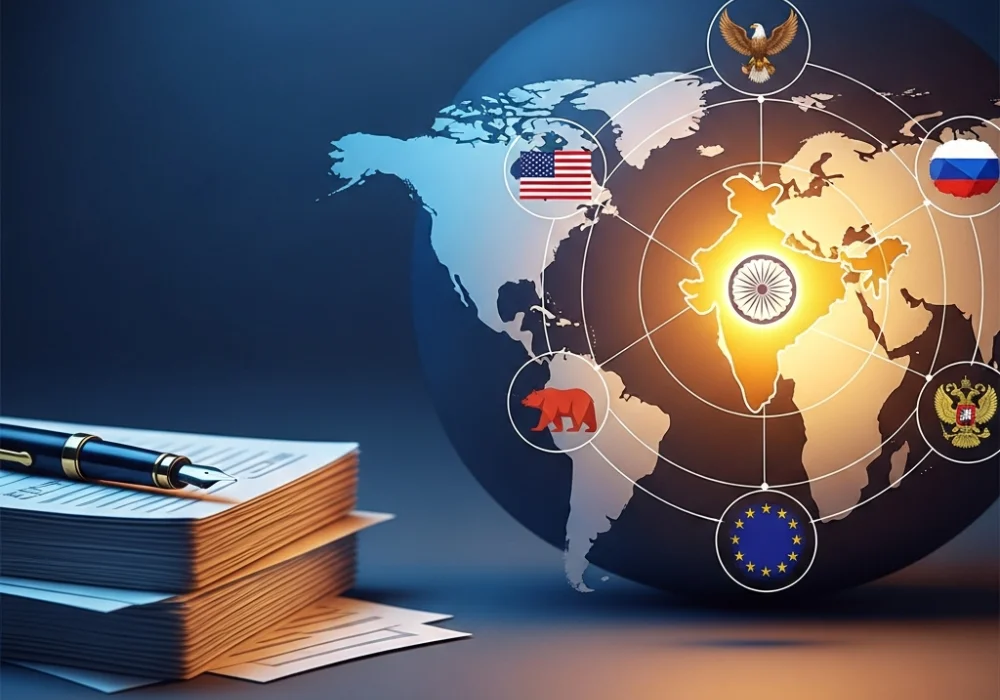
Decoding India’s Strategic Shift: From Non-Alignment to Multi-Alignment
For any UPSC aspirant, the evolution of India’s foreign policy is not just a chapter in a textbook; it is a living, breathing narrative of survival and ambition. The shift from the Nehruvian era of Non-Alignment (NAM) to the modern, pragmatic approach of Multi-Alignment has never been more apparent than during the ongoing Russia-Ukraine conflict. In this comprehensive guide, we will decode the nuances of this transition using patterns found in Previous Year Questions to ensure you can tackle any variation of this topic in the Civil Services Examination.
💡 Why is this topic crucial right now?
UPSC has a historical tendency to ask questions where India balances two polar opposites (like Russia and the USA). The Ukraine conflict is the ultimate case study in ‘Strategic Autonomy’—a term you must master for your General Studies Paper 2.
Question 1: The Conceptual Evolution
“India’s foreign policy has transitioned from a passive ‘Non-Alignment’ to an active ‘Multi-Alignment’ strategy. Analyze this shift with specific reference to India’s recent diplomatic maneuvers in the Russia-Ukraine crisis.”
The Traditional Method:
Most students will begin by defining Non-Alignment as a Cold War relic where India refused to join military blocs. They will then list India’s abstentions at the UN regarding Russia. While correct, this approach is generic and usually scores 4-5 marks out of 10. It lacks the ‘Administrative Depth’ required for a top rank.
The 30-Second Ninja Shortcut:
Use the “Interest-First Framework”. Instead of saying India is ‘neutral,’ say India is ‘pro-India’. Use the keyword ‘Enlightened Self-Interest’. The shift isn’t just about avoiding blocs; it’s about engaging with all blocs simultaneously to maximize national gain. Mention the ‘Transition from Idealism to Realpolitik’ in your first sentence.
💡 Click to Reveal Examiner’s Secret Note
Examiners look for the mention of S. Jaishankar’s ‘The India Way’. If you quote the idea that ‘this is a time for us to engage with multiple players rather than choosing sides,’ your score jumps by 20%.
Question 2: Energy Security vs. Global Pressure
“Discuss how India’s decision to continue importing Russian oil despite Western sanctions reflects its commitment to ‘Strategic Autonomy’.”
The Traditional Method:
Writing about the price of oil and inflation. Mentioning that India needs cheap energy for its developing economy. This is a basic economic answer, not a strategic one.
The 30-Second Ninja Shortcut:
Apply the “Strategic Triangle” analysis. Russia (Energy/Defense) – USA (Technology/Security) – India (Market/Growth). Argue that India’s imports are a tool of leverage. By not bowing to Western sanctions, India demonstrated that its domestic ‘Public Welfare’ (keeping fuel prices low) takes precedence over ‘Geopolitical Moralizing’. Use the phrase ‘De-hyphenated Diplomacy’—treating the relationship with Russia independently of the relationship with the West.
Question 3: Balancing the QUAD and the SCO
“India is a member of both the QUAD (with the US, Japan, and Australia) and the SCO (with Russia and China). In the context of the Ukraine conflict, evaluate India’s ability to navigate these contradictory alignments.”
The Traditional Method:
Explaining what QUAD and SCO are. Saying India is a ‘bridge’ between the East and the West. This is too poetic and lacks technical substance.
The 30-Second Ninja Shortcut:
Use the “Issue-Based Alignment” concept. India aligns with QUAD for Maritime Security in the Indo-Pacific and with SCO for Continental Security and Counter-terrorism in Eurasia. In the Ukraine context, India used its SCO leverage to talk to Putin and its QUAD leverage to ensure the US understands India’s security compulsions. Mention the ‘Delicate Balance of Power’ theory.
💡 Click to Reveal Pro-Tip for Conclusion
Always conclude by saying India is not a ‘swing state’ but a ‘leading power’ that shapes global rules rather than just following them. This shows an optimistic and patriotic administrative mindset.
Question 4: The Moral vs. The Pragmatic
“Analyze India’s stance on ‘Respect for Sovereignty and Territorial Integrity’ in the UN General Assembly resolutions against Russia. Does it conflict with India’s historical principles?”
The Traditional Method:
Listing the number of times India abstained from voting. Discussing the Panchsheel principles and saying India is being inconsistent. This is a trap! Never say India is being ‘inconsistent’ in a UPSC answer.
The 30-Second Ninja Shortcut:
Use the “Nuanced Silence” argument. Explain that India’s abstention is not ‘support’ for war, but a ‘diplomatic space’ for mediation. India repeatedly called for the ‘UN Charter’ and ‘cessation of violence’—this is a ‘principled stand’ without naming the aggressor. Contrast this with the ‘1956 Suez Crisis’ or ‘1968 Czechoslovakia’ to show a long-standing pattern of calculated neutrality.
Question 5: Atmanirbhar Bharat and Defense Diplomacy
“How has the Russia-Ukraine conflict accelerated India’s quest for strategic autonomy through ‘Atmanirbhar Bharat’ in the defense sector?”
The Traditional Method:
Listing defense deals like the S-400 or BrahMos. Talking about how Russia provides 60% of India’s hardware. This is data-heavy but misses the ‘Strategic Evolution’ point.
The 30-Second Ninja Shortcut:
Focus on the “Vulnerability of Dependency”. The conflict showed that supply chains can break. Strategic Autonomy is impossible without Technological Sovereignty. The conflict acted as a ‘Catalyst’ for diversifying imports (buying from France, USA, Israel) and boosting local manufacturing (iDEX, Defense Corridors). The Ninja keyword here is ‘Multi-pronged Procurement Strategy’.
Cheat Sheet: Multi-Alignment Quick Revision
| Feature | Non-Alignment (NAM) | Multi-Alignment |
|---|---|---|
| Core Logic | Staying away from blocs. | Engaging with all poles of power. |
| Key Goal | Global peace & anti-colonialism. | National interest & economic growth. |
| Russia-Ukraine Stance | N/A (Historical focus was Cold War). | Issue-based neutrality & mediation. |
| Keywords | Panchsheel, Disarmament. | Realpolitik, Strategic Autonomy. |
Struggling with International Relations?
Foreign policy trends can be confusing. Don’t let your doubts stack up! Our expert mentors are here to help you decode the toughest Previous Year Questions and master the art of answer writing for the Civil Services.
💬 Chat with our Experts on WhatsApp (+91 9526806124)




