
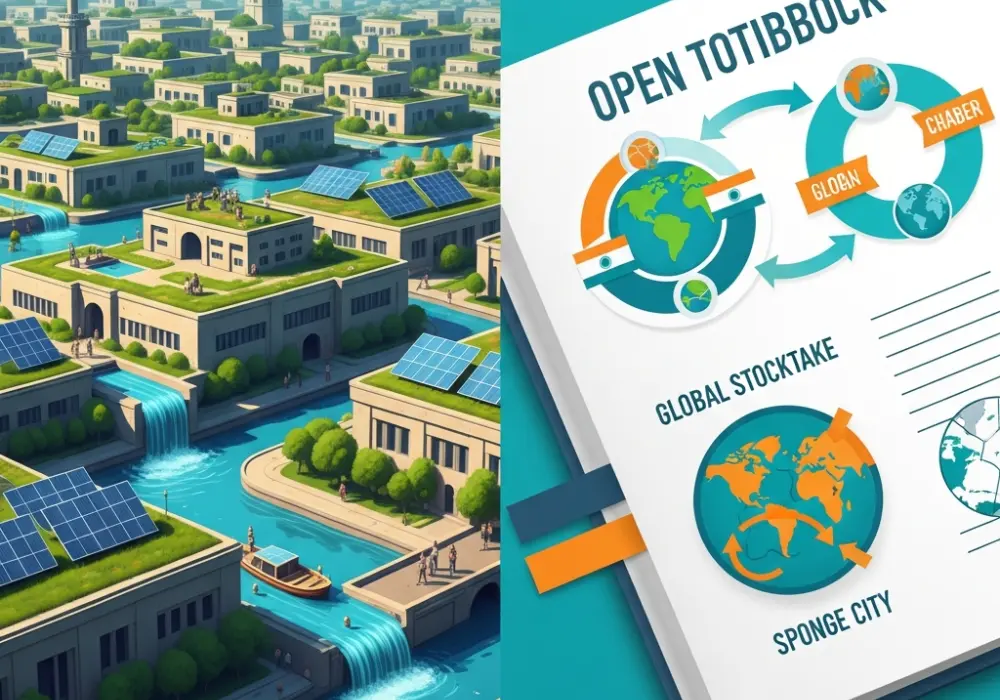
Decoding Urban Resilience: The Post-Global Stocktake Era
Climate Change is no longer a peripheral topic in the Union Public Service Commission (UPSC) examinations. It has shifted from being a part of Environmental Science to a core component of General Studies Paper III (Economy and Disaster Management) and Paper II (Governance). Following the outcomes of the latest Global Stocktake, India’s urban resilience strategies have come under intense scrutiny. As an aspirant, you must understand that urban areas contribute to 75% of global greenhouse gas emissions while remaining the most vulnerable to climate-induced disasters like flooding and heatwaves. This guide decodes the critical themes of adaptation and resilience through the lens of Previous Year Questions, providing you with ‘Ninja Shortcuts’ to tackle the most complex prompts.
💡 Why focus on the Global Stocktake?
The Global Stocktake (GST) is a process for countries and stakeholders to see where they’re collectively making progress towards meeting the goals of the Paris Agreement – and where they’re not. For India, it signals a shift from ‘Mitigation’ (reducing emissions) to ‘Adaptation’ (preparing for impact), especially in its rapidly growing cities.
Simulated Question 1: The Sponge City Concept
Question: In the context of increasing urban flooding in Indian metros, evaluate the relevance of the ‘Sponge City’ concept as a component of India’s climate adaptation strategy. (250 words, 15 Marks)
The Traditional Method
Most students would start by defining urban flooding, listing recent examples (Chennai, Bengaluru), and then explaining that a Sponge City uses permeable surfaces to absorb water. While correct, this approach is generic and lacks the ‘administrative edge’ required by the UPSC.
The 30-Second Ninja Shortcut: The ‘BLUE-GREEN’ Formula
To stand out, use the Blue-Green Infrastructure (BGI) framework. When you see ‘Sponge City’, immediately think: B (Blue) – Restoration of wetlands and water bodies; G (Green) – Parks and urban forests; I (Infiltration) – Permeable pavements. In your intro, link the Global Stocktake’s call for ‘ecosystem-based adaptation’ directly to the Sponge City model.
Deep Conceptual Breakdown
India’s urban resilience relies on shifting from ‘Grey Infrastructure’ (concrete drains, pipes) to ‘Green Infrastructure’. The Global Stocktake highlights that static infrastructure fails under extreme weather. A Sponge City works on three principles: Absorption, Infiltration, and Retention. By integrating these into the AMRUT (Atal Mission for Rejuvenation and Urban Transformation) scheme, India can create climate-proof urban clusters. Key challenges include high land costs and the ‘concretization’ legacy of Indian municipalities.
💡 Click to Reveal Pro-Tip for Mains
Always mention the ‘Sendai Framework for Disaster Risk Reduction’ when discussing urban resilience. It provides a global standard that Indian examiners love to see in answers.
Simulated Question 2: Global Stocktake and Differentiated Responsibilities
Question: How does the outcome of the latest Global Stocktake impact the funding mechanisms for urban climate adaptation in developing nations like India? (150 words, 10 Marks)
The Traditional Method
Writing about the 100 billion dollar promise and how developed nations are not paying enough. This is too emotional and political for a technical GS-III answer.
The 30-Second Ninja Shortcut: The ‘G-A-F’ Pivot
Focus on G-A-F: GAP in adaptation finance (doubling of adaptation finance by 2025 is a key GST outcome); Accessibility for Urban Local Bodies; Fragility of current funding. Mention the ‘New Collective Quantified Goal’ (NCQG) which is the successor to the 100 billion target.
Deep Conceptual Breakdown
The Global Stocktake outcomes have institutionalized the need for ‘Adaptation Finance’. Previously, 80% of climate finance went to ‘Mitigation’ (Solar/Wind). However, for a country like India, adapting cities to withstand heatwaves and rising sea levels is more urgent. The GST forces a conversation on how much money is flowing into resilience. This leads to the concept of ‘Climate Bonds’ and ‘Green Municipal Bonds’ as innovative financing tools for Indian cities like Indore and Ghaziabad, which have already experimented with them.
Simulated Question 3: The Urban Heat Island (UHI) Effect
Question: With the increasing frequency of heatwaves, discuss the effectiveness of ‘Heat Action Plans’ (HAPs) in Indian cities. What improvements are needed post the recent global climate assessments? (250 words, 15 Marks)
The Traditional Method
Listing the symptoms of heatwaves (dehydration, mortality) and stating that cities should plant more trees. This lacks the policy depth required for UPSC.
The 30-Second Ninja Shortcut: The ‘L-V-A’ Rule
Evaluate HAPs based on Localized data (ward-level mapping), Vulnerable population targeting (slum dwellers, outdoor workers), and Administrative accountability. Use the keyword ‘Passive Cooling Strategies’ to show you understand modern adaptation.
Deep Conceptual Breakdown
Urban Heat Islands occur when cities replace natural land cover with dense concentrations of pavement, buildings, and other surfaces that absorb and retain heat. India’s Heat Action Plans (pioneered by Ahmedabad) have been successful in reducing mortality but fail in ‘long-term structural adaptation’. Post-Global Stocktake, the focus must shift to ‘Cool Roof’ policies and ‘Urban Morphology’ (designing buildings to allow wind flow). This is a transition from emergency response to climate-resilient urban design.
💡 Quick Fact for Prelims
The first Heat Action Plan in India was launched in Ahmedabad in 2013 following a devastating heatwave in 2010. It is now a model for over 100 cities in India.
Simulated Question 4: Coastal Resilience and Sea-Level Rise
Question: Coastal cities are at the forefront of climate risk. Examine the role of the ‘Integrated Coastal Zone Management’ (ICZM) project in enhancing India’s urban resilience. (150 words, 10 Marks)
The Traditional Method
Explaining that sea levels are rising and we need to build sea walls. This ignores the ecological impact of hard structures.
The 30-Second Ninja Shortcut: Nature-Based Solutions (NbS)
When discussing coastal resilience, always pivot to NbS. Mention ‘Bio-shields’ (mangroves) instead of just ‘Sea Walls’. Use the term ‘Coastal Regulation Zone (CRZ) Notification’ to anchor your answer in Indian law.
Deep Conceptual Breakdown
The ICZM project, supported by the World Bank, aims to balance economic development with environmental conservation. For cities like Mumbai, Kochi, and Visakhapatnam, resilience isn’t just about disaster response; it’s about ‘Managed Retreat’ and ‘Coastal Setbacks’. The Global Stocktake emphasizes that coastal ecosystems are ‘Carbon Sinks’. Therefore, protecting mangroves in Mumbai (like those in the Thane Creek) serves a dual purpose: Carbon Sequestration (Mitigation) and Storm Surge Protection (Adaptation).
Simulated Question 5: Governance and Urban Local Bodies (ULBs)
Question: The 74th Constitutional Amendment Act was a milestone for urban governance. However, ULBs remain the ‘weak link’ in India’s climate adaptation journey. Discuss. (250 words, 15 Marks)
The Traditional Method
Discussing the lack of funds, functions, and functionaries (the 3 Fs) in general terms without linking it to climate change.
The 30-Second Ninja Shortcut: The ‘Climate-Budgeting’ Link
The Ninja move here is to suggest Climate Budgeting at the municipal level. Argue that resilience cannot be achieved unless ULBs have the power to levy ‘Carbon Cess’ or manage ‘Resilience Funds’. Use the term ‘Sub-national Climate Action’.
Deep Conceptual Breakdown
While the Center signs international treaties like the Paris Agreement, the actual implementation happens at the city level. If a municipality cannot manage solid waste, it cannot prevent urban flooding (clogged drains). The Global Stocktake highlights the need for ‘Multi-level Governance’. In India, the lack of technical expertise at the ULB level is a major hurdle. We need ‘City Resilience Officers’—a concept used globally—to bridge the gap between climate science and urban planning.
Cheat Sheet: Quick Revision for Urban Resilience
Ready to Ace the Environment Section?
Climate change and urban governance are high-yield topics for the UPSC examination. If you have doubts about the Global Stocktake outcomes or need more Previous Year Questions breakdowns, our experts are here to help!
💬 Chat with our Experts on WhatsApp (+91 9526806124)




