
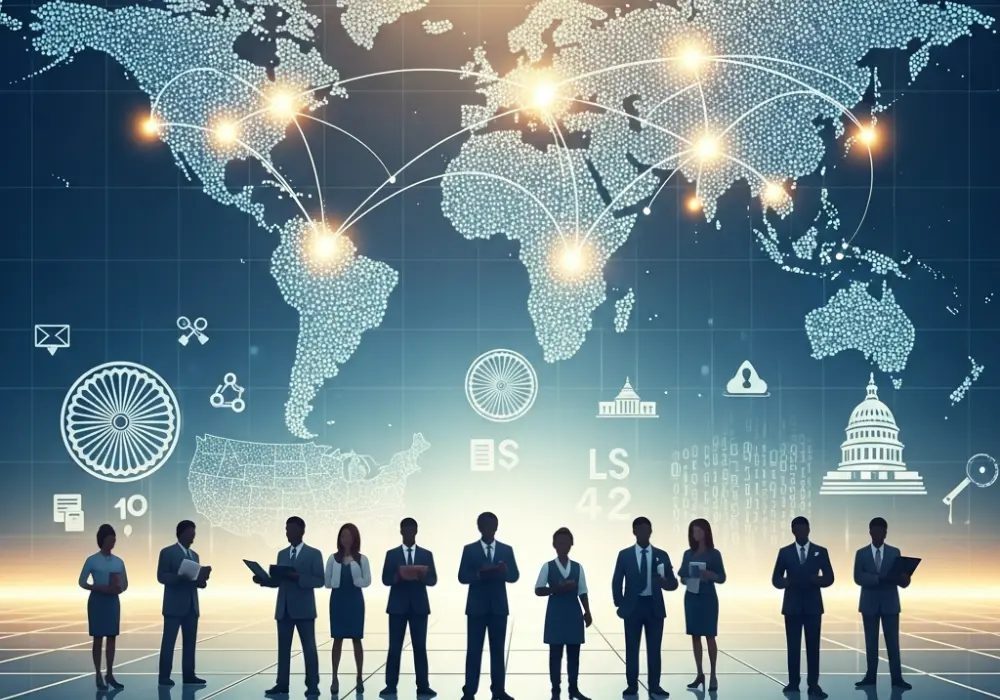
Introduction: The Living Bridge of Indo-US Relations
In the evolving landscape of International Relations, the Indian Diaspora in the United States stands as one of the most potent instruments of India’s soft power. Often referred to by the Prime Minister as the ‘Living Bridge’, this community of over 4 million individuals has transitioned from being mere ‘migrants’ to ‘strategic assets’. For a UPSC aspirant, understanding how this demographic influences bilateral trade, policy lobbying, and cultural diplomacy is not just an academic exercise but a necessity for General Studies Paper II. This guide decodes the patterns of Previous Year Questions to give you a competitive edge.
💡 Why does the Diaspora matter for Trade?
The diaspora acts as a ‘Knowledge Bridge’ and a ‘Trust Catalyst’. They facilitate business-to-business (B2B) connections, reduce information asymmetry in foreign markets, and drive demand for Indian products ranging from software services to ethnic goods.
Question 1: The Influence of the Indian-American Lobby
Question: “To what extent has the Indian Diaspora in the US influenced the strategic and trade partnership between India and the United States? Discuss with examples.”
The Traditional Method
Most students will begin with a chronological history of migration since the 1960s, mention the 123 Agreement (Civil Nuclear Deal), and list generic points about CEOs like Satya Nadella or Sundar Pichai. This approach is descriptive and often fails to address the ‘strategic’ and ‘trade’ nuances deeply, leading to average marks.
The 30-Second Ninja Shortcut
Focus on the ‘Lobby-Capital-Knowledge’ (LCK) Framework. In 30 seconds of brainstorming, map out: 1. Lobbying (USINPAC/Indiaspora), 2. Capital (FDI and Remittances), 3. Knowledge (Tech transfers like iCET). Start your answer directly with the paradigm shift from ‘Brain Drain’ to ‘Brain Gain’.
💡 Pro-Tip: The ‘Impact’ Keyword
Always mention ‘Congressional Caucuses’. The Caucus on India and Indian Americans is the largest country-specific caucus in the US House of Representatives. This is a high-value fact for any Previous Year Questions response.
Question 2: Soft Power and Brand India
Question: “How does the cultural and professional success of the Indian Diaspora contribute to India’s soft power in the US, and how does this translate into economic benefits?”
The Traditional Method
Students usually talk about Yoga, Bollywood, and Diwali celebrations at the White House. While these are valid, they are ‘shallow’ soft power elements. They miss the link between ‘reputation’ and ‘investment’.
The 30-Second Ninja Shortcut
Use the ‘Model Minority’ Logic. The success of Indians in high-tech and medicine creates a ‘Halo Effect’ for Indian services. If the best doctors and engineers in the US are Indian, the US corporate world trusts Indian IT companies (TCS, Infosys) more easily. This reduces the ‘Country Risk’ perception. This link is what examiners look for in Previous Year Questions analysis.
💡 Concept Reveal: Track II Diplomacy
The diaspora performs ‘Track II Diplomacy’—non-governmental, informal interactions that build trust where formal diplomacy might be slow. Mention the role of ‘Indiaspora’ in mobilizing COVID-19 relief as a recent example of this soft power.
Question 3: Bilateral Trade and Tech-Ventures
Question: “Analyze the role of the Indian Diaspora in Silicon Valley in strengthening Indo-US bilateral trade in the technology sector.”
The Traditional Method
Listing the names of famous CEOs and mentioning that they help India. This lacks technical depth and fails to discuss the structural impact on India’s startup ecosystem.
The 30-Second Ninja Shortcut
Think ‘Circulation, not Migration’. Highlight the ‘Reverse Brain Drain’ and ‘Angel Investments’. Mention the TiE (The Indus Entrepreneurs) network. Explain how Diaspora-led US firms establish R&D centers in India (GCCs – Global Capability Centers), which directly boosts bilateral trade in services. This is a crucial pivot in modern Previous Year Questions.
💡 Data Point for Extra Marks
Indian-Americans make up roughly 1% of the US population but contribute about 6% of the US tax revenue and dominate the hospitality and tech sectors. This economic weight gives them political leverage to push for favorable trade policies toward India.
Question 4: Strategic Enabler in Critical Technologies
Question: “The Indian diaspora has moved beyond being a source of remittances to becoming a partner in India’s quest for critical technologies. Comment in the context of the iCET initiative.”
The Traditional Method
Focusing only on the money sent back home (remittances). While India is the top recipient of remittances globally, the US-specific diaspora’s value lies in ‘Human Capital’.
The 30-Second Ninja Shortcut
Map the ‘iCET Connection’. The Initiative on Critical and Emerging Technology (iCET) is driven largely by the professional synergy between Indian scientists in US labs and the Indian tech ecosystem. The diaspora acts as the ‘Security Guarantor’ of tech transfers. Use the phrase ‘Deep Tech Diplomacy’.
💡 Hidden Fact
Organizations like the ‘American Association of Physicians of Indian Origin’ (AAPI) are vital. During policy shifts, these professional bodies provide the expert testimony needed in the US Congress to support India-friendly legislation.
Question 5: Challenges and Friction Points
Question: “Despite the positive influence of the Diaspora, there are emerging challenges that might affect their role as a bridge between India and the US. Critically examine.”
The Traditional Method
Focusing only on H-1B visa issues. This is too narrow for a 250-word answer.
The 30-Second Ninja Shortcut
The ‘Dual-Edged Sword’ Analysis. 1. Political Polarization: The diaspora is becoming divided on Indian domestic issues, which weakens their collective lobbying power. 2. Generational Shift: Second and third-generation Indian-Americans may not have the same emotional ties as their parents. 3. Civil Rights vs. State Interest: The diaspora sometimes critiques the Indian government on human rights, creating friction.
💡 Critical Thinking Tip
Always conclude such answers with a ‘Forward-Looking’ statement. Suggest that India must engage the ‘Global Z’ (Gen Z of the diaspora) through digital outreach and the ‘Pravasi Bharatiya Divas’ to maintain the bridge.
Cheat Sheet: Diaspora & Trade Quick Revision
| Key Concept | UPSC Value Addition |
|---|---|
| Remittances | India receives over $100 Billion annually; US is a major source. |
| Philanthropy | Investment in healthcare, education, and rural development in India. |
| Lobbying Groups | USINPAC, Indiaspora, US-India Strategic Partnership Forum (USISPF). |
| Soft Power | Yoga, Ayurveda, Cuisine, and the ‘Intellectual Brand’ of India. |
| Trade Facilitation | Lowering transaction costs through ethnic networks and business trust. |
- Key Term: Strategic Autonomy – Helped by a strong diaspora supporting India’s stance in US policy circles.
- Key Term: Brain Gain – The return of skilled professionals to start ventures in India.
- Key Term: Track 1.5 Diplomacy – Where government officials and non-official diaspora leaders interact.
Struggling with International Relations or Answer Writing?
The Indian Diaspora is just one of many complex topics. Get personalized mentorship, feedback on your answers, and access to our exclusive question bank to ace the UPSC exam!
💬 Chat with our Experts on WhatsApp (+91 9526806124)




