
UPSC Previous Year Questions: Mastering IMEC Strategic Implications and Global Trade Shifts
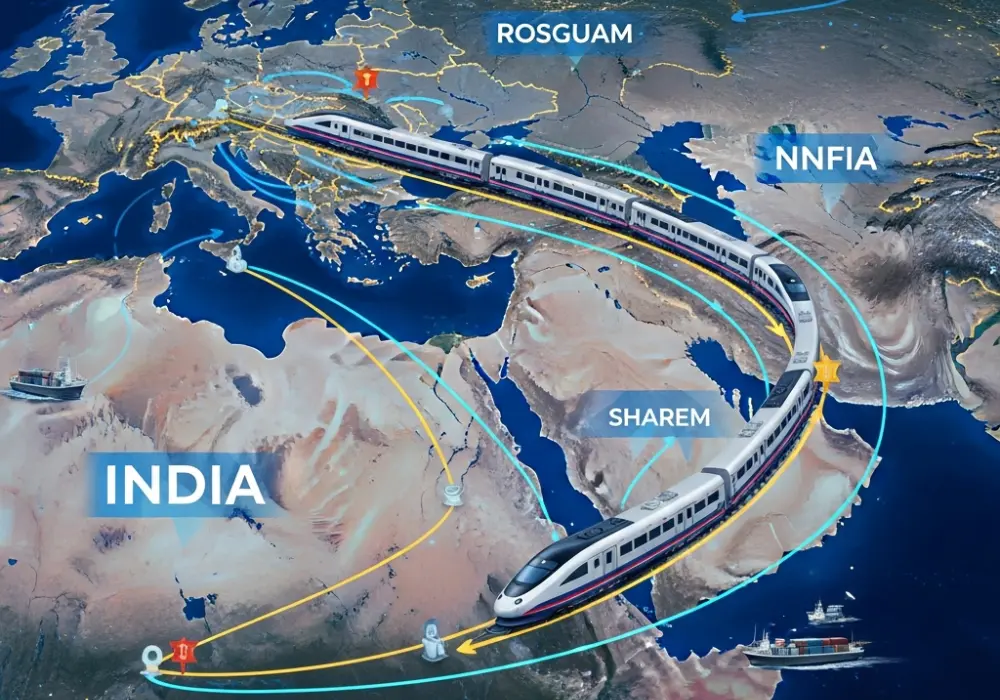
The India-Middle East-Europe Economic Corridor (IMEC) is not merely a transport project; it is a fundamental reconfiguration of the world’s economic geography. Announced on the sidelines of the G20 Summit, this multi-modal corridor aims to integrate India, the Arabian Gulf, and Europe. For a UPSC aspirant, understanding the IMEC is crucial because it touches upon Geopolitics, International Relations, Economy, and Internal Security. In this guide, we decode the strategic implications of IMEC progress as we head toward 2027, analyzing potential shifts in global trade through the lens of Previous Year Questions patterns.
💡 Why is IMEC a ‘Hot Topic’ for UPSC?
UPSC loves ‘corridors’ and ‘connectivity’ projects (think INSTC, BRI, and Chabahar). IMEC is the latest and most significant western-led alternative to the Belt and Road Initiative, making it a goldmine for Mains and Prelims questions.
The Strategic Blueprint: What is IMEC?
The corridor consists of two main segments: the East Corridor connecting India to the Arabian Gulf and the Northern Corridor connecting the Arabian Gulf to Europe. It includes a railway network that will provide a reliable and cost-effective ship-to-rail transit network. By 2027, the initial phases of digital and energy connectivity are expected to show tangible progress, altering the traditional dependence on the Suez Canal.
Key components include:
- Maritime Links: Mundra and Kandla in India to Fujairah and Jebel Ali in the UAE.
- Railway Links: Connecting UAE, Saudi Arabia, Jordan, and Israel (Haifa).
- European Links: Haifa to Piraeus (Greece) and other European ports.
- Additional Infrastructure: Electricity cables, high-speed data cables, and a clean hydrogen pipeline.
Simulated Question 1: Component Analysis
Question: Which of the following are the primary objectives of the India-Middle East-Europe Economic Corridor (IMEC)?
- Enhancing food security through optimized supply chains.
- Establishing a high-speed data connectivity network.
- Directly countering the International North-South Transport Corridor (INSTC).
- Reducing the transit time between India and Europe by 40%.
Select the correct answer using the code below:
(a) 1 and 2 only | (b) 2 and 4 only | (c) 1, 2, and 4 only | (d) 1, 2, 3, and 4
💡 30-Second Ninja Shortcut
Elimination Logic: Statement 3 is a ‘Hostile Objective’. Official diplomatic corridors rarely state their objective is to ‘counter’ another specific project in official documents. Eliminate 3. Once 3 is gone, option (d) is out. Statement 4 is a standard benefit of any major corridor. Statement 2 is a core pillar of modern corridors. Correct Answer: (c). Even if you weren’t sure about food security, it is a logical byproduct of supply chain efficiency.
Simulated Question 2: Geopolitical Geography
Question: Considering the route of IMEC, which of the following water bodies/straits are most likely to see a strategic shift in commercial traffic by 2027?
- Strait of Hormuz
- Suez Canal
- Bab-el-Mandeb
- Strait of Malacca
Select the correct answer:
(a) 1 and 2 | (b) 2 and 3 | (c) 1, 2, and 3 | (d) All of the above
💡 30-Second Ninja Shortcut
Keyword Association: IMEC is designed to bypass the ‘Chokepoint Vulnerability’ of the Suez Canal. The route goes via the Arabian Peninsula (avoiding Bab-el-Mandeb to an extent if land-bridged). However, it starts from the Arabian Sea, which enters the Gulf near Hormuz. Statement 4 (Malacca) is in SE Asia, completely unrelated to the India-Middle East-Europe geography. Eliminate 4. Answer: (c) is the most comprehensive geographically relevant choice.
Simulated Question 3: Strategic Partnerships
Question: Which organization or initiative provided the primary diplomatic scaffolding for the IMEC’s announcement?
(a) The G7 Build Back Better World (B3W) initiative.
(b) The G20 New Delhi Declaration.
(c) The I2U2 Group (India, Israel, USA, UAE).
(d) The Gulf Cooperation Council (GCC) Vision 2030.
💡 30-Second Ninja Shortcut
The ‘Genesis’ Rule: While I2U2 (c) laid the groundwork for Middle East integration, the actual announcement was a headline of the G20 (b) in New Delhi. However, be careful! If the question asks for the ‘Strategic Foundation’, look for the Partnership for Global Infrastructure and Investment (PGII) which is linked to the G7 (a). In the context of the recent Previous Year Questions style, the most direct answer for the scaffolding is the G20 platform. Correct Answer: (b).
Simulated Question 4: Economic Impact
Question: By 2027, the IMEC is expected to significantly reduce India’s ‘Logistics Cost’ which currently stands at roughly 13-14% of GDP. How does it achieve this?
- By shifting from a purely maritime route to a multimodal ship-to-rail link.
- By eliminating the need for customs clearance at every border crossing through digital harmonization.
- By providing a direct land route through Pakistan and Afghanistan.
Codes: (a) 1 only | (b) 1 and 2 | (c) 2 and 3 | (d) 1, 2, and 3
💡 30-Second Ninja Shortcut
Realpolitik Check: Statement 3 is impossible given current geopolitical tensions between India and Pakistan. Any option with 3 is wrong. Statements 1 and 2 are the ‘Technical Pillars’ of IMEC. Correct Answer: (b). This is a classic UPSC trap where they insert a historically failed route (Pak/Afghan) into a modern success story.
Simulated Question 5: Environmental & Energy Strategic Dimensions
Question: The IMEC is described as a ‘Green Corridor’. This terminology refers to:
- The reforestation of the Arabian Desert along the railway tracks.
- The incorporation of hydrogen pipelines to export clean energy to Europe.
- The use of solar-powered locomotives for the entire rail stretch.
- A reduction in carbon footprint compared to the long sea route around the Cape of Good Hope.
Codes: (a) 1 and 3 | (b) 2 and 4 | (c) 1, 2, and 4 | (d) All of the above
💡 30-Second Ninja Shortcut
The ‘Practicality’ Filter: Reforestation (1) is a massive project but not a ‘corridor objective’. Solar-only locomotives (3) are not yet technically feasible for heavy trans-continental freight. Hydrogen (2) and efficient routes (4) are the actual policy goals. Correct Answer: (b). Always filter out ‘idealistic’ but ‘unrealistic’ statements in UPSC connectivity questions.
Deep Concepts: Global Trade Shifts by 2027
As we look toward 2027, the IMEC will trigger several ‘Structural Shifts’ in global trade:
- De-risking vs. Decoupling: IMEC allows Europe and India to ‘De-risk’ their supply chains from a single-country dependency (China) without fully ‘Decoupling’. It provides an alternative that is transparent and standards-driven.
- Strategic Autonomy of the Middle East: Saudi Arabia and the UAE are moving from ‘Oil States’ to ‘Global Logistics Hubs’. This project aligns with Saudi Vision 2030 and UAE’s Projects of the 50.
- India as the ‘Vishwa-Mitra’: By connecting to both the West (via IMEC) and the North (via INSTC), India positions itself as the central node of the Global South.
- Bypassing Chokepoints: The Suez Canal blockages (like the Ever Given incident) highlighted the fragility of current routes. IMEC offers a resilient alternative.
Cheat Sheet: IMEC Quick Revision
| Feature | Details for UPSC |
|---|---|
| Corridors | East (India-Gulf) & North (Gulf-Europe). |
| Signatories | India, USA, UAE, Saudi Arabia, France, Germany, Italy, EU. |
| Key Ports | Mundra (India), Haifa (Israel), Piraeus (Greece). |
| Strategic Goal | 40% faster and 30% cheaper transit than Suez. |
| Hidden Layers | Digital Cables, Green Hydrogen, Power Grids. |
Conclusion: The Road to 2027
For UPSC aspirants, the IMEC represents the ‘New Silk Road’ but with democratic values. While challenges like the geopolitical volatility in West Asia persist, the momentum toward 2027 suggests that trade diversification is irreversible. Focus on the integration of technology (digital nodes) and energy (hydrogen) into physical infrastructure—this is where the next set of Previous Year Questions will likely emerge.
Got doubts about IMEC or International Relations? We are here to help!
💬 Chat with our Experts on WhatsApp (+91 9526806124)




