
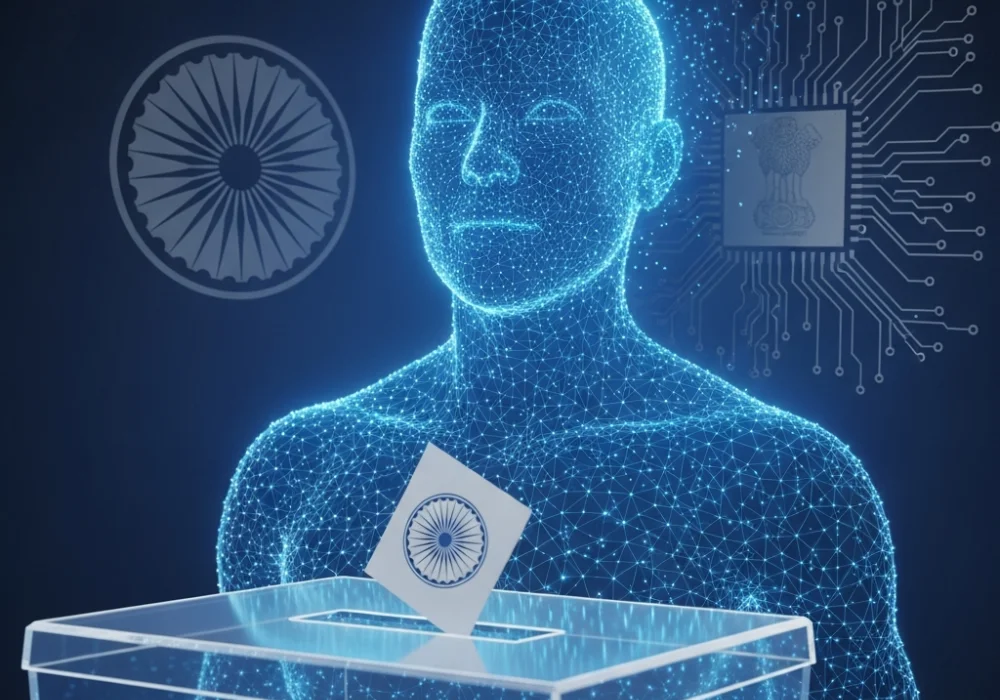
Introduction: The Technological Frontier of Indian Democracy
As the world’s largest democracy, India stands at a critical juncture where the digital revolution meets the ballot box. The emergence of advanced Generative Artificial Intelligence and deepfakes represents a paradigm shift in how information is created, consumed, and manipulated. For a UPSC aspirant, understanding this topic is not just about technology; it is about the sanctity of Article 324, the ethics of political persuasion, and the resilience of our constitutional fabric. This guide decodes the complexities of AI in governance and provides you with the mental models needed to ace questions related to this evolving domain. We will analyze five simulated high-level questions based on the patterns of Previous Year Questions to build your analytical depth.
Question 1: The Ethical Quagmire of Synthetic Media
Question: “The rise of Generative AI-driven deepfakes poses a significant threat to the ‘informed choice’ of a voter. Examine the ethical dilemmas involved in the use of synthetic media during electoral processes in India.” (250 Words)
The Traditional Method
Most candidates will begin by defining deepfakes and listing their negatives, such as spreading rumors about a candidate’s health or false speeches. They will conclude by saying ‘regulation is needed.’ This approach is generic and fails to capture the ‘Ethics’ (General Studies Paper IV) dimension required by the examiner.
The 30-Second Ninja Shortcut: The “TRUTH” Framework
To provide a structured, ethical answer, use the TRUTH acronym: Trust (erosion of institutional faith), Responsibility (who is liable?), Unfair Advantage (digital divide in campaigning), Transparency (disclosure of AI use), and Harm (incitement of violence). Apply these five pillars to structure your body paragraphs immediately.
💡 Click to Reveal Core Concept: Cognitive Autonomy
The core ethical issue is the violation of a citizen’s ‘Cognitive Autonomy’. When a voter is manipulated by a deepfake, their decision-making process is hijacked by falsehoods, rendering the democratic exercise of ‘choice’ illusory. Mentioning this term can significantly boost your marks.
Question 2: Regulatory Architecture and the IT Rules
Question: “Evaluate the effectiveness of the Information Technology (Intermediary Guidelines and Digital Media Ethics Code) Rules in addressing the challenges of AI-generated misinformation. Suggest further regulatory measures.” (250 Words)
The Traditional Method
Candidates often simply list the 2021 Rules and the 2023 amendments. They focus on the ‘removal of content within 36 hours’ but forget to link it specifically to the technical difficulty of identifying Generative AI content in real-time.
The 30-Second Ninja Shortcut: The “S-O-P” Analysis
Evaluate regulations through S-O-P: Speed (How fast is the takedown?), Origination (Can we find the creator?), and Proportionality (Does the regulation stifle free speech?). This allows you to critique the law systematically rather than just describing it.
💡 Click to Reveal Pro-Tip: The Liars Dividend
In your answer, discuss the ‘Liar’s Dividend’—a phenomenon where real evidence is dismissed as a ‘deepfake’ by corrupt actors, further complicating the regulatory landscape. Regulation must address both the creation of fakes and the false claims of fakes.
Question 3: AI as a Tool for Electoral Inclusion vs. Exclusion
Question: “While Generative AI can bridge the language barrier in a diverse country like India, it also risks creating ‘digital echo chambers’. Discuss the dual impact of AI on the democratic process.” (150 Words)
The Traditional Method
Writing a standard ‘Pros and Cons’ list. Pros: Translation. Cons: Fake news. This is too basic for the Civil Services Examination level.
The 30-Second Ninja Shortcut: The “Bridge vs. Barrier” Model
Structure the answer by showing how the same technology acts as both. AI as a Bridge: Real-time translation of manifestos into 22 scheduled languages (Inclusion). AI as a Barrier: Algorithmic bias and hyper-personalized targeting that isolates voters from opposing viewpoints (Polarization).
💡 Click to Reveal Key Example: Bhashini
Mention the ‘Bhashini’ mission by the Government of India. It uses AI to translate Indian languages, which can be leveraged for democratic participation, but must be guarded against synthetic manipulation.
Question 4: Constitutional Safeguards and the Right to Information
Question: “Analyze how deepfakes infringe upon the fundamental rights guaranteed under Articles 19 and 21 of the Indian Constitution. Can technological solutions alone suffice?” (250 Words)
The Traditional Method
Focusing only on Freedom of Speech. Candidates often forget that the ‘Right to receive accurate information’ is a derivative of Article 19, as established by the Supreme Court in the ADR vs. Union of India case.
The 30-Second Ninja Shortcut: The “Triad of Rights”
Link deepfakes to three specific constitutional points: 1. Article 19(1)(a) (Right to know vs. Right to mislead), 2. Article 21 (Right to reputation/dignity), and 3. Article 324 (ECI’s mandate for free and fair elections). Then, argue that ‘Techno-Legal’ (Technology + Law) approach is better than technology alone.
💡 Click to Reveal Pro-Tip: Content Provenance
Technological solutions like ‘Digital Watermarking’ and ‘C2PA standards’ (Content Authenticity) are essential keywords to include when discussing the ‘technological’ part of the solution.
Question 5: Global Best Practices and the Indian Path
Question: “Compare the European Union’s AI Act with India’s current approach to AI regulation. What lessons can India draw to protect its democratic processes?” (250 Words)
The Traditional Method
Describing both laws in isolation without comparing them. A comparison question requires a thematic analysis, not two separate descriptions.
The 30-Second Ninja Shortcut: The “Risk-Based vs. User-Based” Comparison
Contrast the EU’s Risk-Based Approach (categorizing AI based on threat levels) with India’s User-Centric/Intermediary Approach (holding platforms like WhatsApp/Meta responsible). Suggest that India needs a hybrid model that specifically identifies ‘high-risk’ electoral AI.
💡 Click to Reveal Core Concept: Sovereignty in the Age of AI
Discuss ‘Digital Sovereignty’. India must ensure that foreign-owned AI models do not influence domestic political narratives, ensuring that our democratic data is protected from external manipulation.
Cheat Sheet: Quick Revision for Generative AI & Democracy
| Key Concept | UPSC Application Context |
|---|---|
| Article 324 | Election Commission’s power to issue guidelines on AI use in polls. |
| IT Rules 2021 (Rule 3) | Due diligence for intermediaries to remove non-consensual deepfakes. |
| Bletchley Declaration | Global consensus on ‘Frontier AI’ safety; signed by India. |
| DPDP Act 2023 | Protects personal data used to train AI models without consent. |
| Algorithmic Accountability | The ethical obligation for developers to explain how their AI works. |
Final Thoughts for the Aspirant
When solving Previous Year Questions related to technology, always remember: technology is the ‘context’, but the Constitution and Ethics are the ‘content’. Never lose sight of the human element. The goal of any regulation should be to empower the citizen, not just control the machine. Master these frameworks, and you will find yourself writing answers that are structurally superior and conceptually deeper than the average candidate.
Struggling with Tech-Ethics Topics?
Our mentors are here to help you decode the most complex UPSC syllabus themes with ease and precision.
💬 Chat with our Experts on WhatsApp (+91 9526806124)




