
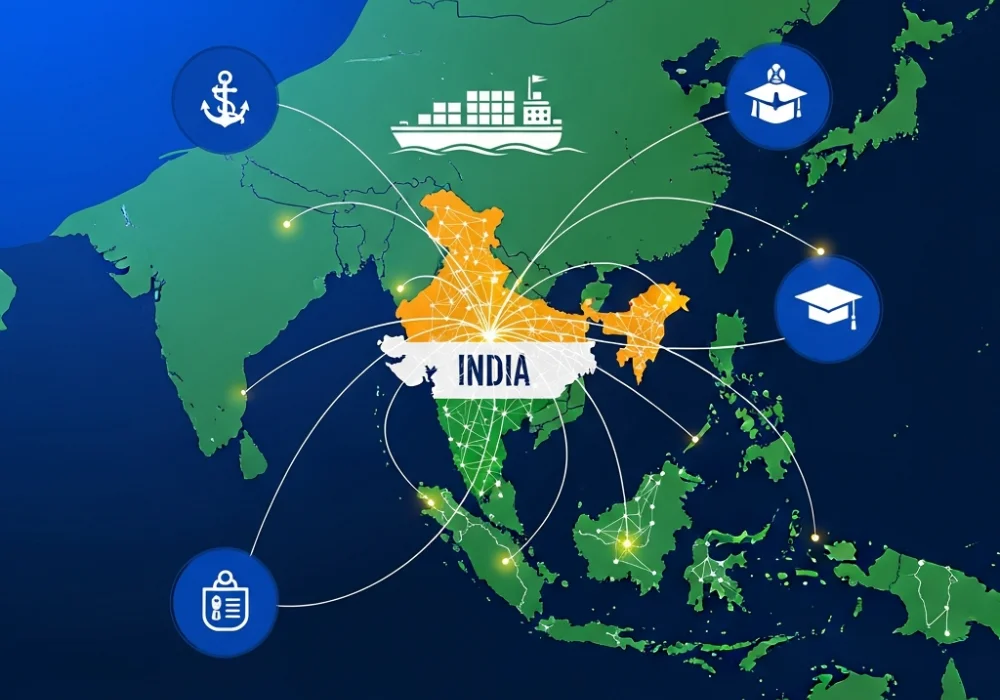
Mastering India’s ‘Act East Policy’ and BIMSTEC: The Ultimate UPSC Guide
For any UPSC aspirant, the shift from ‘Look East’ to ‘Act East’ is not just a semantic change; it is a fundamental transformation in India’s geopolitical posture. This transformation places the Bay of Bengal Initiative for Multi-Sectoral Technical and Economic Cooperation (BIMSTEC) at the very heart of India’s foreign policy. As an aspirant, you must understand that the Bay of Bengal is no longer a ‘forgotten sea’ but a ‘bridge of prosperity.’ In this guide, we decode the complexities of connectivity and security through the lens of Previous Year Questions patterns to give you the competitive edge needed for the Civil Services Examination.
💡 Click to Reveal the Secret UPSC Theme
The most frequent theme in international relations is ‘Regionalism vs. Globalism.’ For BIMSTEC, focus on why it is succeeding where SAARC failed. The keyword is ‘Functional Cooperation’ over ‘Political Deadlock.’
Simulated Question 1: The Bridge of Connectivity
Question: “The India-Myanmar-Thailand Trilateral Highway and the Kaladan Multi-Modal Transit Transport project are the twin pillars of India’s connectivity ambitions in BIMSTEC. Critically analyze their impact on the development of Northeast India.”
The Traditional Method
Most candidates will write about the geography of the projects, mention the names of the cities (Moreh, Mae Sot, Sittwe), and conclude that it will boost trade. They might mention the ‘Chicken’s Neck’ corridor briefly. While correct, this approach lacks the analytical depth required for a high score in the Mains.
The 30-Second Ninja Shortcut
Use the ‘Three-E’ Framework: Economy, Equity, and External Security. 1. Economy: Transformation from land-locked to land-linked. 2. Equity: Integrating the peripheral Northeast into the national value chain. 3. External Security: Reducing dependence on the Siliguri Corridor and countering the ‘String of Pearls’ through institutional presence in the Bay of Bengal.
💡 Click to Reveal Pro-Tip on Map Marking
In your answer, always draw a rough sketch of the Bay of Bengal showing the Sittwe port connection to Mizoram. This visual representation can fetch you an extra 1.5 marks!
Simulated Question 2: Security Cooperation Trends
Question: “Maritime security in the Bay of Bengal is increasingly threatened by non-traditional security challenges. Discuss how BIMSTEC provides a platform for India to take a leadership role in Net Security Provision.”
The Traditional Method
Students often focus heavily on ‘Hard Security’ (navy, warships, military exercises). They list maritime piracy and terrorism as the main issues. This is a narrow view that ignores the ‘Human Security’ aspect which is central to modern Previous Year Questions trends.
The 30-Second Ninja Shortcut
Apply the ‘S.A.G.A.R.’ Doctrine (Security and Growth for All in the Region). Structure the answer around: 1. HADR (Humanitarian Assistance and Disaster Relief) – BIMSTEC is the most disaster-prone region. 2. IUU Fishing (Illegal, Unreported, and Unregulated). 3. MDA (Maritime Domain Awareness) – Sharing white shipping information. This proves India is a ‘Responsible Stakeholder’ rather than a ‘Hegemon.’
Simulated Question 3: BIMSTEC vs. SAARC Debate
Question: “With the stagnation of SAARC, BIMSTEC has emerged as the primary vehicle for India’s regional integration. Evaluate the challenges in making BIMSTEC an effective economic bloc.”
The Traditional Method
The standard answer focuses on the ‘Pakistan Factor’ in SAARC and how BIMSTEC avoids it. While true, a top-tier answer must look forward, not backward. Don’t just blame SAARC; analyze BIMSTEC’s own structural weaknesses.
The 30-Second Ninja Shortcut
Think ‘FTA & Institutionalization’. The secret to this answer is pointing out that despite 25+ years, the BIMSTEC Free Trade Agreement (FTA) is still not finalized. Use the ‘Implementation Gap’ theory: India provides the vision, but slow bureaucracy and member state sensitivities provide the friction.
💡 Click to Reveal the ‘Buzzword’ for this Question
Use the term ‘Sub-regionalism.’ BIMSTEC is a classic example of sub-regionalism where contiguous states cooperate on specific shared interests regardless of larger regional failures.
Simulated Question 4: The ‘Act East’ Shift
Question: “How does the ‘Act East Policy’ go beyond the ‘Look East Policy’ in its engagement with the BIMSTEC countries? Highlight the strategic dimensions of this shift.”
The Traditional Method
Students usually say ‘Act East is more proactive.’ They list a few summits. This is too superficial for the GS Paper 2 level. You must demonstrate a shift from ‘Economic Focus’ to ‘Strategic and Security Alignment.’
The 30-Second Ninja Shortcut
Use the ‘4C’ Evolution: Look East was about Commerce. Act East is about Connectivity, Culture, Commerce, and Capacity Building. Mention the ‘Indo-Pacific’ context—Act East is India’s contribution to a ‘Free and Open Indo-Pacific.’ This links regional policy to global strategy.
Simulated Question 5: Blue Economy & Sustainability
Question: “The Bay of Bengal is a shared resource for BIMSTEC nations. Examine the potential for cooperation in the ‘Blue Economy’ and the hurdles posed by climate change.”
The Traditional Method
Focusing only on fishing and offshore oil/gas. This ignores the modern environmental context that Previous Year Questions examiners love. A basic answer fails to mention the vulnerability of the Sundarbans or the low-lying areas of Bangladesh.
The 30-Second Ninja Shortcut
Apply the ‘Resource vs. Resilience’ model. 1. Resource: Deep-sea mining, marine biotechnology, and coastal tourism. 2. Resilience: Joint early warning systems for cyclones and mangrove conservation. Keyword: ‘Sustainable Ocean Governance.’ Mention that the Bay of Bengal is warming faster than the global average.
🚀 UPSC Cheat Sheet: BIMSTEC & Act East
| Key Concept | Quick Fact for Prelims / Mains |
|---|---|
| Establishment | 1997 Bangkok Declaration (Initial members: BIST-EC). |
| Lead Countries | India leads Security & Connectivity; Thailand leads Economy. |
| Connectivity Projects | IMT Trilateral Hwy, Kaladan (Sittwe Port), BBIN MVA. |
| Security Focus | Counter-terrorism, Transnational Crime, Disaster Management. |
| The 3 Pillars of AEP | ASEAN Centricity, Northeast India Development, Indo-Pacific focus. |
- Mnemonic for Members: “MBBS TIN” -> Myanmar, Bhutan, Bangladesh, Sri Lanka, Thailand, India, Nepal.
- Critical Keyword: “Neighborhood First” + “Act East” = BIMSTEC.
- Economic Data: The region hosts 22% of the world’s population with a combined GDP of over $3.5 trillion.
Confused about International Relations?
Our mentors are here to help you navigate the complex web of foreign policy and connectivity for the UPSC exam. Get personalized guidance today!
💬 Chat with our Experts on WhatsApp (+91 9526806124)




