
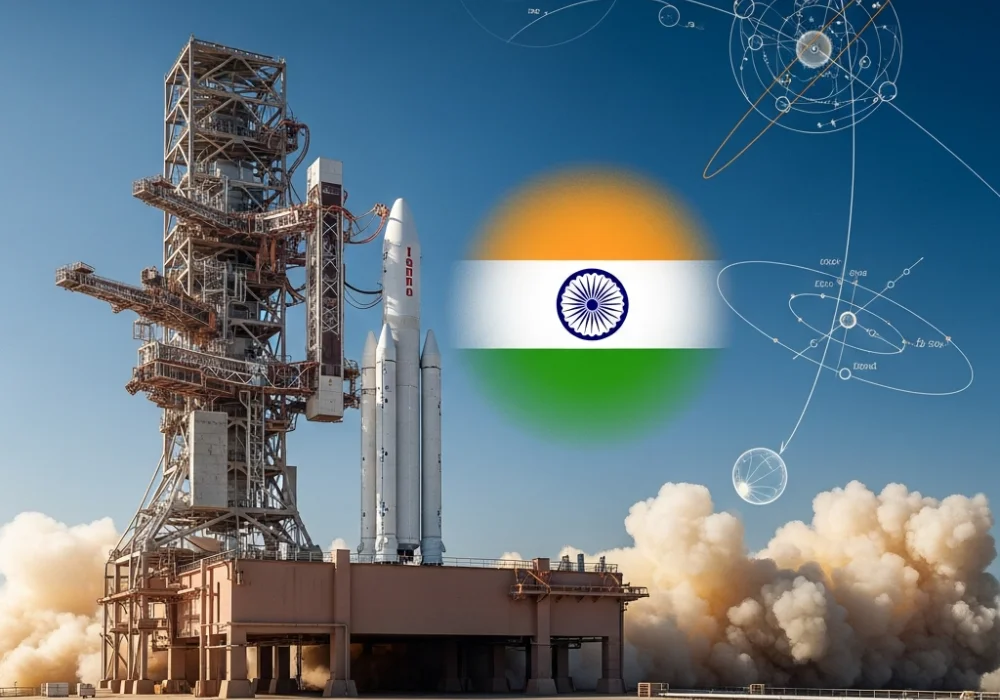
1. Introduction: Space Technology in the UPSC Context
Space technology is a cornerstone of the ‘Science and Technology’ section in the UPSC Civil Services Examination (GS Paper III and Prelims). In recent years, the focus has shifted from basic satellite terminology to complex mission architectures and the socio-economic impacts of space exploration. For an aspirant, understanding India’s evolution from a ‘rocket on a bicycle’ era to becoming a global launch hub is essential for writing balanced answers in the Mains.
The significance of space tech lies in its multi-dimensional application: ranging from national security and disaster management to agricultural productivity and climate change monitoring. This masterclass will provide a structured deep-dive into orbits, launch vehicles, ISRO’s flagship missions, and the emerging private space sector.
💡 Click to Reveal: Why Space Tech is a UPSC Favorite
UPSC frequently links Science & Tech with current affairs. Since 2018, questions on GSLV, NavIC, Gravitational Waves, and IRNSS have appeared repeatedly. Recent developments like Aditya-L1, Chandrayaan-3, and the Space Policy 2023 make this topic highly probable for upcoming attempts.
2. The Mechanics of the Cosmos: Understanding Orbits
To grasp space missions, one must first understand the ‘roads’ in space—Orbits. An orbit is a gravitationally curved path of an object around a point in space.
- Low Earth Orbit (LEO): Altitudes between 160 km and 2,000 km. Ideal for high-resolution earth observation and spy satellites because they are closer to the surface. Most human spaceflight missions (like the ISS) reside here.
- Medium Earth Orbit (MEO): Located between LEO and GEO (approx. 20,200 km). Primarily used for navigation systems like GPS, GLONASS, and Galileo.
- Geostationary Orbit (GEO): At 35,786 km. Satellites here move at the same speed as the Earth’s rotation, appearing stationary over a fixed point. This is crucial for telecommunications and weather monitoring.
- Sun-Synchronous Orbit (SSO): A special type of polar orbit where the satellite passes over any given point of the Earth’s surface at the same local mean solar time. This ensures consistent lighting conditions for remote sensing.
💡 Click to Reveal: The Concept of Lagrange Points
Lagrange points are positions in space where the gravitational forces of a two-body system (like Sun and Earth) produce enhanced regions of attraction and repulsion. These can be used by spacecraft to reduce fuel consumption. Aditya-L1 is placed at L1, providing an uninterrupted view of the Sun.
3. Evolution of India’s Launch Vehicles
India’s self-reliance in space is defined by its Launch Vehicle program. ISRO has transitioned through various stages to achieve heavy-lift capability.
- SLV-3 & ASLV: The pioneers that laid the foundation for solid propulsion and staging technologies in the 1980s.
- PSLV (Polar Satellite Launch Vehicle): Known as the ‘Workhorse of ISRO.’ It is a four-stage vehicle using alternating solid and liquid stages. It was instrumental in Chandrayaan-1 and Mangalyaan (MOM).
- GSLV (Geosynchronous Satellite Launch Vehicle): Designed to carry heavier communication satellites to GTO. The GSLV Mk II uses a Russian-derived or indigenous cryogenic upper stage.
- LVM3 (Launch Vehicle Mark 3): Formerly GSLV Mk III, this is India’s most powerful rocket. It is a three-stage heavy-lift vehicle capable of carrying 4,000 kg to GTO and 8,000 kg to LEO. It was used for Chandrayaan-3 and is designated for the Gaganyaan mission.
- SSLV (Small Satellite Launch Vehicle): Designed for ‘launch on demand’ for small satellites (up to 500kg), aiming to capture the commercial market.
Critical Analysis: The development of the Indigenous Cryogenic Engine was a strategic milestone, overcoming the technology denial regimes (MTCR) of the 1990s.
4. Flagship Missions & Future Horizons
India’s mission profile has evolved from utilitarian (weather/telecom) to exploratory (Moon/Mars/Sun).
- Chandrayaan-3: India became the first country to land near the lunar south pole. The mission demonstrated safe landing and roving capabilities, proving the efficacy of the ‘failure-based design’ approach.
- Aditya-L1: India’s first solar observatory. It studies the Solar Corona, Photosphere, and Chromosphere, helping us understand space weather that affects satellite electronics.
- Gaganyaan: India’s maiden Human Spaceflight Mission. It aims to demonstrate the capability to send a crew of 3 members to an orbit of 400 km and bring them back safely. This involves critical technologies like the Crew Escape System and Environmental Control and Life Support System (ECLSS).
- Mangalyaan (MOM): India’s first interplanetary mission, making ISRO the 4th agency to reach Mars and the first to do so in its maiden attempt.
5. Space Governance and the New Space Policy 2023
The global space economy is moving from a government-led model to a commercial model. India has responded with significant institutional reforms.
Indian Space Policy 2023: This policy aims to institutionalize the participation of Non-Governmental Entities (NGEs) in the space sector. It defines the roles of three key bodies:
- ISRO: Will focus on R&D, advanced technologies, and deep-space exploration, moving away from routine satellite manufacturing.
- IN-SPACe (Indian National Space Promotion and Authorization Centre): Acts as a single-window clearance agency and regulator for both ISRO and private players.
- NSIL (NewSpace India Limited): The commercial arm of ISRO, responsible for productionizing launch vehicles and outsourcing space services to the private sector.
💡 Click to Reveal: Kessler Syndrome and Space Debris
As the number of satellites grows, the risk of ‘Kessler Syndrome’—a chain reaction of collisions creating a cloud of debris that makes orbits unusable—increases. ISRO’s Project NETRA is an early warning system to protect Indian space assets from such debris.
6. UPSC Interactive Mock Quiz (High Difficulty)
Test your conceptual clarity with these UPSC Prelims-style questions.
Q1. With reference to the ‘Indigenous Cryogenic Engine’ used in LVM3, consider the following statements:
- It utilizes Liquid Hydrogen as fuel and Liquid Oxygen as an oxidizer.
- The engine provides higher thrust for the same mass of propellant compared to solid or earth-storable liquid engines.
- A cryogenic stage is essential for the 4th stage of the PSLV rocket.
Which of the statements given above is/are correct?
- A) 1 and 2 only
- B) 2 and 3 only
- C) 1 and 3 only
- D) 1, 2 and 3
✅ Click to Reveal Answer & Deep Explanation
Correct Answer: A
Statement 1 and 2 are correct. Cryogenic engines use fuels stored at extremely low temperatures (-253°C for H and -183°C for O). They offer high ‘specific impulse.’ However, Statement 3 is incorrect because the PSLV is a 4-stage rocket that uses solid and liquid stages (UDMH/N2O4) but NOT a cryogenic stage. Cryogenic stages are primarily used in GSLV/LVM3 for heavy lifting.
Q2. Which of the following best describes the ‘NavIC’ system?
- A) It consists of a constellation of 24 satellites covering the entire globe.
- B) It uses only Geostationary satellites for positioning accuracy.
- C) It provides two services: Standard Positioning Service for civilians and Restricted Service for authorized users.
- D) It is a joint venture between ISRO and NASA for deep space navigation.
✅ Click to Reveal Answer & Deep Explanation
Correct Answer: C
NavIC (IRNSS) is a regional navigation system, not global like GPS. It uses 7 satellites (3 Geostationary and 4 Geosynchronous). It provides SPS for all users and RS for military/strategic users. It covers India and a region extending 1,500 km around its boundary.
Q3. Consider the following pairs of Missions vs. Target Body:
- LUPEX – Moon (Joint mission with JAXA)
- Shukrayaan-1 – Venus
- Project NETRA – Asteroid Mining
Which of the pairs given above is/are correctly matched?
- A) 1 only
- B) 1 and 2 only
- C) 2 and 3 only
- D) 1, 2 and 3
✅ Click to Reveal Answer & Deep Explanation
Correct Answer: B
Pair 1 is correct: LUPEX is a joint ISRO-JAXA lunar mission. Pair 2 is correct: Shukrayaan-1 is the planned mission to Venus. Pair 3 is incorrect: Project NETRA is an SSA (Space Situational Awareness) initiative for tracking space debris and hazards, not asteroid mining.
Q4. With reference to the ‘Small Satellite Launch Vehicle’ (SSLV), consider the following:
- It uses a purely liquid propulsion system for cost-efficiency.
- It can be integrated and launched within a few days compared to months for PSLV.
- It is designed for injecting satellites into the Sun-Synchronous Orbit.
Which of the statements given above are correct?
- A) 1 and 2 only
- B) 2 and 3 only
- C) 1 and 3 only
- D) 1, 2 and 3
✅ Click to Reveal Answer & Deep Explanation
Correct Answer: B
Statement 1 is incorrect: SSLV is a three-stage ALL-SOLID vehicle with a liquid propulsion-based Velocity Trimming Module (VTM) as a terminal stage. Statement 2 and 3 are correct: It offers quick turnaround time and is meant for LEO/SSO orbits for small satellites.
Q5. ‘Liquid Apogee Motor’ (LAM) is a term often seen in the news related to:
- A) The primary engine of the first stage of GSLV Mk II.
- B) A specialized engine used for orbital maneuvers and circularization of satellite orbits.
- C) A reusable engine used in the RLV-TD program.
- D) The solid booster propellant used for heavy-lift rockets.
✅ Click to Reveal Answer & Deep Explanation
Correct Answer: B
The Liquid Apogee Motor is a critical engine on the satellite itself (not the rocket). It is used to raise the orbit of the satellite from the initial transfer orbit to the final geostationary orbit or to perform braking maneuvers for interplanetary capture (as seen in MOM and Aditya-L1).
Conclusion: The Strategic Imperative
For UPSC aspirants, space technology is not just about rote learning rocket names but understanding the policy shift from ‘state-control’ to ‘facilitation.’ The move toward privatization through IN-SPACe is a major Mains topic. Furthermore, international cooperation (like the Artemis Accords) and space-security (ASAT tests) are critical geopolitical dimensions to keep an eye on.
As ISRO gears up for Gaganyaan and the Bharatiya Antariksha Station (BAS), India is poised to move from a space-faring nation to a space-power nation.
Have doubts about Space Tech or any other UPSC subject?
💬 Chat with our Experts on WhatsApp (+91 9526806124)




