
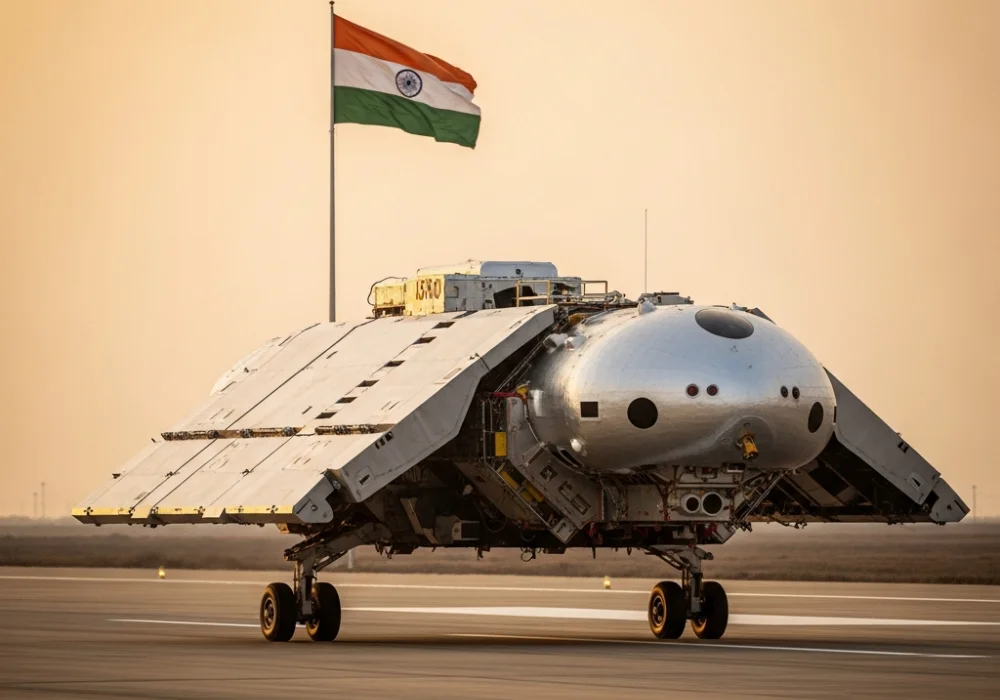
Introduction: The Paradigm Shift in Space Exploration
For decades, space exploration was defined by the ‘disposable’ model. Rockets were multi-million dollar architectural marvels designed to fly once and discard their stages into the ocean or burn up in the atmosphere. However, the advent of Reusable Launch Vehicles (RLVs) has fundamentally altered this trajectory. For a UPSC aspirant, understanding the science and geopolitics of reusability is essential, as it directly impacts India’s strategic autonomy and its 2030 space ambitions. Reusability is not just a feat of engineering; it is the cornerstone of the New Space Policy 2023, aimed at making space travel affordable, sustainable, and frequent.
💡 Why Reusability Matters for UPSC Prelims
Questions regarding Space Technology often focus on the ‘why’ and ‘how’. Reusability directly addresses the ‘Cost of Access to Space’. Reducing the cost from approximately $20,000 per kg to under $2,000 per kg is the primary driver for missions like Gaganyaan and the Indian Space Station (Bharatiya Antariksha Station).
1. The Technological Spectrum: VTVL vs. VTHL
In the domain of reusable rockets, two primary landing philosophies exist. Understanding these is critical for the Science & Tech section of GS Paper III.
- Vertical Take-off, Vertical Landing (VTVL): Pioneered by companies like SpaceX (Falcon 9) and Blue Origin (New Shepard). The rocket uses its engines to decelerate and land vertically on a designated pad or drone ship. This requires high-precision thrusters and significant fuel reserves (propellant margins).
- Vertical Take-off, Horizontal Landing (VTHL): This approach involves a rocket that launches like a traditional vehicle but returns to Earth like an airplane, landing on a runway. This is the model adopted by NASA’s retired Space Shuttle and ISRO’s current Pushpak (RLV-TD) program.
The choice between VTVL and VTHL depends on the mission profile, payload requirements, and the desired refurbishment time. While VTVL is often more fuel-intensive for landing, VTHL requires heavy wings and landing gear that reduce the initial payload capacity.
2. ISRO’s ‘Pushpak’: India’s Strategic Leap
The Indian Space Research Organisation (ISRO) is currently developing its own reusable launch vehicle, nicknamed Pushpak. This project is a series of technology demonstration (TD) missions designed to perfect the art of horizontal landing.
Key Milestones in ISRO’s RLV Program:
- HEX (Hypersonic Flight Experiment – 2016): Demonstrated the vehicle’s ability to survive hypersonic speeds during re-entry using heat shields.
- LEX (Landing Experiment – 2023 & 2024): In these experiments, the RLV was dropped from a Chinook helicopter and successfully performed an autonomous landing on a runway at Chitradurga, Karnataka. This proved the sophisticated navigation, guidance, and control (NGC) systems.
- OREX (Orbital Re-entry Experiment): The future phase where the vehicle will be launched into orbit and brought back to land on a runway.
💡 Pro-Tip: The ‘Scramjet’ Connection
ISRO is also experimenting with Air-Breathing Propulsion (Scramjets). Integrating reusability with Scramjet technology could further reduce launch costs by using atmospheric oxygen during the ascent, significantly reducing the oxidizer weight the rocket must carry.
3. Economic and Environmental Implications
From a Mains perspective (GS Paper III: Economy and Environment), reusability offers a dual advantage. Firstly, the Space Economy: India aims to increase its share in the global space market from 2% to 10% by 2030. Reusable rockets allow for high-frequency launches, enabling India to offer competitive pricing for commercial satellite launches (e.g., via NewSpace India Limited – NSIL).
Secondly, the Environmental Impact: Every expendable rocket adds to the growing problem of ‘Orbital Debris’ or Space Junk. While the first stages fall back to Earth, upper stages often remain in orbit, threatening active satellites. Reusable vehicles are designed to return entirely, mitigating the risk of the Kessler Syndrome—a catastrophic cascade of collisions in Low Earth Orbit (LEO).
4. Challenges in Achieving Full Reusability
Despite the successes of SpaceX, full reusability remains an elusive ‘Holy Grail’. Aspirants should be aware of the following technical barriers:
- Thermal Protection Systems (TPS): Upon re-entry, temperatures can exceed 1,500°C. Developing lightweight tiles or shields that can withstand these heats repeatedly without replacement is incredibly difficult.
- The Payload Penalty: Carrying landing gear, extra fuel for landing burns, and wings (for VTHL) reduces the amount of satellite weight a rocket can carry into orbit.
- Refurbishment Costs: If it takes 6 months and millions of dollars to fix a ‘reusable’ rocket after flight, the economic benefit is lost. The goal is ‘Rapid Refurbishment’.
5. UPSC Interactive Mock Quiz
Test your knowledge with these high-difficulty Prelims-style questions. Focus on the nuances!
Q1. With reference to ISRO’s Reusable Launch Vehicle (RLV-TD), consider the following statements:
- It is a two-stage-to-orbit (TSTO) vehicle designed for vertical landing.
- The LEX experiment successfully demonstrated the autonomous landing of the vehicle on a runway.
- It utilizes an Air-Breathing Scramjet engine during its entire flight profile.
Which of the statements given above is/are correct?
- A) 2 only
- B) 1 and 2 only
- C) 2 and 3 only
- D) 1, 2 and 3
✅ Click to Reveal Answer & Deep Explanation
Correct Answer: A) 2 only
Statement 1 is incorrect because RLV-TD is designed for horizontal landing (VTHL), not vertical landing. Statement 2 is correct; the LEX (Landing Experiment) specifically tested autonomous runway landing. Statement 3 is incorrect because while ISRO is developing Scramjets, the current RLV-TD is a technology demonstrator that primarily uses conventional rocket motors; Scramjets would only operate in specific atmospheric phases, not the entire flight profile.
Q2. What is the primary significance of ‘Kessler Syndrome’ in the context of reusable space technology?
- A) The economic collapse of space agencies due to high launch costs.
- B) A cascade of collisions between space objects making orbits unusable.
- C) The physiological impact of long-term zero gravity on human health.
- D) The failure of thermal protection systems during re-entry.
✅ Click to Reveal Answer & Deep Explanation
Correct Answer: B) A cascade of collisions between space objects making orbits unusable.
Kessler Syndrome is a theoretical scenario where the density of objects in Low Earth Orbit (LEO) is high enough that collisions between objects could cause a cascade in which each collision generates space debris that increases the likelihood of further collisions. Reusable rockets help mitigate this by ensuring stages return to Earth rather than staying in orbit.
Q3. Consider the following pairs of Rocket Technology and their Landing Methods:
1. Falcon 9 : Vertical Landing (VTVL)
2. Space Shuttle : Horizontal Landing (VTHL)
3. ISRO Pushpak : Vertical Landing (VTVL)
Which of the pairs given above is/are correctly matched?
- A) 1 only
- B) 1 and 2 only
- C) 2 and 3 only
- D) 1, 2 and 3
✅ Click to Reveal Answer & Deep Explanation
Correct Answer: B) 1 and 2 only
Falcon 9 is famous for its vertical landings on pads and ships. The Space Shuttle was a glider that landed horizontally on a runway. ISRO’s Pushpak (RLV-TD) is specifically designed for horizontal landing (VTHL) on a runway, mirroring the Space Shuttle’s landing style, making pair 3 incorrect.
Q4. With reference to the ‘New Space Policy 2023’, which of the following is a primary objective?
- A) Nationalization of all private space startups.
- B) Ending international cooperation in space technology.
- C) Encouraging private sector participation across the entire value chain of the space economy.
- D) Shifting focus exclusively from satellite technology to planetary exploration.
✅ Click to Reveal Answer & Deep Explanation
Correct Answer: C) Encouraging private sector participation across the entire value chain of the space economy.
The New Space Policy 2023 seeks to transition ISRO from a manufacturer to a research and development body while empowering the private sector (Non-Governmental Entities) to handle satellite launches, ownership, and application services, where reusable rockets will play a vital role in cost reduction.
Q5. Which material is most commonly used for the thermal protection systems (TPS) in reusable vehicles to withstand re-entry heat?
- A) Pure Iron and Steel alloys.
- B) Carbon-Carbon composites and Ceramic tiles.
- C) Synthetic High-Density Polyethylene (HDPE).
- D) Liquid Nitrogen cooling jackets.
✅ Click to Reveal Answer & Deep Explanation
Correct Answer: B) Carbon-Carbon composites and Ceramic tiles.
Re-entry generates immense heat through air friction. Conventional metals would melt. Reinforced Carbon-Carbon (RCC) and specialized ceramic tiles (silica-based) are used because they have extremely low thermal conductivity and can dissipate heat while maintaining structural integrity.
🚀 Ready to Ace your UPSC Journey?
Join our exclusive guidance program and get personalized mentorship for GS Science & Technology and Current Affairs.
💬 Chat with our Experts on WhatsApp (+91 9526806124)




