
1. Introduction: India’s Giant Leap in Lunar Exploration
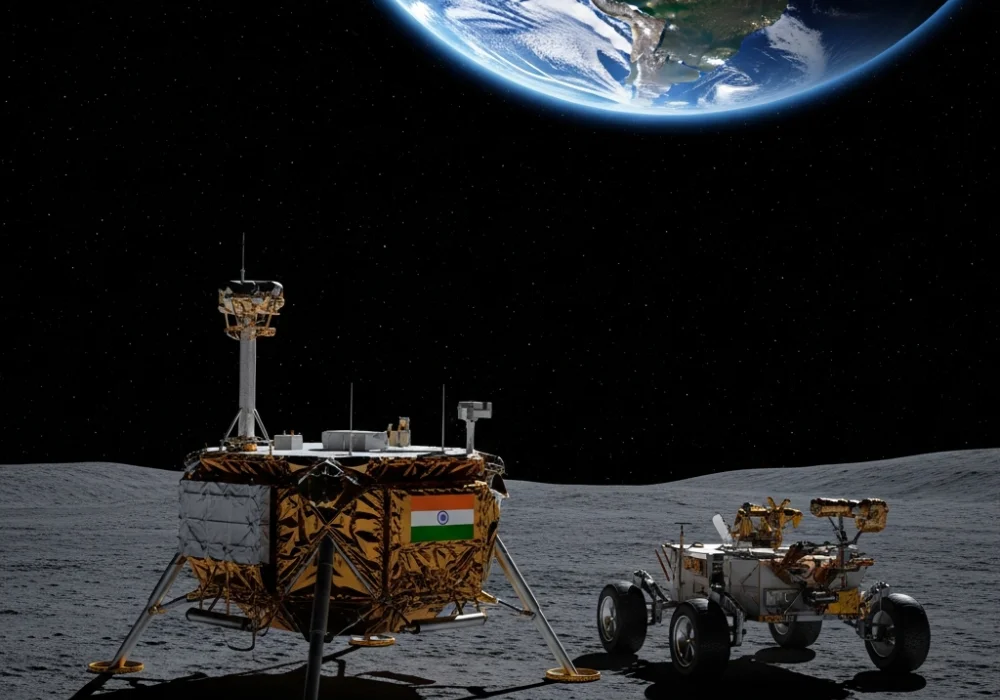
The success of the Chandrayaan-3 mission on August 23, 2023, marked a watershed moment in the history of the Indian Space Research Organisation (ISRO) and the global space community. For the UPSC aspirant, this mission is not merely a scientific achievement but a testament to India’s growing ‘Soft Power’ and technological ‘Atmanirbharta’ (self-reliance). Chandrayaan-3 made India the fourth country to achieve a soft landing on the lunar surface—joining the elite club of the USA, Russia, and China—and notably, the first-ever nation to land in the proximity of the Lunar South Pole. This mission is a direct follow-on to Chandrayaan-2, aimed at demonstrating end-to-end capability in safe landing and roving on the lunar surface.
💡 UPSC Pro-Tip: The ‘Why’ behind the South Pole
UPSC often asks about the logic of exploration sites. The Lunar South Pole is critical because of its ‘Permanently Shadowed Regions’ (PSRs) where temperatures are extremely low. These areas are believed to harbor water ice, which could provide clues about the early solar system and serve as a resource (fuel and water) for future human colonization.
2. Mission Architecture and Technical Specifications
Chandrayaan-3 was launched using the LVM3-M4 (Launch Vehicle Mark-III), formerly known as GSLV Mk-III. This ‘Fat Boy’ of ISRO is a three-stage heavy-lift launch vehicle consisting of two solid strap-on motors (S200), one liquid core stage (L110), and a high-thrust cryogenic upper stage (C25). Unlike its predecessor, Chandrayaan-3 followed a ‘failure-based design’ philosophy. This meant ISRO engineers anticipated what could go wrong and built redundancies into the system.
The mission consisted of three primary modules: 1. The Propulsion Module: Its primary role was to carry the Lander and Rover from injection orbit to a 100km circular polar lunar orbit. It also carried a scientific payload called SHAPE. 2. The Lander (Vikram): Named after Dr. Vikram Sarabhai, it was designed for a soft landing. It possessed four landing legs and four landing thrusters (800 Newtons each). 3. The Rover (Pragyan): A 26kg, six-wheeled robotic vehicle designed to explore the lunar surface and conduct in-situ chemical analysis.
3. Scientific Payloads: Decoding the Instruments
For the GS Paper III (Science & Technology), understanding the specific scientific objectives of each payload is crucial. Each instrument was meticulously chosen to maximize data collection during the 14-earth-day (one lunar day) mission life.
- RAMBHA-LP (Radio Anatomy of Moon Bound Hypersensitive Ionosphere and Atmosphere – Langmuir Probe): To measure the near-surface plasma density and its changes with time.
- ChaSTE (Chandra’s Surface Thermo-physical Experiment): To carry out measurements of the thermal properties of the lunar surface near the polar region.
- ILSA (Instrument for Lunar Seismic Activity): To measure seismicity around the landing site and delineating the structure of the lunar crust and mantle.
- APXS (Alpha Particle X-ray Spectrometer): Carried by the Rover to determine the elemental composition (Magnesium, Aluminum, Silicon, Potassium, Calcium, Titanium, Iron) of the lunar soil and rocks.
- LIBS (Laser Induced Breakdown Spectroscopy): To derive the chemical composition and infer mineralogical composition. It notably confirmed the presence of Sulphur on the lunar surface.
- SHAPE (Spectro-polarimetry of Habitable Planet Earth): Located on the Propulsion Module, it studies the Earth’s spectro-polarimetric signatures to help identify similar signatures in exoplanets that could host life.
4. Strategic and Geopolitical Significance
The success of Chandrayaan-3 is not just a scientific victory; it is a geopolitical statement. By signing the Artemis Accords just months before the landing, India aligned itself with a US-led international vision for lunar exploration. This mission proves India’s cost-effective space engineering—costing roughly $75 million, which is significantly lower than many Hollywood space movies. This makes India a preferred partner for commercial satellite launches and collaborative missions like the upcoming LUPEX (Lunar Polar Exploration) mission with Japan’s JAXA.
💡 Key Fact for Prelims: Nomenclature
Prime Minister Modi announced that the spot where Chandrayaan-3 landed will be known as ‘Shiv Shakti Point’, while the site where Chandrayaan-2’s lander crashed in 2019 will be called ‘Tiranga Point’. August 23 is now celebrated as ‘National Space Day’.
5. Evolution: From Chandrayaan-2 to Chandrayaan-3
The transition from the partial success of Chandrayaan-2 to the total success of Chandrayaan-3 highlights ISRO’s resilient engineering culture. Key improvements included: 1. Expanded Landing Area: The landing zone was increased from 500m x 500m to 4km x 2.4km. 2. Enhanced Fuel: The lander was equipped with more fuel to handle longer-distance travel to the landing site or for alternate landing site selection. 3. Structural Rigidity: The lander’s legs were strengthened to ensure stability even at higher landing speeds. 4. Removal of the 5th Engine: The central engine used in Chandrayaan-2 was removed to simplify the control logic during the ‘fine braking’ phase.
UPSC Interactive Mock Quiz
Q1. With reference to the LVM3-M4 launch vehicle used in Chandrayaan-3, consider the following statements: 1. It is a four-stage launch vehicle. 2. It utilizes two solid strap-on motors for initial thrust. 3. The uppermost stage is powered by a cryogenic engine. Which of the statements given above is/are correct?
- A) 1 and 2 only
- B) 2 and 3 only
- C) 3 only
- D) 1, 2 and 3
✅ Click to Reveal Answer & Deep Explanation
Correct Answer: B) 2 and 3 only
Statement 1 is incorrect because LVM3 is a three-stage launch vehicle (Solid, Liquid, Cryogenic), not four. Statement 2 is correct as it uses S200 solid boosters. Statement 3 is correct as the C25 stage is a cryogenic stage using liquid oxygen and liquid hydrogen.
Q2. Which of the following payloads of Chandrayaan-3 is specifically designed to study Earth from the lunar orbit?
- A) ChaSTE
- B) ILSA
- C) SHAPE
- D) RAMBHA
✅ Click to Reveal Answer & Deep Explanation
Correct Answer: C) SHAPE
SHAPE (Spectro-polarimetry of Habitable Planet Earth) is located on the Propulsion Module. Its objective is to study the spectro-polarimetric signatures of Earth in the near-infrared wavelength range to understand how to detect habitability on distant exoplanets.
Q3. The presence of which chemical element was unambiguously confirmed by the Laser-Induced Breakdown Spectroscopy (LIBS) instrument on the Pragyan rover?
- A) Helium-3
- B) Sulphur
- C) Nitrogen
- D) Chlorine
✅ Click to Reveal Answer & Deep Explanation
Correct Answer: B) Sulphur
ISRO confirmed that the LIBS instrument found clear evidence of Sulphur. Finding Sulphur is significant because it is typically associated with volcanic activity or lunar core processes and was not easily detectable by previous orbital remote sensing.
Q4. Consider the following statements regarding the ‘Shiv Shakti’ point: 1. It is the designated landing site for Chandrayaan-3. 2. It is located in the northern hemisphere of the Moon. 3. The naming was approved by the International Astronomical Union (IAU). Which of the statements given above is/are correct?
- A) 1 only
- B) 1 and 3 only
- C) 2 and 3 only
- D) 1, 2 and 3
✅ Click to Reveal Answer & Deep Explanation
Correct Answer: B) 1 and 3 only
Statement 1 is correct. Statement 2 is incorrect because the landing site is near the South Pole (Southern Hemisphere). Statement 3 is correct as the IAU officially approved the name ‘Statio Shiv Shakti’ for the landing site in early 2024.
Q5. What is the mission life of the Vikram lander and Pragyan rover on the lunar surface?
- A) 1 Earth Year
- B) 1 Lunar Day (approx. 14 Earth days)
- C) 28 Earth days
- D) Indefinite, powered by RTGs
✅ Click to Reveal Answer & Deep Explanation
Correct Answer: B) 1 Lunar Day (approx. 14 Earth days)
The mission was designed to operate for one lunar day because the lander and rover are solar-powered and do not have thermal protection (like RTGs) to survive the extremely cold lunar night (-230°C).
Confused about Space-Tech or Science Prep?
Our UPSC experts are here to help you navigate through complex concepts with personalized mentorship.
💬 Chat with our Experts on WhatsApp (+91 9526806124)




