
The Universe’s Silent Ruler
Have you ever wondered how astronomers accurately measure the vast distances to stars, light-years away from Earth? It seems like an impossible task, yet there’s an ingenious, fundamental principle at play, a cosmic trick called Stellar Parallax. For aspirants preparing for demanding competitive examinations like SSC, UPSC, PSC, NID, NIFT, and other government roles, understanding this core concept isn’t just about astronomy; it’s about grasping a foundational element of scientific measurement and general knowledge that frequently appears in exams. You can build a strong foundation with our comprehensive static gk guide.
What is Stellar Parallax? A Simple Cosmic Shift
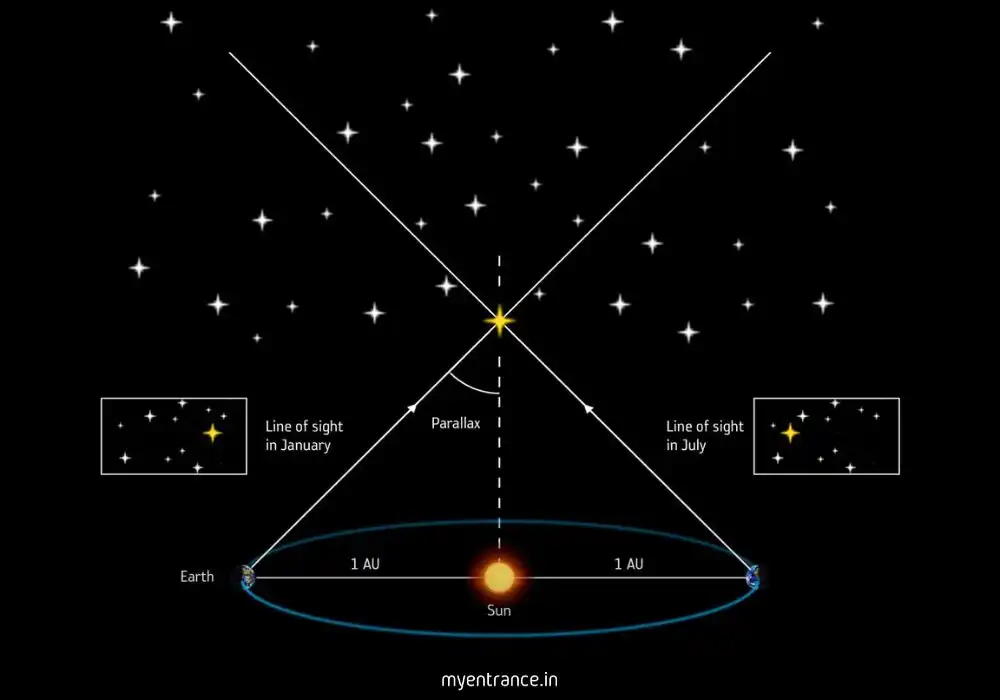
At its heart, Stellar Parallax describes the apparent shift in the position of a nearby star when viewed from two different points in Earth’s orbit around the Sun. Imagine holding a finger up close to your face and alternately closing one eye then the other; your finger seems to jump against the distant background. Stars, too, appear to “jump” or shift their position, not because they are physically moving, but because our viewpoint, Earth, is constantly moving. This perceived change in position against much more distant, fixed background stars is what we call stellar parallax. It’s a fundamental observational effect, crucial for understanding our place in the cosmos.
Why is Measuring Star Distances So Important?
The ability to precisely measure the distance to stars is not merely an academic exercise; it’s the bedrock of modern astronomy. Knowing how far away a star is allows scientists to determine its true luminosity, its size, and even its age. Without accurate distance measurements, our understanding of stellar evolution, the structure of our galaxy, and indeed, the entire universe, would be severely limited. For competitive exams, questions about celestial distances, astronomical units, and the methods used to determine them are common. Grasping stellar parallax unlocks a deeper appreciation for the scientific process and provides crucial context for related topics in general science and current affairs sections.
How Does Stellar Parallax Work? Earth’s Orbital Baseline
The “how” behind stellar parallax is elegantly simple, relying on Earth’s annual journey around the Sun. To measure a star’s parallax, astronomers observe its position against a background of much more distant stars at a specific point in Earth’s orbit. Six months later, when Earth has moved to the exact opposite side of its orbit – a colossal baseline of approximately 300 million kilometers (twice the Earth-Sun distance) – they observe the same star again. The star, due to our change in perspective, will appear to have shifted slightly. This tiny angular difference, the parallax angle, is then used in a simple trigonometric calculation. The larger the shift (or angle), the closer the star. Conversely, a smaller, almost imperceptible shift indicates a more distant star. This method acts like a cosmic triangulation, allowing us to build a three-dimensional map of our stellar neighborhood.
Calculating Distances: The Tiny Angles and Cosmic Units
The angles involved in stellar parallax are incredibly small, often measured in arcseconds, which are tiny fractions of a degree (one degree equals 3600 arcseconds!). To simplify these vast distances, astronomers use a special unit derived from parallax: the “parsec.” One parsec is defined as the distance at which a star would have a parallax angle of one arcsecond. To put it in perspective, one parsec is roughly equivalent to 3.26 light-years. The mathematical relationship is inverse: the distance to a star is inversely proportional to its parallax angle. This means that if a star has a parallax of 0.5 arcseconds, it is two parsecs away. This direct, inverse relationship makes stellar parallax a powerful and precise tool for charting the nearby universe.
The Reach and Limits of Stellar Parallax
While immensely valuable, stellar parallax is primarily effective for measuring the distances to relatively nearby stars. As stars get further away, their parallax angles become exceedingly small – too tiny for even the most powerful telescopes to accurately measure. Beyond a certain distance, typically a few hundred parsecs from Earth, the parallax method becomes unreliable. This is why astronomers have developed other techniques for gauging the distances to more remote galaxies and objects, building upon the foundational understanding provided by stellar parallax. Nevertheless, for our immediate stellar neighborhood, from our Sun to stars thousands of light-years away, stellar parallax remains the most direct and accurate method available. Studying this concept gives you a solid foundation for more advanced topics in space science and enhances your general knowledge preparation. Ensure you’ve covered everything with our final hour exam preparation checklist.





