
Prime Minister Narendra Modi and his Israeli counterpart Benjamin Netanyahu recently engaged in a crucial phone conversation, reaffirming their commitment to fortify the India-Israel Strategic Partnership. This high-level dialogue underscores the evolving depth of a relationship guided by shared democratic values, profound mutual trust, and an ambitious forward-looking vision for the future. For students preparing for competitive examinations, understanding the multifaceted dimensions of this partnership is not just about current events, but about grasping a significant pillar of India’s foreign policy and its implications on global dynamics.
Why the India-Israel Partnership Matters Deeply for India
The strategic alliance between India and Israel is born out of a confluence of mutual interests and shared challenges in an increasingly complex global landscape. Both nations, vibrant democracies navigating diverse regional dynamics, recognize the immense value in close cooperation. For India, this partnership is crucial for several reasons: it provides access to cutting-edge technology, particularly in defense, agriculture, and water management, which are vital for national security and sustainable development. Geopolitically, diversifying India’s partnerships in West Asia enhances its strategic autonomy and influence, while also presenting a united front against common threats. Moreover, the robust economic complementarities between the two nations offer pathways for innovation, trade, and investment, contributing significantly to India’s growth trajectory.
Core Pillars: What Defines This Strategic Alliance?
The foundation of the India-Israel Strategic Partnership rests firmly on shared democratic values and a deep, abiding mutual trust that has grown stronger over decades. This trust enables open discussions on sensitive matters and fosters cooperation across a wide spectrum of sectors. One of the most prominent pillars is defense and security cooperation, which includes intelligence sharing, joint military exercises, and the procurement of advanced defense equipment. Integral to this is a reiterated commitment to a “zero-tolerance” approach towards terrorism, signifying a shared resolve to combat this global menace through concerted efforts and information exchange.
Beyond security, the partnership extends robustly into critical areas like agriculture, where Israeli expertise in arid farming, drip irrigation, and water conservation technologies has significantly benefited India’s agricultural sector. Similarly, in science and technology, both countries collaborate on research and development, cybersecurity, and innovation, reflecting their shared vision for a knowledge-driven economy. The burgeoning people-to-people connect, encompassing cultural exchange, tourism, and academic collaborations, further solidifies the bond, moving beyond governmental ties to encompass societal engagement.
Evolution of Engagement: When Did Ties Strengthen?
While diplomatic relations were officially established in 1992, the India-Israel partnership truly began to blossom and take on a strategic character in the 21st century. Key visits have marked significant turning points, none more so than Prime Minister Modi’s historic visit to Israel in 2017, the first by an Indian Prime Minister. This visit elevated the relationship to a strategic partnership and moved it out of the shadows, making it overtly and proudly celebrated. This was reciprocated by then-Prime Minister Netanyahu’s visit to India in 2018. These high-level interactions, alongside numerous ministerial and official exchanges, have systematically expanded the scope and depth of cooperation, fostering an environment of proactive engagement rather than reactive diplomacy.
Forging Ahead: How is the Partnership Being Reinforced?
The recent conversation between Prime Minister Modi and Prime Minister Netanyahu serves as a testament to the ongoing and dynamic nature of this partnership. During their discussion, both leaders identified specific “shared priorities” aimed at further strengthening the strategic partnership. This involves not only consolidating existing areas of cooperation but also exploring new frontiers. The “forward-looking vision” articulated in their dialogue points towards future collaborations in emerging technologies, renewable energy, and critical infrastructure, aligning with India’s national development goals and Israel’s innovation prowess. Initiatives like the I2U2 Group (India, Israel, UAE, USA) further exemplify how bilateral trust can extend into multilateral frameworks, demonstrating a shared commitment to regional stability and economic prosperity. Continuous high-level dialogues and joint working groups are mechanisms through which specific projects and initiatives are conceptualized, implemented, and monitored, ensuring sustained progress.
Broader Impact: The Significance for India and Global Politics
The robust India-Israel Strategic Partnership holds profound implications for India’s foreign policy and its role on the global stage. It represents a successful example of non-alignment evolving into multi-alignment, where India forges strong ties based on mutual benefit and shared values, irrespective of historical baggage or traditional blocs. This alliance enhances India’s capabilities in critical sectors, strengthens its national security apparatus, and provides valuable diplomatic leverage. Globally, this partnership, especially within the wider Indo-Pacific and West Asian contexts, contributes to regional stability, counter-terrorism efforts, and fosters economic growth through technological innovation. For competitive exam aspirants, understanding this relationship transcends mere facts, offering insights into complex international relations, strategic decision-making, and the dynamic interplay of global powers.
Frequently Asked Questions
1. What are the primary drivers of the India-Israel Strategic Partnership?
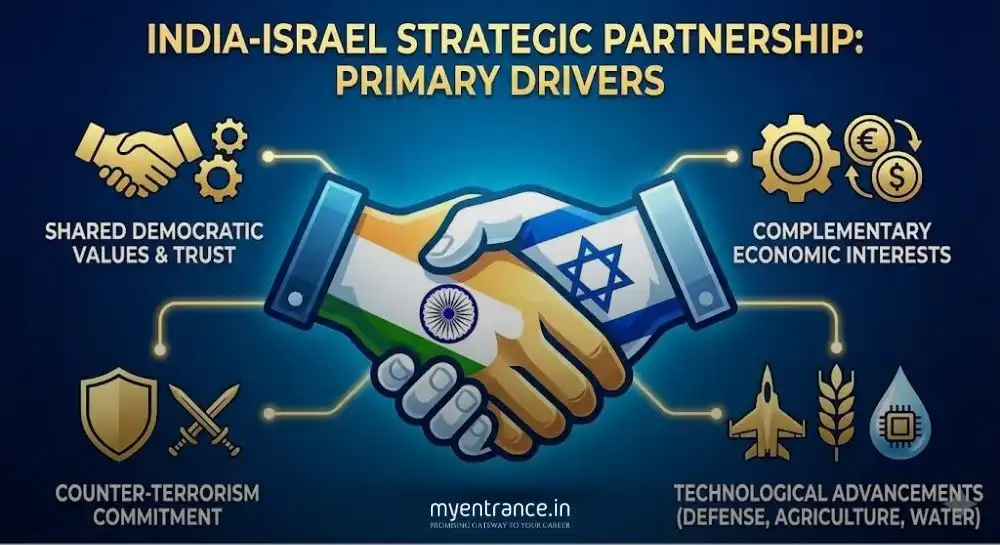
The primary drivers of the India-Israel Strategic Partnership include shared democratic values, a deep mutual trust, complementary economic interests, and a common commitment to counter-terrorism. Both nations seek technological advancements for national development and security, making cooperation in defense, agriculture, water management, and technology particularly attractive and fruitful.
2. How do both nations demonstrate a ‘zero-tolerance’ approach in their partnership?
India and Israel demonstrate a ‘zero-tolerance’ approach by actively collaborating on counter-terrorism initiatives. This includes intelligence sharing, joint training exercises for security forces, and discussions on strategies to combat extremist ideologies and cross-border terrorism. Their shared commitment reflects a recognition of terrorism as a global threat requiring unified action.
3. Beyond defense, what other crucial areas of cooperation exist between India and Israel?
Beyond defense, crucial areas of cooperation include agriculture, where Israeli technologies like drip irrigation and water recycling are vital for India; science and technology, encompassing research and development, cybersecurity, and innovation; and water management, focusing on sustainable solutions. People-to-people exchanges, cultural programs, and tourism also form significant aspects of their engagement.
4. What is the significance of the “shared democratic values” mentioned in the context of this partnership?
The “shared democratic values” signify that both India and Israel operate under democratic systems, upholding principles of freedom, rule of law, and pluralism. This shared ideological foundation fosters mutual understanding, trust, and alignment on various international issues, providing a stable bedrock for their strategic cooperation despite geographical distances and regional complexities.
5. How does this bilateral relationship contribute to India’s broader foreign policy objectives?
This bilateral relationship significantly contributes to India’s broader foreign policy objectives by diversifying its strategic partnerships, providing access to critical technologies, and enhancing its geopolitical influence in West Asia and beyond. It exemplifies India’s pragmatic multi-alignment strategy, strengthening its national security, economic growth, and diplomatic standing on the global stage.





