
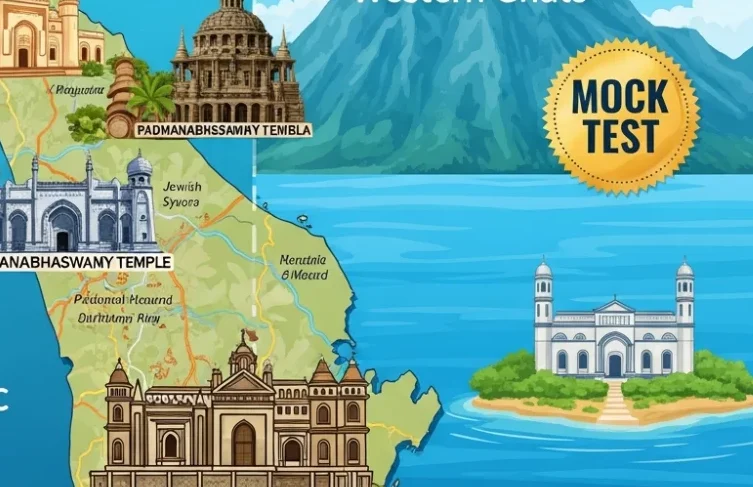
Introduction: The Importance of Kerala History and Geography
For any aspirant aiming to clear the Kerala Public Service Commission (PSC) examinations, the dual pillars of Kerala History and Kerala Geography are non-negotiable. These subjects form the foundational bedrock of the General Knowledge paper, often accounting for a significant percentage of the total marks. History provides insights into the socio-political evolution of the state, from the ancient Sangam period and the reign of the Perumals to the heroic struggles of the Kerala Renaissance and the Indian Independence movement. Geography, on the other hand, demands a precise understanding of the state’s unique physiography, its intricate river systems, climate patterns, and biodiversity. Mastering these topics not only helps you score high in the preliminary exams but also gives you a critical edge in the mains and interview rounds. This mock test is meticulously designed by experts at MyEntrance to challenge your conceptual clarity and factual recall, ensuring you are prepared for the most difficult questions the commission might throw your way.
💡 Pro-Tip for PSC Aspirants
When studying Geography, always use a map-based approach. Locate the 44 rivers and their tributaries visually. For History, create a timeline of the Kerala Renaissance leaders like Sree Narayana Guru and Chattampi Swamikal to avoid chronological confusion.
Section 1: Kerala Geography Challenge
Test your knowledge of the ‘God’s Own Country’ landscape.
- Which of the following peaks is the highest point in Kerala and the Western Ghats?
- A) Agasthyarkoodam
- B) Anamudi
- C) Meesapulimala
- D) Chembra Peak
- The river Periyar, often called the ‘Lifeline of Kerala’, originates from which range?
- A) Anamalai Hills
- B) Agasthyamala
- C) Sivagiri Hills
- D) Nilgiri Hills
- Which is the largest backwater (Kayal) in Kerala?
- A) Ashtamudi Lake
- B) Sasthamkotta Lake
- C) Vembanad Lake
- D) Pookode Lake
- In terms of physiography, the ‘Midland’ region of Kerala lies at an elevation of:
- A) 0 to 7.5 meters
- B) 7.5 to 75 meters
- C) 75 to 150 meters
- D) Above 150 meters
- Which district in Kerala has the longest coastline?
- A) Alappuzha
- B) Malappuram
- C) Kannur
- D) Ernakulam
- Which of the following is the only east-flowing river among the three mentioned in Kerala’s geography textbooks?
- A) Kabani
- B) Bharathappuzha
- C) Chalakudy River
- D) Pamba
- Silent Valley National Park is situated in which district?
- A) Idukki
- B) Palakkad
- C) Wayanad
- D) Pathanamthitta
- The ‘Palakkad Gap’ is a low mountain pass in the Western Ghats between which two ranges?
- A) Nilgiri Hills and Anaimalai Hills
- B) Cardamom Hills and Pandalam Hills
- C) Agasthyamala and Sivagiri Hills
- D) Wayanad Hills and Coorg Hills
Section 2: Kerala History Challenge
Dive into the rich heritage and revolutionary past of Kerala.
- Who was the leader of the ‘Ezhava Memorial’ submitted to the Maharaja of Travancore in 1896?
- A) Dr. Palpu
- B) G.P. Pillai
- C) Kumaranasan
- D) T.K. Madhavan
- The famous ‘Channar Revolt’ (Maru Marakkal Samaram) primarily fought for what right?
- A) Right to enter temples
- B) Right of lower-caste women to cover their upper bodies
- C) Right to walk on public roads
- D) Right to education
- Which Portuguese explorer arrived at Kappad, Kozhikode, in 1498?
- A) Pedro Álvares Cabral
- B) Francisco de Almeida
- C) Afonso de Albuquerque
- D) Vasco da Gama
- The ‘Kundara Proclamation’ of 1809 was issued by:
- A) Pazhassi Raja
- B) Velu Thampi Dalawa
- C) Paliath Achan
- D) Sakthan Thampuran
- Who founded the ‘Sadhujana Paripalana Yogam’ in 1907?
- A) Ayyankali
- B) Sahodaran Ayyappan
- C) Vakkom Moulavi
- D) Pandit Karuppan
- In which year did the Vaikom Satyagraha begin?
- A) 1921
- B) 1924
- C) 1931
- D) 1936
- The ‘Temple Entry Proclamation’ was issued by Sri Chithira Thirunal Balarama Varma in which year?
- A) 1924
- B) 1932
- C) 1936
- D) 1947
- Who is known as the ‘Lincoln of Kerala’ for his work against untouchability?
- A) Sree Narayana Guru
- B) K. Kelappan
- C) Pandit Karuppan
- D) Ayyankali
Answer Key & Detailed Explanations
Reviewing your mistakes is the fastest way to learn. Here are the in-depth explanations for each question.
Anamudi is located in the Idukki district and stands at an elevation of 2,695 meters. It is the highest peak in India south of the Himalayas and is often referred to as the ‘Everest of South India’. It is part of the Eravikulam National Park and represents the junction of the Anaimalai, Palani, and Cardamom hills.
The Periyar River is the longest river in Kerala with a length of 244 km. It originates from the Sivagiri Hills in the Sundaramala region of the Western Ghats. It flows through the Idukki and Ernakulam districts, providing water for drinking and electricity generation (Idukki Arch Dam) before emptying into the Arabian Sea.
Vembanad Lake is the longest lake in India and the largest in Kerala, spanning multiple districts including Alappuzha, Kottayam, and Ernakulam. It hosts the famous Nehru Trophy Boat Race and is a designated Ramsar site due to its immense ecological importance.
Kerala is divided into three distinct physiographic zones: the Highlands (above 75m), the Midlands (7.5m to 75m), and the Lowlands (coastal plains below 7.5m). The Midland region is characterized by undulating hills and valleys, where most of Kerala’s commercial crops like rubber and pepper are grown.
Kannur district has the longest coastline in Kerala, stretching approximately 82 km. It is followed by Alappuzha. These coastal regions are vital for Kerala’s fishing industry and tourism, featuring famous beaches like Muzhappilangad, the only drive-in beach in Kerala.
Out of the 44 rivers in Kerala, 41 are west-flowing and 3 are east-flowing. The east-flowing rivers are the Kabani, Bhavani, and Pambar. These rivers flow into the neighboring states of Karnataka and Tamil Nadu and are tributaries of the Kaveri River.
Silent Valley National Park is located in the Nilgiri Hills of Palakkad district. It is famous for its rare lion-tailed macaques and its untouched tropical evergreen forest. The ‘Save Silent Valley’ movement in the 1970s was a landmark event in India’s environmental history.
The Palakkad Gap is a major break in the Western Ghats, roughly 32 km wide. It facilitates the movement of winds (like the Southwest Monsoon) and trade between Kerala and Tamil Nadu. It sits between the Nilgiri Hills to the north and the Anaimalai Hills to the south.
The Ezhava Memorial was a mass petition signed by 13,176 members of the Ezhava community and submitted to the Maharaja of Travancore in 1896. Led by Dr. Palpu, it demanded government representation and jobs for the community, which were previously denied despite their educational qualifications.
The Channar Revolt occurred in the 19th century in the Princely State of Travancore. It was a struggle by Nadar (Channar) women to wear clothes that covered their breasts, a right previously reserved only for upper-caste women. It is considered one of the earliest social reform movements in Kerala.
Vasco da Gama’s arrival in 1498 marked the beginning of the colonial era in India. He landed at Kappad beach near Kozhikode (Calicut) and was received by the Zamorin. This discovery of a direct sea route to India shifted the balance of global trade power from the Mediterranean to the Atlantic.
Velu Thampi Dalawa, the Prime Minister (Dalawa) of Travancore, issued the Kundara Proclamation on January 11, 1809. It was a clarion call to the people to rise against the British East India Company’s interference in the state’s internal affairs and remains a symbol of early anti-colonial resistance.
Ayyankali, a prominent social reformer, founded the Sadhujana Paripalana Yogam (Association for the Protection of the Poor) in 1907. He fought for the rights of the Dalits (Pulayas), including the right to walk on public roads and the right for Dalit children to attend schools.
The Vaikom Satyagraha (1924–25) was a non-violent protest against untouchability and the prohibition of lower castes from using the roads leading to the Vaikom Temple. It was the first organized agitation in Kerala for human rights and saw participation from leaders like T.K. Madhavan and K. Kelappan.
Issued on November 12, 1936, the Temple Entry Proclamation was a landmark decree by Maharaja Sri Chithira Thirunal Balarama Varma. It abolished the ban on ‘low-caste’ Hindus from entering temples controlled by the Travancore government, a monumental victory for the Kerala Renaissance.
Ayyankali was famously hailed as the ‘Lincoln of Kerala’ (by some historians and social observers) because of his radical efforts to emancipate the oppressed classes. He organized the first strike by agricultural laborers in Kerala to demand educational rights for Dalit children.
Frequently Asked Questions (FAQ)
❓ Which is the smallest river in Kerala?
The Manjeswaram River is considered the smallest river in Kerala, with a length of only 16 km, flowing through the Kasaragod district.
❓ Who is known as the Father of the Kerala Renaissance?
Sree Narayana Guru is widely regarded as the Father of the Kerala Renaissance for his message of ‘One Caste, One Religion, One God for Mankind’ and his revolutionary consecration of the Aruvikkara Shiva temple.
Need More Help with Your Preparation?
Success in Kerala PSC requires consistent practice and expert mentorship. If you have doubts about any topic or need access to more free mock tests and study materials, our experts are here to guide you 24/7!
💬 Chat with our Experts on WhatsApp (+91 9526806124)




