
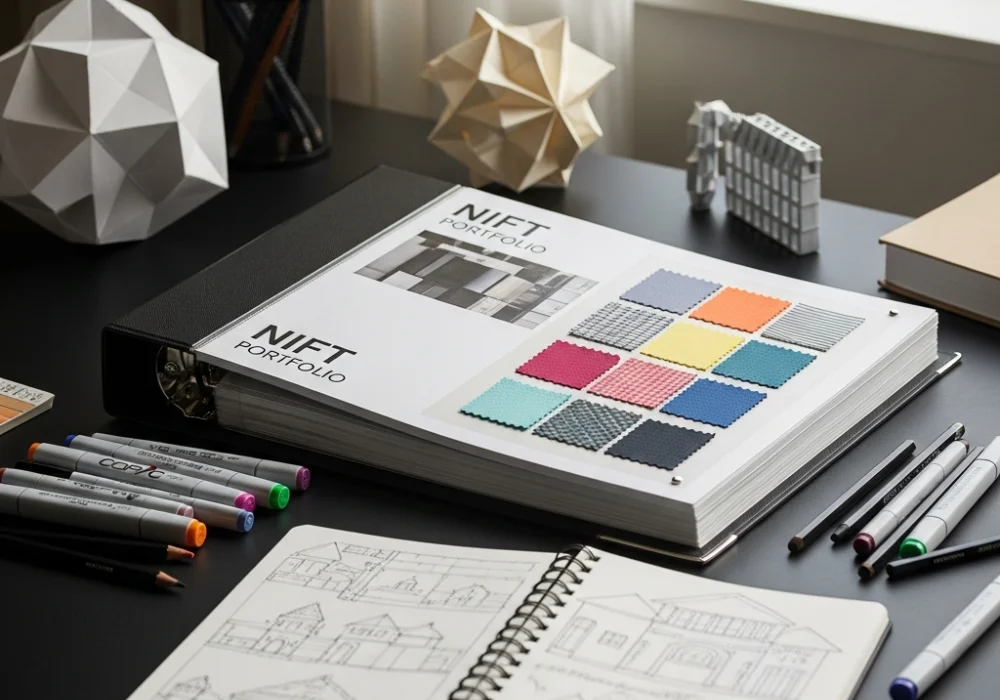
Mastering the NIFT Portfolio: Your Gateway to Design Excellence
The National Institute of Fashion Technology (NIFT) is the premier destination for aspiring designers in India. While the initial rounds of the entrance examination focus on your General Ability and Creative Ability, the portfolio and interview stages are where your true persona as a designer comes to life. Creating a portfolio isn’t just about compiling your best drawings; it is about narrating a story of your creative evolution, your unique perspective on the world, and your technical potential. In this guide, we explore the most effective strategies to build a portfolio that resonates with the NIFT selection committee.
Before you dive into the artistic aspects, it is crucial to remember that a strong foundation in the entrance basics is mandatory. Practicing with the latest pattern NIFT DAT and GAT mock tests available on myentrance.in will ensure you clear the first hurdle with confidence, giving you the mental space to perfect your portfolio.
1. Define Your Design Philosophy
A portfolio without a central theme is just a collection of sketches. To stand out, you must define your design vision. Are you inspired by sustainable fashion? Are you fascinated by brutalist architecture or traditional Indian textiles? Your portfolio should reflect a consistent line of thought. Start by creating a ‘Personal Manifesto’—a short paragraph describing what design means to you. This vision should act as the North Star for every piece of work you include.
2. Focus on the Process, Not Just the Result
NIFT examiners are more interested in how you think than how well you can shade a circle. Showcasing your ‘Process’ is vital. For every major project in your portfolio, include:
- Inspiration/Mood Boards: Where did the idea come from? Use photographs, textures, and color palettes.
- Ideation Sketches: The messy, initial doodles that show your brain at work.
- Material Exploration: If you are making a 3D model, show the different fabrics or papers you tested.
- Final Outcome: A high-quality image or physical sample of the finished piece.
3. Comparing Basic vs. Professional NIFT Portfolios
Understanding the gap between a standard art file and a professional design portfolio is key to success. The following table highlights the differences that the selection committee looks for:
| Feature | Basic Portfolio (Standard) | Professional NIFT Portfolio (Advanced) |
|---|---|---|
| Content | Random collection of school art projects. | Curated projects centered around a theme. |
| Documentation | Only finished drawings. | Initial sketches, mood boards, and failure logs. |
| Variety | Only pencil sketches or paintings. | Mix of 2D art, 3D models, digital work, and photography. |
| Mediums | Limited to paper and pencil. | Exploration of textiles, clay, digital tools, and unconventional materials. |
| Narrative | No clear connection between pieces. | A cohesive story reflecting the designer’s identity. |
4. Demonstrate Versatility Across Mediums
While you might want to specialize in Fashion Design, NIFT values a candidate who can think across disciplines. A well-rounded portfolio should ideally include a mix of the following:
- Freehand Sketching: Live sketches of people, landscapes, or everyday objects.
- Color Theory: Demonstrating your understanding of complementary, analogous, and monochromatic schemes.
- 3D Prototyping: Use of wire, clay, paper-mâché, or even recycled waste to create three-dimensional forms.
- Digital Literacy: While not mandatory, basic proficiency in digital illustration or photo manipulation can show your readiness for the current industry.
- Photography: A series of photos that capture a specific emotion or light play.
5. The Importance of Originality
One of the biggest mistakes candidates make is copying existing designs from the internet. NIFT looks for ‘Originality of Thought.’ If you are designing a garment, don’t just replicate a runway look. Instead, take an unconventional object—like a seashell or a skyscraper—and deconstruct its shapes to create a new silhouette. This shows the examiners that you have the ‘Design Thinking’ required for the rigorous curriculum at NIFT.
6. Organizational Aesthetics and Layout
How you present your work is just as important as the work itself. Use a clean, professional binder or a high-quality digital layout if you are presenting on a tablet. Ensure that there is enough white space so that the pages don’t look cluttered. Use consistent typography for titles and descriptions. Each project should lead logically into the next.
7. Prepare for the Portfolio Interview
Your portfolio is the script for your interview. Be prepared to answer questions like “Why did you choose this color palette?” or “What challenges did you face while creating this 3D model?” Practice articulating your thoughts. Remember, the examiners might challenge your choices to see how you handle criticism—stay calm and explain your rationale clearly.
To build the analytical skills needed for such discussions, engaging with the comprehensive study materials and current syllabus mock tests on myentrance.in can be incredibly helpful. These resources sharpen your general awareness and logical reasoning, which are frequently tested during the interview phase.
Frequently Asked Questions (FAQ)
How many pieces should be in a NIFT portfolio?
Quality always trumps quantity. Aim for 12 to 15 high-quality projects. It is better to have 10 exceptional pieces that show your process than 30 mediocre sketches.
Do I need to be an expert at drawing to get into NIFT?
No, you do not need to be a master artist. NIFT looks for observation skills, proportion, and creative expression. As long as you can communicate your ideas clearly through your drawings, you are on the right track.
Can I include digital art in my portfolio?
Yes, digital art is highly welcomed as it shows your adaptability to modern design tools. However, ensure it is balanced with manual sketches to demonstrate your foundational skills.
Is a physical portfolio better than a digital one?
For the NIFT situation test and interview rounds, a physical portfolio is often preferred as it allows the examiners to feel the textures and see the details of your work up close. However, having a digital backup is always a smart move.
How can I improve my creative thinking for the NIFT entrance?
Consistent practice is key. Use the mock tests and previous year style papers at myentrance.in to understand the types of creative prompts given in the DAT. This helps in training your brain to think outside the box under time constraints.





