
The Psychology of the Final Countdown
As you stand on the threshold of the National Institute of Design (NID) entrance exam, it is completely natural to feel a surge of adrenaline, coupled with a dash of anxiety. As an exam psychologist, I want to reassure you that these feelings are not signs of weakness; they are signs that your body is preparing for a high-performance event. The next 24 hours are not about learning new design theories or mastering complex perspective drawings. Instead, they are about ‘state management.’ Your goal is to enter the exam hall in a state of ‘relaxed alertness’—a psychological sweet spot where your creativity flows without the inhibition of fear.
Understanding the ‘Zeigarnik Effect’ is crucial today. This psychological phenomenon suggests that our brains remember uncompleted tasks better than completed ones. This is why you might feel like you have forgotten everything. Your brain is simply focusing on the tiny percentage of the syllabus you didn’t cover. Rest assured, the thousands of sketches you have made and the hours of logical reasoning you have practiced are safely stored in your long-term memory. They will surface the moment you see the question paper. Trust the process and trust your preparation.
💡 Pro-Tip: How to combat ‘Blank Mind’ syndrome
If you feel your mind go blank, focus on your breath for 30 seconds. This shifts your brain from the ‘amygdala hijack’ (fight or flight) back to the prefrontal cortex, which handles creative problem solving. Drink a sip of water and start doodling small shapes to break the mental block.
The ‘Red Zone’: What Strictly NOT to Do
In the final 24 hours, what you choose NOT to do is arguably more important than what you do. Avoiding these common pitfalls will preserve your mental energy and prevent unnecessary panic.
- 🚫 No New Topics: Attempting to learn a new concept today will only create ‘proactive interference,’ where new information confuses the stuff you already know.
- 🚫 No Mock Tests: Do not take a full-length mock test today. A low score could shatter your confidence, and a high score might lead to complacency. Your focus should be on maintenance, not evaluation.
- 🚫 Avoid ‘Stress-Vampires’: Stay away from peers or groups who are panic-posting about difficult questions. Anxiety is contagious; stay in your calm bubble.
- 🚫 Limit Digital Consumption: Put away the screen. The blue light from your phone inhibits melatonin production, which you desperately need for a deep sleep tonight.
Nutritional Fueling for Peak Creativity
Design is a high-energy mental activity. Your brain accounts for 20% of your body’s energy consumption. To perform well, you need stable blood sugar levels. Avoid the ‘sugar crash’ cycle caused by chocolates or energy drinks. Instead, focus on complex carbohydrates and proteins.
For dinner tonight, opt for something familiar and light, like dal-chawal or a simple pasta. Avoid spicy or heavy street food that could cause digestive discomfort. Hydration is equally critical. Even mild dehydration can lead to a significant drop in cognitive flexibility—the very thing you need for the NID creative section. Drink water consistently, but avoid excessive caffeine in the evening, as it has a half-life of 6 hours and will interfere with your sleep architecture.
💡 Nutrition Hack: The Power of Walnuts
Walnuts are rich in DHA and omega-3 fatty acids, which help in neural communication. Having a few walnuts today can provide a gentle boost to your cognitive processing speeds without the jitteriness of caffeine.
The Night-Before Essential Checklist
Remove all morning-of stress by packing your bag right now. Use this checklist to ensure you have everything required by NID regulations:
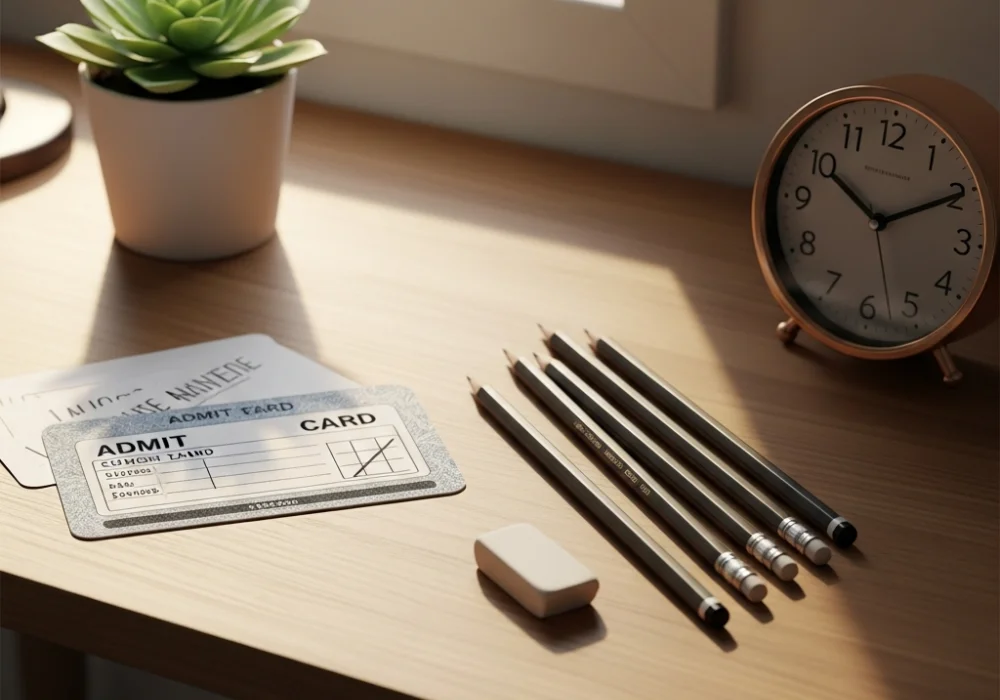
- Admit Card: A clear, color printout of your NID hall ticket.
- Identity Proof: Original Aadhar card, Passport, or Voter ID (as specified in instructions).
- Graphite Pencils: A range from 2H (for light construction) to 6B (for deep shading). Ensure they are pre-sharpened.
- Erasers & Sharpeners: A soft kneadable eraser is excellent for highlights.
- Coloring Media: Dry pastels, colored pencils, or plastic crayons (avoid oils/watercolors unless explicitly allowed).
- Geometry Box: Compass, ruler, and protractor for those precise technical drawing questions.
- Water Bottle: A transparent bottle to stay hydrated during the 3-hour marathon.
- Analog Watch: To manage your time without relying on the hall clock.
Minute-by-Minute Timeline
Follow this schedule to ensure you are perfectly primed for the exam tomorrow:
07:00 PM: Final review of your ‘Cheat Sheet’ (only formulas, color theories, or basic proportions). No new drawing.
08:00 PM: Dinner time. Keep it light, nutritious, and soul-comforting.
08:45 PM: Logistics check. Place your bag, shoes, and clothes for tomorrow in one spot.
09:15 PM: Relaxation ritual. Listen to ambient music, practice 4-7-8 breathing (inhale for 4, hold for 7, exhale for 8).
10:00 PM: Lights out. Even if you don’t fall asleep immediately, keep your eyes closed. This ‘quiet wakefulness’ still provides significant rest to the brain.
06:00 AM (Exam Day): Wake up and stretch. Do not touch your books. Your preparation is complete.
07:30 AM: Eat a breakfast with slow-release energy (like oats or eggs). Head to the center with time to spare.
Strategy for the Exam Hall
Once you are in the hall, remember the NID DAT is as much about ‘Thinking’ as it is about ‘Drawing.’ For the MCQ section, use the elimination method. Often, identifying why three options are wrong is easier than finding the right one. For the drawing section, spend the first 5 minutes of every question brainstorming. A well-thought-out, unique concept with average drawing will score higher than a cliché concept with masterful drawing. The NID examiners are looking for your ‘Designer’s Mindset’—how you observe the world, how you empathize with users, and how you solve problems creatively.
Maintain your pace. If a question feels like a dead end, move on and return to it later. Your subconscious will continue to work on it while you solve other parts of the paper. This is known as ‘incubation’ in creative studies.
💡 Strategy Hack: The ‘Thumb-Rule’ for Time
Divide your time based on marks. If a question is worth 10 marks in a 100-mark paper, it should ideally take 10% of your total time (minus 15 minutes for final review). Don’t over-invest in one sketch at the cost of leaving another question blank.
You Are Ready.
Success in NID is not about perfection; it is about authenticity. Show them how you see the world. We believe in your talent and your hard work. Go forth and design your future!
Need last-minute clarity or a quick tip? Reach out to us!
💬 Chat with our Experts on WhatsApp (+91 9526806124)




