
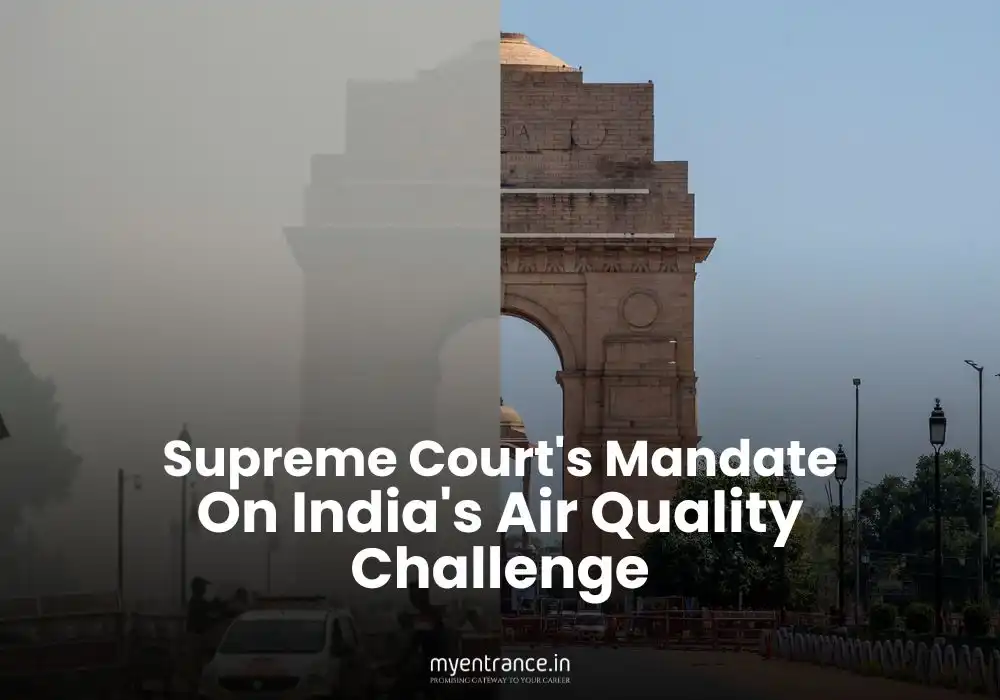
The annual descent of a toxic grey haze over Northern India, particularly the Delhi-National Capital Region (NCR), is more than a seasonal meteorological phenomenon; it is a stark, recurring symbol of a profound environmental and governance crisis. As visibility drops, tempers flare, and public health alerts are issued, the conversation invariably zeroes in on one primary culprit: stubble burning. For aspirants preparing for competitive examinations such as the UPSC, SSC, PSC, and others, this issue is a critical case study that sits at the confluence of environmental science, federal governance, judicial activism, agricultural economics, and public policy. This extended analysis, aligned with the mission of Myentrance.in, delves deep into the layers of this challenge, equipping you with the nuanced understanding required to excel.
The Annual Agony: A Deep Dive into Stubble Burning and its Persistence
Stubble burning is the practice of deliberately igniting the residual straw and stubble left in fields after the harvest of paddy (rice). While seemingly a simple agricultural act, its persistence is a symptom of a complex, broken system, predominantly in the agrarian heartlands of Punjab and Haryana.
The “Why” Behind the Flames:
- The Tyranny of the Calendar: The most critical driver is the incredibly short window—often just 10-20 days—between the harvesting of the Kharif season paddy (around October) and the sowing of the Rabi season wheat. Any delay can significantly impact the wheat yield. Burning offers a swift, almost instantaneous, method to clear the land.
- Economic Compulsion: For the average farmer, burning is not a choice of convenience but one of economic survival. The alternatives—such as operating specialized machinery or manually removing the residue—incur significant costs. With already thin profit margins, the zero-monetary-cost solution of a matchstick is overwhelmingly persuasive.
- Mechanization’s Unintended Consequence: The widespread adoption of combine harvesters, while boosting efficiency, has exacerbated the problem. These machines leave behind tall (1-2 feet) and dense stubble stands, which are far more cumbersome to manage manually than the shorter residues of traditional harvesting methods.
The Multifaceted Cost: Beyond Just Dirty Air
The environmental and health costs of this practice are catastrophic and far-reaching:
- The Poisoned Air: The smoke from these fires is a toxic cocktail of pollutants, including fine particulate matter (PM2.5 and PM10), which can penetrate deep into the lungs and bloodstream; carbon monoxide (CO), which reduces oxygen delivery to the body’s organs; carcinogenic hydrocarbons; and volatile organic compounds (VOCs). Driven by seasonal wind patterns, this plume travels southeast, contributing an estimated 30-40% of Delhi’s peak winter PM2.5 concentration.
- The Public Health Emergency: This pollution manifests as a severe health crisis. Hospitals report a surge in cases of aggravated asthma, bronchitis, chronic obstructive pulmonary disease (COPD), eye irritation, and cardiovascular events. The long-term exposure to such high levels of PM2.5 is linked to increased mortality, reduced lung development in children, and a range of other debilitating conditions.
- The Degradation of the Land: The immediate benefit of clearing fields masks a severe long-term agricultural detriment. Burning stubble kills the vital microbial life in the soil that is essential for nutrient cycling. It also incinerates organic carbon and nitrogen, leading to a gradual decline in soil fertility, increased dependency on chemical fertilizers, and ultimately, a threat to the very foundation of sustainable agriculture.
The Supreme Court’s Intervention: A Judicial Mandate for Accountability
In the face of what it has often termed a “complete failure of governance,” the Supreme Court of India has emerged as a central actor, actively interpreting the Right to Life (Article 21) to unequivocally include the Right to Clean Air. Its recent directive to the states of Punjab and Haryana to submit a comprehensive status report is a significant escalation in judicial oversight.
Decoding the Judicial Mandate:
This move is not a routine administrative check. It is a powerful tool of judicial activism with several key objectives:
- Enforcing Executive Accountability: By demanding a detailed report, the Court is compelling the state governments to move beyond rhetoric and present verifiable data on the ground situation. It forces them to quantify their efforts—the number of machines distributed, the area covered by bio-decomposers, the number of awareness camps held, and the number of penalties imposed.
- Identifying Policy and Implementation Gaps: The Court is essentially conducting a performance audit. The status report will highlight the chasm between policy announcements on paper and their effective implementation on the ground. It seeks to answer why, despite numerous schemes and subsidies, the practice continues unabated.
- Catalyzing Cooperative Federalism: The airshed is a shared resource, and pollution is a transboundary problem. The Court’s intervention underscores the necessity for a coordinated response between the central government, the states of Punjab, Haryana, Uttar Pradesh, and the Delhi government. It pushes for a collaborative framework, moving beyond the prevalent cycle of blame-shifting.
For aspirants, this is a live case study in the dynamic interplay between the judiciary and the executive, the scope of Public Interest Litigation (PIL), and the application of constitutional principles to contemporary environmental challenges.
Impact, Implications, and the Forged Path Forward
The implications of the stubble burning crisis extend far beyond the annual news cycle. It represents a critical test for India’s environmental governance, its commitment to climate action, and its ability to manage complex socio-economic transitions.
Broader Implications:
- A Challenge to Federalism: The crisis exposes the limitations of state-specific solutions to a regional problem, highlighting the urgent need for a robust, legally backed mechanism for inter-state environmental cooperation.
- Global Climate Commitments: Large-scale stubble burning releases significant amounts of black carbon and greenhouse gases, contradicting India’s ambitious pledges at international forums like COP26 to combat climate change and reduce its carbon footprint.
- Economic Toll: The health impacts lead to massive economic losses through healthcare expenditures and lost productivity. The smog disrupts transportation, leading to flight cancellations and road accidents, further straining the economy.
A Multi-Pronged Strategy for a Sustainable Solution:
Addressing this deep-rooted issue requires a holistic, empathetic, and multi-pronged strategy that acknowledges the farmer’s predicament.
- In-Situ Management (Managing Stubble in the Field):
- Happy Seeder Technology: This tractor-mounted machine allows wheat to be sown directly into the stubble-field, eliminating the need for burning. While effective, challenges remain in ensuring widespread access and affordability for small and marginal farmers.
- Pusa Bio-Decomposer: This low-cost, microbial solution spray decomposes the stubble into nutrient-rich manure within 3-4 weeks. Its scalability and effectiveness on a mass scale are currently being tested and promoted.
- Ex-Situ Management (Creating Value from Stubble):
- Biomass Energy: Establishing a robust supply chain to collect, transport, and utilize paddy straw in biomass power plants. This creates a market for the waste, turning a problem into a resource.
- Industrial Use: Stubble can be used in production of bio-ethanol, cardboard, packaging material, and as fodder for cattle in other regions.
- Policy and Economic Incentives:
- Subsidies and Infrastructure: Enhancing and streamlining subsidies for farm machinery, and establishing custom hiring centers (CHCs) to make technology accessible to all.
- Monetary Incentives: Exploring direct financial incentives for farmers who adopt non-burning practices, effectively paying them for the ecosystem service of clean air.
- Crop Diversification: The most long-term solution lies in incentivizing a shift away from the water-intensive paddy-wheat cycle. Promoting alternative crops like maize, pulses, and cotton, and ensuring their Minimum Support Price (MSP) and procurement, can break the cycle at its source.
Conclusion
The Supreme Court’s mandate for a status report is a crucial step, but it is only one piece of the puzzle. The fight against the annual smog is a marathon, not a sprint. It demands a concerted effort where judicial oversight, proactive state policy, scientific innovation, and, most importantly, a fair economic deal for the farmer, all converge. For the aspiring civil servant, this crisis is a profound lesson in the complexities of governing a modern India—where the plumes of smoke from a distant field are inextricably linked to the breath of millions in the capital, and where a sustainable solution must be rooted in both ecological wisdom and economic justice.





