
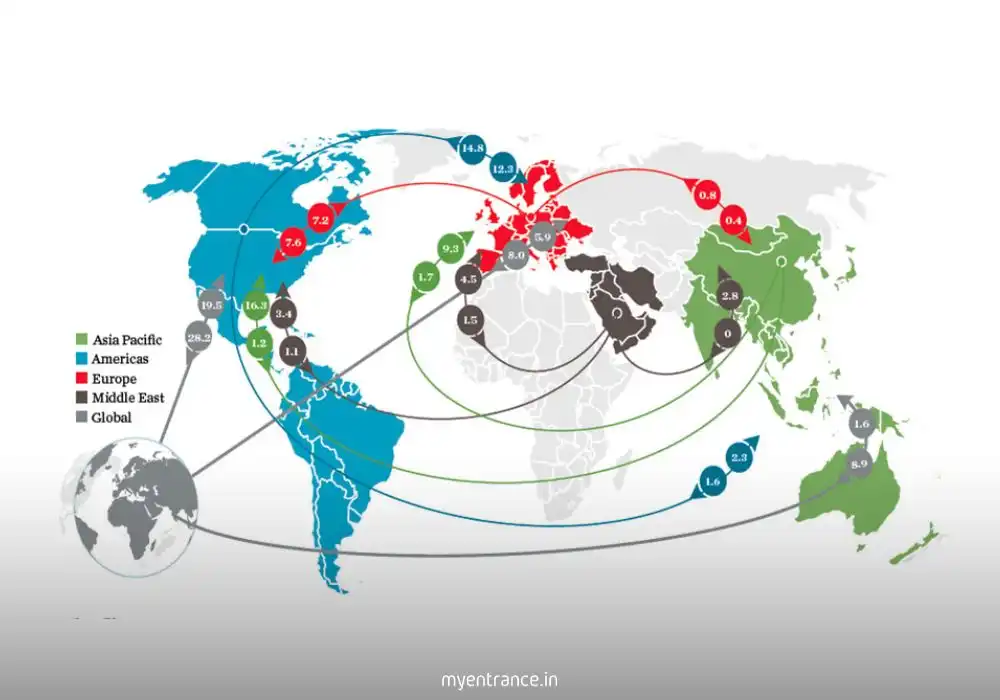
In the intricate world of international finance, a perplexing observation often challenges conventional economic theories: the foreign capital paradox. This intriguing phenomenon describes why capital frequently flows from capital-scarce developing nations to capital-abundant developed economies, contrary to traditional expectations. Understanding this counter-intuitive movement is absolutely essential for aspirants aiming to excel in competitive government exams like UPSC, SSC, and PSC.
The Enigma of Global Capital Flows
Traditional economic models, such as the Solow growth model, posit that capital should flow from regions where it is abundant and yields lower returns to areas where it is scarce and promises higher marginal productivity. Logically, this would imply a substantial influx of investment into developing countries, where capital scarcity would naturally lead to elevated returns on investment. However, real-world observations frequently present a different picture. The “Foreign Capital Paradox” highlights the persistent tendency for capital to move from countries with low capital-per-worker ratios (developing nations) to those with high capital-per-worker ratios (developed nations). This seemingly defies the fundamental principle of diminishing marginal returns to capital and warrants a deeper examination for any serious exam candidate. This curated static gk syllabus for all exams helps you focus on what truly matters.
Unpacking the Root Causes of This Counter-Intuitive Movement
Several critical factors contribute to this puzzling economic behavior, which every aspirant must grasp thoroughly. Firstly, institutional quality and governance play an overriding role. Developed economies generally boast robust legal frameworks, secure property rights, efficient judicial systems, lower corruption levels, and greater policy predictability. These elements significantly reduce investment risk, making them more attractive to global capital, even if the raw economic returns might seem lower. Investors prioritize the safety and security of their assets over potentially higher, but riskier, returns.
Secondly, the sophistication and depth of financial markets in developed economies are a major draw. These markets offer a wide array of financial instruments, greater liquidity, and more efficient mechanisms for capital allocation and risk management. Developing countries, often characterized by nascent or less developed financial systems, may struggle to absorb large capital inflows efficiently or provide the necessary avenues for portfolio diversification that global investors seek.
Furthermore, political stability and macroeconomic certainty are crucial considerations. Developed nations typically exhibit greater political stability, more predictable economic policies, and lower levels of sovereign risk. In contrast, developing countries can sometimes be perceived as having higher geopolitical risks, frequent policy shifts, or a greater susceptibility to economic shocks, all of which deter long-term foreign investment despite potentially attractive growth prospects. Finally, information asymmetries and the scale of market opportunities also contribute. Investors may have better information about developed markets and find it easier to invest larger sums without significantly impacting market prices, something that might be more challenging in smaller, less transparent developing markets. Ensure you have the most up-to-date gk news for your exam from a trusted source.
Why Mastering This Concept is Indispensable for Your Exams
Understanding the Foreign Capital Paradox is not merely an academic exercise; it’s a critical component for excelling in a multitude of competitive examinations. For UPSC Civil Services Examination aspirants, this concept is central to the Economy section of General Studies Paper III, enabling a nuanced analysis of international trade, investment patterns, and India’s economic policies. It frequently forms the basis for analytical questions in current affairs, essay writing, and even the personality test. Knowing this allows you to critically evaluate government policies related to Foreign Direct Investment (FDI) and Foreign Institutional Investment (FII).
For SSC, PSC, and other government recruitment exams, questions on the Foreign Capital Paradox often appear in the General Awareness and Economics sections. These might range from direct conceptual questions – asking for its definition or key contributing factors – to analytical questions presented in a multiple-choice format. It demonstrates a deeper understanding of global economic trends beyond mere memorization. Even for less directly economics-focused exams like NID and NIFT, a strong grasp of general knowledge and critical global phenomena enhances your overall profile and analytical thinking abilities, which are implicitly tested. In essence, this concept equips you with a sophisticated lens through which to view global economic realities, setting you apart from other candidates.
Sample Questions and Answers: Testing Your Understanding
Here are five questions to test your grasp of the Foreign Capital Paradox, vital for your exam preparation:
1. Question: Which of the following best describes the “Foreign Capital Paradox”?
Answer: It refers to the observed phenomenon where capital flows predominantly from developing countries (where it is scarce) to developed countries (where it is abundant), contrary to traditional economic theory.
Importance: This question tests your fundamental understanding and definition of the concept, a common type of inquiry in General Awareness sections.
2. Question: According to the Foreign Capital Paradox, which of these factors primarily deters capital flow into developing nations despite potentially higher returns?
(a) Lower labor costs
(b) Higher technological advancement
(c) Weak institutional frameworks and political instability
(d) Abundance of natural resources
Answer: (c) Weak institutional frameworks and political instability.
Importance: This assesses your knowledge of the underlying reasons, crucial for both factual recall in SSC/PSC and analytical depth in UPSC.
3. Question: How does the Foreign Capital Paradox challenge the neoclassical economic prediction regarding capital allocation?
Answer: It challenges the neoclassical prediction that capital should flow to regions where its marginal product (and thus expected return) is highest, implying capital should move to capital-scarce developing nations. The paradox suggests that non-economic factors like risk, institutions, and market depth override simple return differentials.
Importance: This question demands a conceptual understanding of how the paradox critiques established economic theory, a higher-order thinking skill relevant for UPSC mains.
4. Question: In the context of India’s economic development, what policy measures could potentially mitigate the effects of the Foreign Capital Paradox and attract more foreign investment?
Answer: Policy measures could include strengthening legal and regulatory frameworks, ensuring political stability, improving ease of doing business, developing deeper and more transparent financial markets, and focusing on macroeconomic stability to enhance investor confidence.
Importance: This applies the concept to a real-world scenario, testing your ability to link theory with practical policy, crucial for UPSC GS Paper III and interviews.
5. Question: Critically analyze the statement: “The Foreign Capital Paradox is solely a reflection of institutional failures in developing countries.”
Answer: While institutional failures (weak property rights, corruption, inefficient judiciary) are significant contributors, stating it is “solely” a reflection is an oversimplification. Other factors like the depth and liquidity of financial markets in developed economies, perceived political instability, information asymmetries, and the sheer scale and diversification opportunities in developed markets also play crucial roles. A holistic understanding requires acknowledging this multifaceted interplay.
Importance: This question requires critical analysis and nuanced reasoning, vital for essay writing and analytical questions in UPSC mains, pushing beyond mere factual recall.





