
What Is the NID Studio Test?
If you’ve cleared the NID DAT Prelims, congratulations you’ve made it past the first gate. Now comes the real challenge: the NID Studio Test, officially part of the DAT Mains (the second and decisive stage of NID admissions).
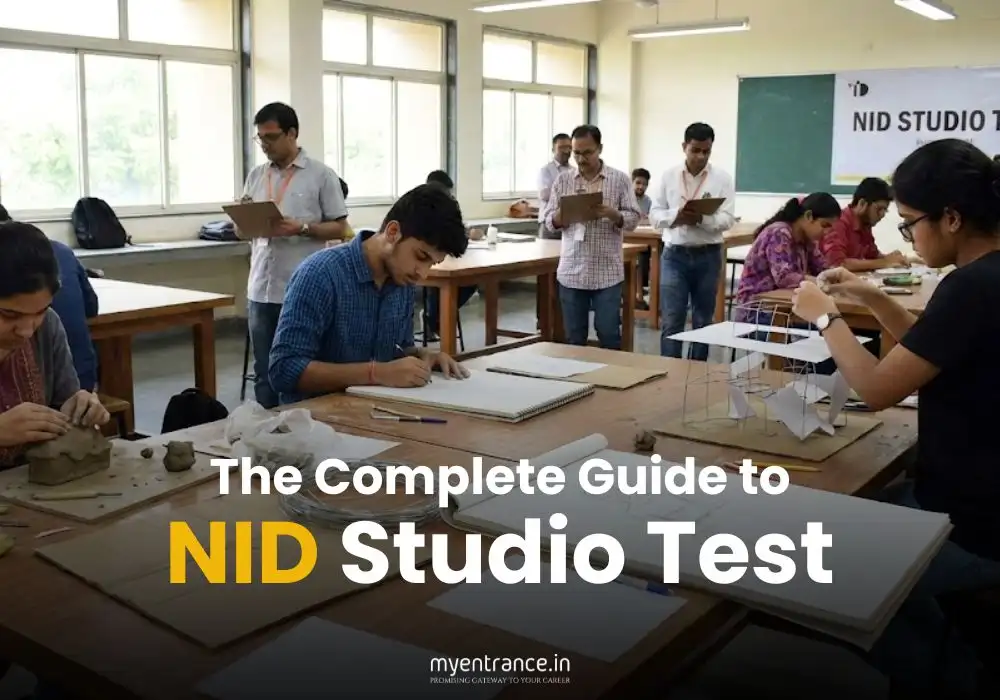
The Studio Test is a hands-on, in-person practical examination conducted at NID campuses (Ahmedabad, Gandhinagar, Bengaluru). Unlike the Prelims, which test you on paper with MCQs and sketching, the Studio Test puts you in a room with real materials clay, wire, paper, thermocol and challenges you to think, create, and solve design problems on the spot.
The test evaluates your design thinking, creativity, material intelligence, observation skills, and ability to communicate ideas visually and verbally. There are no right or wrong answers here. Your score depends entirely on originality, clarity, neatness, and the creative depth of your approach.
For NID 2026, one important update: DAT Prelims now carry 0% weightage in the final merit list. They are purely qualifying. Your entire final score is based on DAT Mains which is 100% of your final rank. This makes mastering the Studio Test more critical than ever.
What Does the NID Studio Test Include?
The Studio Test covers two broad types of tasks:
1. Observation-Based Tasks — These test how well you notice, remember, and reproduce visual information. Examples include memory drawing, texture identification, and audio-visual exercises where you sketch what you hear or see in a short video or audio clip.
2. Conceptualisation Tasks — These test your ability to ideate, innovate, and execute. Examples include 3D model-making, doodling/visual completion exercises, story illustration, and material-handling challenges.
Here’s a breakdown of what you’ll typically encounter in the test room:
Doodling/Sketching (15 min): You’ll receive a sheet with abstract lines or empty boxes and must complete them into meaningful visuals. Classic example: “Draw 30 meaningful visuals from 30 scribbled lines.”
Audio-Visual Test (15 min): Identify textures just by touch, recall details from a 30-second video, or recognize objects from sounds. This tests your sensory awareness and observational memory.
3D Model Making (2 hours): The centrepiece of the Studio Test. You’ll be given a set of materials and asked to build a functional or creative 3D model addressing a specific problem or theme. Classic example: “Use card paper, ice cream sticks, rubber bands, straws, and wire to build a catapult that can fling a small ball 5 feet in the air.”
Story Illustration / Thematic Appreciation: Create a visual narrative or illustrate a theme using drawing, doodling, or collage.
Psychometric / Written Response: Some disciplines include a short written exercise testing your design reasoning and self-awareness.
For M.Des applicants, studio test tasks are discipline-specific — meaning an Apparel Design aspirant will face different tasks than a Product Design aspirant.
Is the Portfolio Evaluated in the NID Studio Test?
This is one of the most frequently asked questions — and the answer is nuanced.
For B.Des: NID does NOT require a separate portfolio submission during the Studio Test itself. However, having a personal portfolio is strongly recommended as it helps you prepare better and may be referred to informally. For NID 2026 B.Des specifically, no formal portfolio is part of the studio test scoring.
For M.Des: The portfolio plays a significant role. M.Des candidates are required to present their portfolio during the personal interview that follows the Studio Test. In some recent years, NID has asked candidates to upload a theme poster and portfolio as part of the Mains process. The interview panel evaluates your portfolio as a reflection of your design thinking, process, and creative maturity.
The portfolio for M.Des is uploaded as a single PDF file, not exceeding 10 MB, before the interview stage.
Weightage Breakdown for NID 2026
Understanding the scoring structure is essential to focus your energy correctly.
| Stage | Purpose | Weightage in Final Merit |
|---|---|---|
| DAT Prelims | Shortlisting only (top 1.5× seats per category) | 0% |
| DAT Mains (Studio Test + Interview) | Final selection | 100% |
Within DAT Mains, while NID does not publish a precise marks breakup for every activity, expert analysis and past trends suggest the following approximate distribution:
- Studio Test activities (model-making, doodling, AV test): ~40% of Mains score
- Personal Interview (M.Des only, includes portfolio review): ~60% of Mains score
This means for M.Des aspirants, the interview — where your portfolio is presented — carries enormous weight. For B.Des, the Studio Test is everything in Mains.
How to Prepare for the NID Studio Test: A Strategic Guide
1. Daily Sketching (Non-Negotiable)
Dedicate at least 1–2 hours every day to freehand sketching. Start with simple objects — furniture, plants, household items — then move to human figures, street scenes, product sketches, and technical drawings. Speed AND accuracy both matter.
2. Practice 3D Model Making With Every Material You Can Find
Get comfortable with paper, cardboard, clay, wire, thermocol (styrofoam), rubber sheets, straws, cloth, pins, thread, and plaster of Paris. Don’t wait for exam-day materials to surprise you. The trick is to understand the structural and aesthetic properties of each material and how to combine them creatively.
3. Solve Previous Year Studio Test Papers
NID doesn’t repeat questions, but understanding the patterns helps enormously. Practice under timed conditions. Typical exercises include making a half-cut apple from a wet sponge, building a moving object from paper, or creating a model that makes sound.
4. Train Your Observation Skills
Practice looking at everyday objects for 30 seconds, then sketching them from memory. Identify textures by touch, replicate what you hear as visual metaphors. These habits directly prepare you for the audio-visual and tactile components of the test.
5. Understand Design Principles
Study the basics of form, balance, proportion, colour theory, ergonomics, and visual hierarchy. These aren’t just academic topics — they’ll inform how you approach every task in the Studio Test.
6. Time Management Under Pressure
The Studio Test is 3 hours long with multiple tasks. Practice completing exercises in shorter-than-required timeframes so exam-day pressure doesn’t catch you off guard.
7. Build a Personal Portfolio (Especially for M.Des)
Even if you’re applying for B.Des, maintaining a portfolio prepares your mind for design documentation and forces you to reflect on your creative process — both of which sharpen your Studio Test performance.
How to Make a Portfolio for NID Entrance Exam
A great portfolio doesn’t just showcase finished work — it tells the story of how you think.
Structure Your Portfolio Like This:
Cover/Introduction Page: Your name, the discipline you’re applying for, and a short design statement — who you are as a creative person in 2–3 sentences.
Best Works (8–15 pieces): Curate ruthlessly. Include your strongest 8–15 projects. Quality over quantity. Each project should show your skill in drawing/illustration, concept development, and execution.
Process Sheets: For at least 3–4 projects, show your ideation — rough sketches, mind maps, iterations, and how you arrived at your final outcome. NID evaluators care deeply about your thinking process, not just the polished result.
Diverse Media: Include a mix — freehand sketches, watercolour or ink illustrations, collages, photography, 3D models/clay work, digital work if any. This shows range.
Design Projects: If you’ve worked on any design briefs — a product concept, packaging redesign, a poster series, a typography project — include them with context (what the brief was, what problem you solved).
Discipline-Specific Work: If applying for Textile Design, show fabric explorations, surface patterns, and motif studies. For Graphic Design, show typography, layouts, and visual communication work. Tailor it.
Tips for Presentation:
- Keep the PDF clean, readable, and well-organized
- Use consistent margins and fonts for text labels
- File size must be under 10 MB for digital submission
- Print quality matters if presenting physically — use A4 or A3 size, laminated or in a neat folder
- Avoid cluttering — white space is your friend
- Label each project with a one-line description of the brief and your approach
Sample Q&A: NID Studio Test Practice Questions
These are based on patterns from previous years. Practice answering them under timed conditions.
Q1. You are given a wet sponge, scissors, and toothpicks. Make a half-cut apple. Focus: Material manipulation, form understanding, realistic representation
Q2. Create an object that can move AND make sound using: A4 paper, a rubber band, and two straws. Focus: Functional design thinking, engineering creativity, material intelligence
Q3. Doodle Exercise — 12 empty boxes are given. Complete each box starting from a pre-drawn line or squiggle into a meaningful visual. Focus: Imagination, speed, visual variety, storytelling
Q4. Audio-Visual Test — A 30-second audio clip plays. Draw/sketch what you imagine while listening to it. Focus: Synesthetic thinking, abstract visualization, expressive drawing
Q5. Build a 3D model using the following materials: cardboard strips, rubber bands, safety pins, and thread. The model must represent the concept of “Balance.” Focus: Conceptual interpretation, structural thinking, abstract representation
Q6. Sketch 5 different chairs from memory, each for a different user a child, an elderly person, a musician, a gamer, and an astronaut. Focus: Empathy-driven design, observational knowledge, human-centred thinking
Q7. You’re shown an image of a traditional Indian craft object for 30 seconds. Reproduce it from memory with as much detail as possible. Focus: Visual memory, observation skills, cultural awareness
Final Thoughts: What NID Is Really Looking For
NID is not looking for the most technically perfect sketch or the most polished model. They want to see a designer’s mind at work — someone who can observe keenly, imagine boldly, make quickly, and communicate clearly.
As one NID M.Des alumnus put it: “The Studio Test isn’t about being an artist. It’s about being curious, resourceful, and fearless with materials and ideas.”
Your preparation strategy should reflect this. Practice not just skills, but the mindset — embrace ambiguity, make decisive creative choices, and always be ready to explain your reasoning.
Good luck, and design on.





