
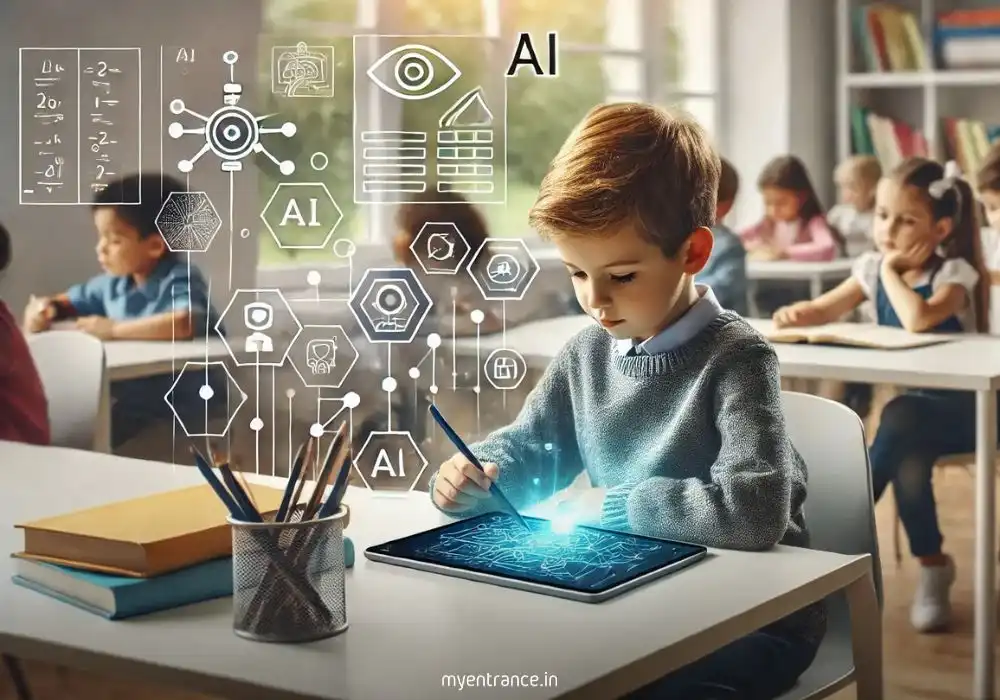
Artificial Intelligence (AI) is rapidly moving from the realm of science fiction into our daily lives, and the education sector is at the forefront of this transformation. This technological wave presents a pivotal question for a nation like India: how do we integrate AI into our classrooms to empower students and teachers, without losing the invaluable human touch that defines true learning? For aspirants preparing for competitive examinations like UPSC, SSC, and various PSCs, understanding this dynamic is no longer optional; it is a critical component of contemporary national discourse.
AI: The New Assistant in the Classroom
The potential for AI to act as a powerful educational tool is immense. Far from being a mere replacement for educators, AI promises to be a great liberator, freeing them from the drudgery of administrative tasks such as grading objective assessments, tracking attendance, and managing repetitive queries. This allows teachers to dedicate their valuable time to what truly matters: mentoring students, fostering critical thinking, and designing more engaging, interactive learning experiences. Furthermore, AI-powered platforms can offer personalized learning pathways for each student, identifying their specific strengths and weaknesses and providing tailored content and exercises. This data-driven approach can help bridge learning gaps far more efficiently than a traditional one-size-fits-all model, a concept central to the objectives of the National Education Policy (NEP) 2020.
Preserving the Guru: The Irreplaceable Human Element
While AI can process data and automate tasks, it cannot replicate the empathy, intuition, and inspiration that a human teacher provides. The core of education, especially in the Indian context with its rich history of the *guru-shishya parampara*, is built on mentorship, moral guidance, and the development of emotional intelligence. A machine can teach facts, but a teacher imparts wisdom. They nurture curiosity, build resilience in the face of failure, and cultivate the soft skills that are essential for success not just in exams, but in life. The challenge, therefore, lies not in choosing between AI and teachers, but in creating a synergistic model where technology handles the mechanics of information delivery, while educators focus on the holistic development of the student.
Policy and Preparedness: The Path Forward
For this synergy to be successful, a robust policy framework is non-negotiable. Policymakers and educational bodies must provide teachers with the necessary training and resources to use these new tools creatively and effectively. Simply introducing technology without a pedagogical strategy is a recipe for failure. The focus must be on digital literacy for educators, developing ethical guidelines for AI use to ensure data privacy and prevent bias, and building the digital infrastructure needed to provide equitable access to all students, regardless of their geographical or socio-economic background. This careful, strategic implementation is the only way to ensure that AI becomes an instrument of empowerment, not a tool for deepening the digital divide.
Why is this Topic Crucial for Your Exams?
The integration of AI in education is a high-relevance topic for a multitude of competitive exams. For UPSC and PSC aspirants, it is a key subject under GS Paper 2 (Governance, Social Justice, Education) and GS Paper 3 (Science & Technology, Economic Development). It is also a probable topic for the Essay paper, where you might be asked to analyze its pros and cons. For exams like SSC, NID, and NIFT, questions related to new government initiatives in EdTech, significant technological advancements, and policy changes like NEP 2020 are frequently featured in the General Awareness and Current Affairs sections. A thorough understanding of this subject showcases your awareness of contemporary national issues and your ability to think critically about the future.
If you’re preparing for SSC CGL or CHSL, explore our SSC Exam Preparation Resources for success.
For consistent scoring in exams, refer to this Static General Knowledge Resource curated for aspirants.
Strengthen your current affairs with our Daily GK Quiz Practice Questions to boost exam confidence.
Sample Questions & Answers for Exam Practice
Question 1: The National Education Policy (NEP) 2020 emphasizes the use of technology in education. Which of the following is a key objective it aims to achieve through technology integration?
(a) To replace teachers with AI systems completely.
(b) To improve educational planning, administration, and management.
(c) To limit learning to online platforms only.
(d) To eliminate traditional textbook-based learning.
Answer: (b) To improve educational planning, administration, and management. The NEP 2020 advocates for using technology to streamline administrative tasks and improve overall governance in the education sector, thereby enhancing efficiency.
Question 2: What is considered the primary advantage of using AI-powered personalized learning platforms in a diverse classroom?
(a) They reduce the cost of educational materials.
(b) They cater to the individual learning pace and style of each student.
(c) They ensure all students score the same marks.
(d) They eliminate the need for physical school infrastructure.
Answer: (b) They cater to the individual learning pace and style of each student. Personalization is the core strength of AI in education, as it allows for adaptive learning experiences tailored to each student’s unique needs.
Question 3: What is a significant ethical concern regarding the widespread adoption of AI in the student assessment process?
(a) The high speed of computation.
(b) The potential for algorithmic bias to disadvantage certain student groups.
(c) The reduction in paper usage.
(d) The ability of AI to work 24/7.
Answer: (b) The potential for algorithmic bias to disadvantage certain student groups. If the AI is trained on biased data, it may unfairly penalize students from specific backgrounds, creating an inequitable assessment system.
Question 4: In an AI-integrated classroom, the role of the human teacher is expected to evolve from an instructor to a…
(a) Technician
(b) Facilitator and Mentor
(c) Data Entry Operator
(d) System Administrator
Answer: (b) Facilitator and Mentor. With AI handling direct instruction and repetitive tasks, the teacher’s role shifts to guiding students, fostering discussions, and mentoring their overall development.
Question 5: The Government of India’s DIKSHA platform is an example of a digital initiative in education. What does DIKSHA stand for?
(a) Digital Infrastructure for Knowledge Sharing
(b) Direct Initiative for Knowledge and Skills Here
(c) Digital India Knowledge and Security Hub
(d) Distributed Infrastructure for Keen Scholars’ Access
Answer: (a) Digital Infrastructure for Knowledge Sharing. DIKSHA is a national platform for school education that provides e-content and resources for teachers and students.





