Translate Language
Swadeshi vs. Atmanirbhar Bharat: Is Modi’s Vision Different from Gandhi’s
The term ‘Swadeshi’ is making a major comeback in India’s political and economic dialogue. While its roots are deeply embedded in the Indian Freedom Struggle, its modern interpretation under Prime Minister Narendra Modi presents a new vision for self-reliance, sparking essential discussions for competitive exam preparation.
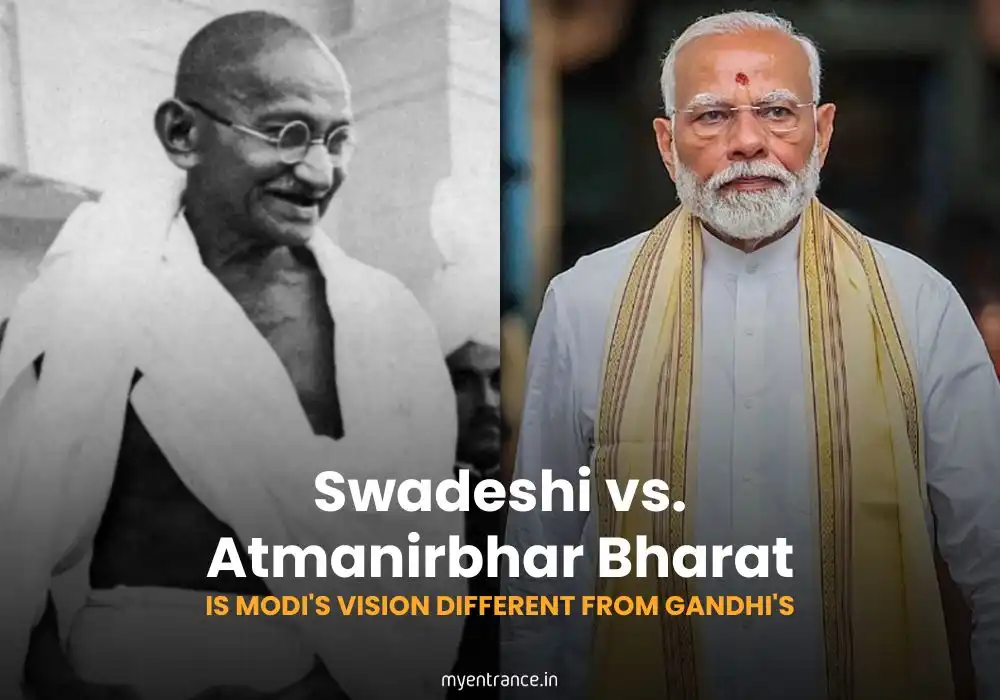
The recent push for ‘Atmanirbhar Bharat’ (Self-Reliant India) by Prime Minister Narendra Modi has brought the century-old concept of ‘Swadeshi’ back into the spotlight. But to truly understand its current form, we need to take a quick journey back in history.
The original Swadeshi Movement ignited in 1905 as a powerful protest against the British decision to partition Bengal. It was a brilliant strategy of non-cooperation where Indians boycotted British goods, especially textiles, and fervently promoted products made in India. This wasn’t just an economic move; it was the first major expression of Indian nationalism that captured the masses’ imagination.
However, it was Mahatma Gandhi who truly weaponized Swadeshi and made it the soul of the Independence movement. For Gandhi, Swadeshi was deeply personal and philosophical. It meant:
Economic Self-Sufficiency: Promoting small-scale, local industries, famously symbolized by the charkha (spinning wheel).
Cultural Assertion: It was a rejection of Western industrial culture and a return to Indian traditions.
Mass Empowerment: It was a tool of resistance that every common person could participate in by simply changing what they bought. The impact was staggering – Indian-made cloth’s market share jumped from 62% in 1936 to 76% by 1945.
After independence, the idea morphed into the Nehruvian model of self-reliance, which focused on heavy industries and state-led development, often behind protective trade barriers.
Now, fast-forward to today. PM Modi’s call for ‘Atmanirbhar Bharat’ echoes the sentiment of self-reliance but with a critical difference in definition. He has stated, “My definition of Swadeshi is very simple… What matters is that in production, the sweat belongs to my countrymen.”
This marks a significant shift:
Then (Gandhi): Boycott foreign goods; promote indigenous ownership and methods.
Now (Modi): Encourage foreign companies to “Make in India”; focus on local production and jobs, regardless of the company’s origin.
This modern approach is less about isolation and more about integrating India into global supply chains as a manufacturing powerhouse. It’s a pragmatic response to contemporary challenges like global trade tensions and supply chain disruptions, aiming to boost export-led growth rather than relying on protectionism.
Sample Questions and Answers for Exam Prep:
1. The Swadeshi Movement acquired an intense character under the leadership of which national leader?
Answer: Mahatma Gandhi, who integrated it into the broader Non-Cooperation and Civil Disobedience movements from 1920 onwards.
2. What was the immediate cause for the launch of the original Swadeshi Movement in 1905?
Answer: The decision by Viceroy Lord Curzon to partition the province of Bengal.
3. How does the current ‘Atmanirbhar Bharat’ initiative conceptually differ from the Gandhian idea of Swadeshi?
Answer: While Gandhi’s Swadeshi emphasized boycotting foreign goods and promoting indigenous ownership and cottage industries, ‘Atmanirbhar Bharat’ focuses on boosting local manufacturing and creating jobs within India, even welcoming foreign investment and companies to achieve this goal.
4. The Swadeshi Jagran Manch is an organization associated with which larger socio-political group?
Answer: The Sangh Parivar.
5. Name one major economic impact of the historical Swadeshi and Boycott movement.
Answer: It significantly boosted the market share of Indian-made cloth, severely impacting the sales of British textiles in India.
Why is this Important for Exams?
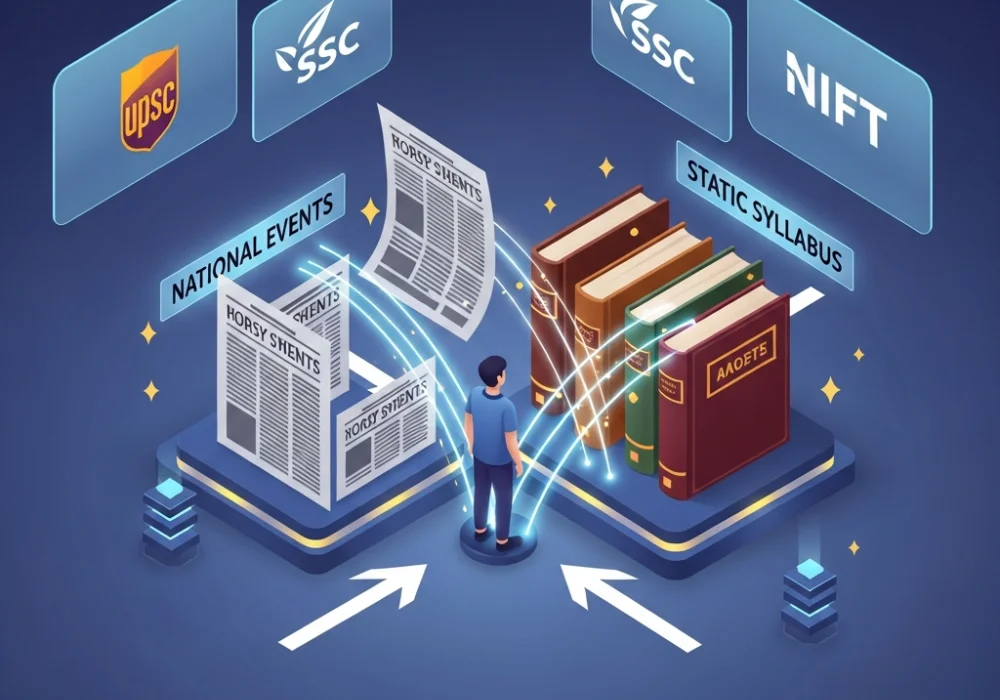
This topic sits at a perfect crossroads for several competitive exams:
UPSC: Directly relevant for Prelims (Current Events) and Mains GS-I (Modern History & Post-Independence India) and GS-II (India’s foreign policy and international relations). It allows you to draw analytical comparisons across eras.
SSC & Kerala PSC: Frequently features questions on both the historical Swadeshi Movement and recent government initiatives like ‘Make in India’ and ‘Atmanirbhar Bharat’. Understanding the link between them adds depth to your answers.
Analytical Value: It tests your ability to compare and contrast historical concepts with their contemporary interpretations, a skill highly valued in descriptive papers.
Mastering this evolution from Gandhi’s Swadeshi to Modi’s Atmanirbhar Bharat will give you a comprehensive edge, allowing you to tackle both history and current affairs questions with confidence.
Read More Topics