
Introduction to Information Technology for SSC Aspirants
Information Technology (IT) has transitioned from being a niche subject to a core component of the Staff Selection Commission (SSC) examinations, particularly after the recent changes in the SSC CGL Tier-II syllabus. Understanding the chronological history of IT is not merely about learning dates; it is about grasping the logic behind the technological revolution that defines our modern era. From the manual calculations of the ancient abacus to the complex neural networks of today’s Artificial Intelligence, every milestone represents a significant leap in human productivity. In this comprehensive study guide, we provide a detailed vertical timeline and an extensive analysis of the key historical events in Information Technology, designed specifically to help students score maximum marks in the Computer Awareness section of SSC CGL, CHSL, MTS, and other competitive exams.
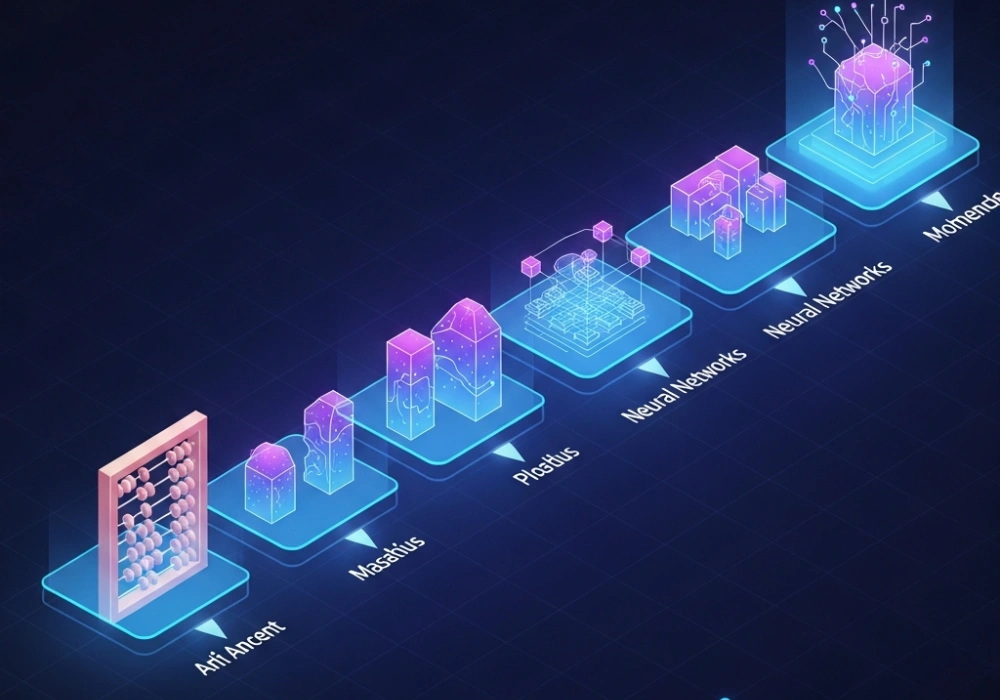
The following timeline highlights the ten most critical phases of IT evolution. Each entry is packed with exam-relevant facts, such as the names of inventors, the components used in different computer generations, and the significance of various hardware and software breakthroughs. By studying this timeline, you will be able to answer questions regarding the ‘Father of Computers’, the first electronic machines, and the birth of the internet with confidence. Let us explore the digital journey that transformed the world.
3000 BC / ANCIENT ERA
The Abacus: The First Calculating Machine
The Abacus is historically recognized as the first mechanical device used for mathematical calculations. Developed in ancient Mesopotamia and refined by the Chinese, it consists of a wooden frame with rods and sliding beads. For SSC aspirants, it is essential to remember that the abacus is the primary ancestor of all modern computing devices. It was used to perform basic arithmetic operations like addition, subtraction, multiplication, and division. Many SSC questions focus on the origin of computing, where the abacus is cited as the foundational tool that proved physical objects could be used to process data systematically.
1642 / MECHANICAL ERA
The Pascaline: First Mechanical Calculator
Invented by the French mathematician Blaise Pascal, the Pascaline was the first mechanical calculator capable of performing addition and subtraction directly. It used a series of gears and wheels to manage carries from one digit to the next. In the context of SSC exams, Pascaline is a frequent topic in the ‘History of Computers’ segment. This invention marked a shift from manual counting to automated mechanical counting. Pascal developed this machine to help his father, a tax collector, with laborious calculations, setting a precedent for using technology to solve administrative and financial problems.
1837 / THE BIRTH OF LOGIC
The Analytical Engine by Charles Babbage
Charles Babbage, widely known as the ‘Father of the Computer’, proposed the Analytical Engine in 1837. This was the first design for a general-purpose computer that included an ALU (Arithmetic Logic Unit), basic flow control, and integrated memory. For competitive exams, understanding Babbage’s contribution is vital. His engine was designed to be programmable using punch cards, a concept that became the blueprint for modern digital computers. Although never fully built during his lifetime, his work laid the theoretical foundation for the entire Information Technology industry, making ‘Babbage’ one of the most common answers in SSC General Awareness sections.
1945 / FIRST GENERATION
ENIAC: The First Electronic General-Purpose Computer
The Electronic Numerical Integrator and Computer (ENIAC) was the first programmable, electronic, general-purpose digital computer, completed in 1945 by J. Presper Eckert and John Mauchly. It used vacuum tubes for its circuitry, which were large, consumed massive amounts of power, and generated significant heat. In SSC exams, ENIAC is frequently mentioned as the hallmark of the First Generation of computers. It was used primarily for calculating artillery firing tables for the United States Army. This era is critical for students to study because it highlights the transition from mechanical systems to electronic ones, ushering in the modern age of IT.
1947 / SECOND GENERATION
The Transistor Revolution
In 1947, John Bardeen, Walter Brattain, and William Shockley invented the transistor at Bell Labs. This invention replaced the bulky and unreliable vacuum tubes, leading to the Second Generation of computers. Transistors were smaller, faster, cheaper, and more energy-efficient. For SSC candidates, this is a major ‘General Science and IT’ intersection question. The use of transistors allowed for the development of computers that were more accessible to businesses and governments. This era also saw the development of high-level programming languages like COBOL and FORTRAN, which are important terms for the SSC Computer Knowledge module.
1958 / THIRD GENERATION
The Integrated Circuit (IC)
The Third Generation of computers began with the invention of the Integrated Circuit (IC) by Jack Kilby and Robert Noyce. An IC places thousands of transistors on a single silicon chip, drastically increasing speed and efficiency while reducing size. This development is a core part of the SSC IT syllabus. The move to ICs allowed computers to become small enough for personal use in the future and introduced the concept of operating systems (OS), which allowed machines to run many different programs simultaneously. Understanding ICs is key to answering questions about the miniaturization of technology.
1969 / NETWORKING ERA
ARPANET: Birth of the Internet
ARPANET (Advanced Research Projects Agency Network) was the world’s first operational packet-switching network and the predecessor to the global internet. Developed by the US Department of Defense, it sent its first message in 1969. For SSC aspirants, the full form of ARPANET and its role as the origin of the internet is highly important. This event marked the transition from standalone computing to interconnected systems, enabling data sharing across vast distances. The protocols developed for ARPANET, such as TCP/IP, remain the foundation of how the internet works today, making this a frequent topic in ‘Network Awareness’ questions.
1981 / FOURTH GENERATION
The Personal Computer (PC) Boom
The Fourth Generation is characterized by the use of VLSI (Very Large Scale Integration) and microprocessors. In 1981, IBM introduced its first Personal Computer (the IBM PC), which used Microsoft’s MS-DOS operating system. This era brought computers into the homes and offices of common people. For SSC exams, it is vital to know that the microprocessor (Intel 4004 was the first) is the ‘brain’ of the Fourth Generation computers. This period also saw the rise of legendary figures like Bill Gates and Steve Jobs. Most of the technology we use today, including laptops and desktops, is an evolution of the Fourth Generation architectural principles.
1989 / WEB ERA
World Wide Web (WWW)
In 1989, Tim Berners-Lee, a British scientist at CERN, invented the World Wide Web (WWW). He developed the first web browser, HTML, and HTTP. It is crucial for SSC students to distinguish between the ‘Internet’ (the hardware/network infrastructure) and the ‘World Wide Web’ (the service used to access information via the internet). Questions about the inventor of WWW or the full forms of HTML/HTTP are staple items in competitive exams. The WWW made the internet accessible to the general public, leading to the information explosion of the 1990s and 2000s, forever changing how we store and retrieve data.
PRESENT / FIFTH GENERATION
Artificial Intelligence and Cloud Computing
The Fifth Generation of computers focuses on Artificial Intelligence (AI) and Ultra Large Scale Integration (ULSI). Modern computing is defined by machines that can ‘think’, learn from data, and recognize speech or images. Cloud computing allows for vast storage and processing power over the internet. For the SSC exam, terms like AI, Machine Learning, and Cloud Computing are becoming increasingly relevant in current affairs and computer knowledge sections. These technologies aim to create computers that can interact with humans in natural language and solve complex problems without explicit programming, representing the pinnacle of Information Technology evolution.
Post-Timeline Study Guide: Key IT Facts for SSC Exams
To truly master the Information Technology section, students must look beyond the timeline and understand the broader classifications and terminologies frequently used in Staff Selection Commission exams. Here is a concentrated study guide to boost your preparation:
Computer Generations Summary
- 1st Generation (1940-1956): Main component was Vacuum Tubes. Machines like ENIAC and UNIVAC. High power consumption and huge size.
- 2nd Generation (1956-1963): Main component was Transistors. Smaller and faster. Introduction of COBOL and FORTRAN.
- 3rd Generation (1964-1971): Main component was Integrated Circuits (ICs). Introduction of Operating Systems and keyboards/monitors.
- 4th Generation (1971-Present): Main component is Microprocessors (VLSI). Birth of Personal Computers (PC), Networking, and the Internet.
- 5th Generation (Present & Future): Main component is Artificial Intelligence (ULSI). Focus on natural language processing and parallel processing.
The ‘Fathers’ of IT
- Father of Computer: Charles Babbage
- Father of Modern Computer Science: Alan Turing
- Father of Personal Computer: Henry Edward Roberts
- Father of the Internet: Vint Cerf and Bob Kahn
- Father of World Wide Web: Tim Berners-Lee
- Father of Email: Ray Tomlinson
Must-Know Abbreviations
SSC exams often ask for the full forms of IT-related terms. Be sure to memorize these: ALU (Arithmetic Logic Unit), CPU (Central Processing Unit), BIOS (Basic Input/Output System), RAM (Random Access Memory), ROM (Read-Only Memory), URL (Uniform Resource Locator), HTTP (Hypertext Transfer Protocol), and GUI (Graphical User Interface). Understanding these terms and their historical context as shown in our timeline will ensure you are well-prepared for any question the exam throws at you.
Ready to Ace your SSC Exams?
Don’t let the Computer Knowledge section hold you back. Get expert guidance and high-quality mock tests today!
💬 Chat with our Experts on WhatsApp (+91 9526806124)




