
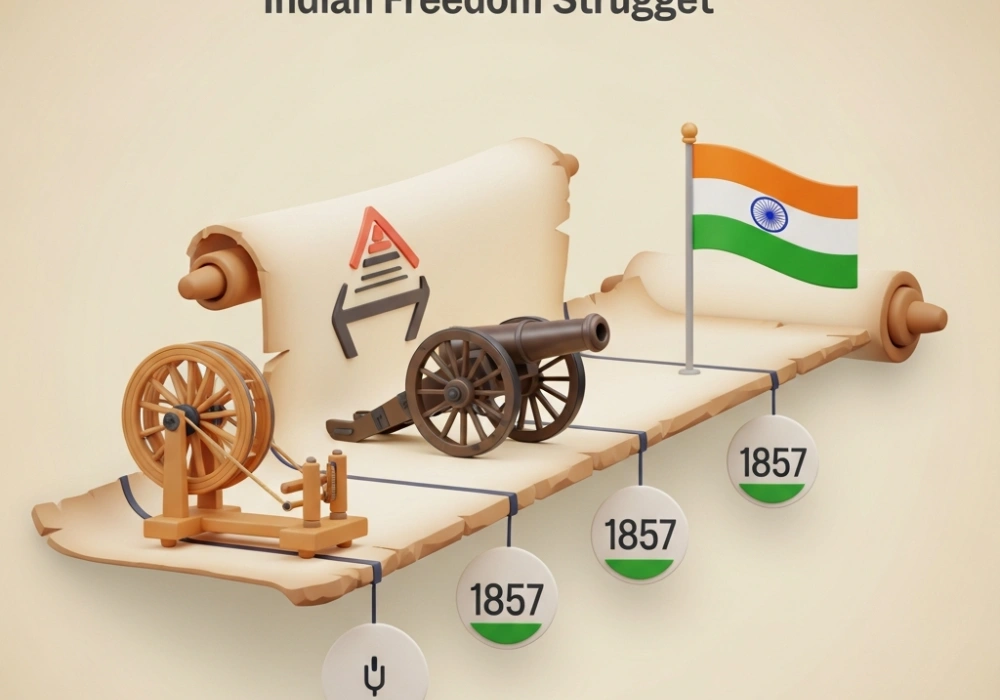
The Indian Freedom Struggle: A Comprehensive SSC Study Guide
The Indian Freedom Struggle is one of the most critical segments of the General Awareness section in SSC exams like CGL, CHSL, and MTS. To help you master this vast subject, we have curated an interactive study module and a detailed guide focusing on the chronology and key figures that shaped our nation’s history.
🎯 Exam Readiness Checklist
Mark the topics you have mastered to track your progress.
Phase 1: The Early Struggles (1857 – 1905)
The journey toward independence began significantly with the Revolt of 1857. Known as the First War of Independence, it was sparked by various factors, including the Doctrine of Lapse and the introduction of greased cartridges. Key leaders like Mangal Pandey, Bahadur Shah Zafar, and Rani Laxmi Bai became symbols of resistance. For SSC aspirants, it is crucial to remember the specific centers of revolt and their corresponding British suppressors.
Following the revolt, the Indian National Congress (INC) was formed in 1885 by A.O. Hume. The early phase (1885-1905) was dominated by ‘Moderates’ like Dadabhai Naoroji (The Grand Old Man of India) and W.C. Bonnerjee. They believed in constitutional methods and petitions.
Phase 2: The Rise of Extremism and the Gandhian Era
The 1905 Partition of Bengal by Lord Curzon led to a shift. The ‘Extremists’—Lal-Bal-Pal (Lala Lajpat Rai, Bal Gangadhar Tilak, and Bipin Chandra Pal)—advocated for Swadeshi and Boycott. Tilak’s slogan, “Swaraj is my birthright, and I shall have it,” became a rallying cry.
The arrival of Mahatma Gandhi in 1915 marked a turning point. His experiments with Satyagraha in Champaran (1917), Kheda (1918), and the Ahmedabad Mill Strike established him as a national leader. The brutal Jallianwala Bagh Massacre (1919) led to the Non-Cooperation Movement (1920-22), which was later called off due to the Chauri Chaura incident.
Phase 3: The Final Push for Swaraj
The 1930s saw the Civil Disobedience Movement launched with the iconic Dandi March to protest the Salt Tax. This period also witnessed the Three Round Table Conferences. Moving into the 1940s, the Quit India Movement (1942) was launched with the slogan “Do or Die.” Parallelly, Netaji Subhash Chandra Bose organized the Indian National Army (INA) to fight British forces from abroad.
Finally, the Mountbatten Plan led to the passing of the Indian Independence Act of 1947, marking the end of colonial rule. For SSC exams, ensure you memorize dates of key pacts like the Gandhi-Irwin Pact (1931) and Poona Pact (1932).
💡 Pro-Tip for SSC Aspirants
Focus on the ‘Chronology’ of events. SSC often asks to arrange movements in order. Also, keep a list of famous books/newspapers (e.g., ‘Hind Swaraj’, ‘Kesari’) and slogans ready!
Need help with your SSC preparation?
Get access to free mock tests, detailed study notes, and one-on-one guidance from our subject matter experts.
💬 Chat with our Experts on WhatsApp (+91 9526806124)




