
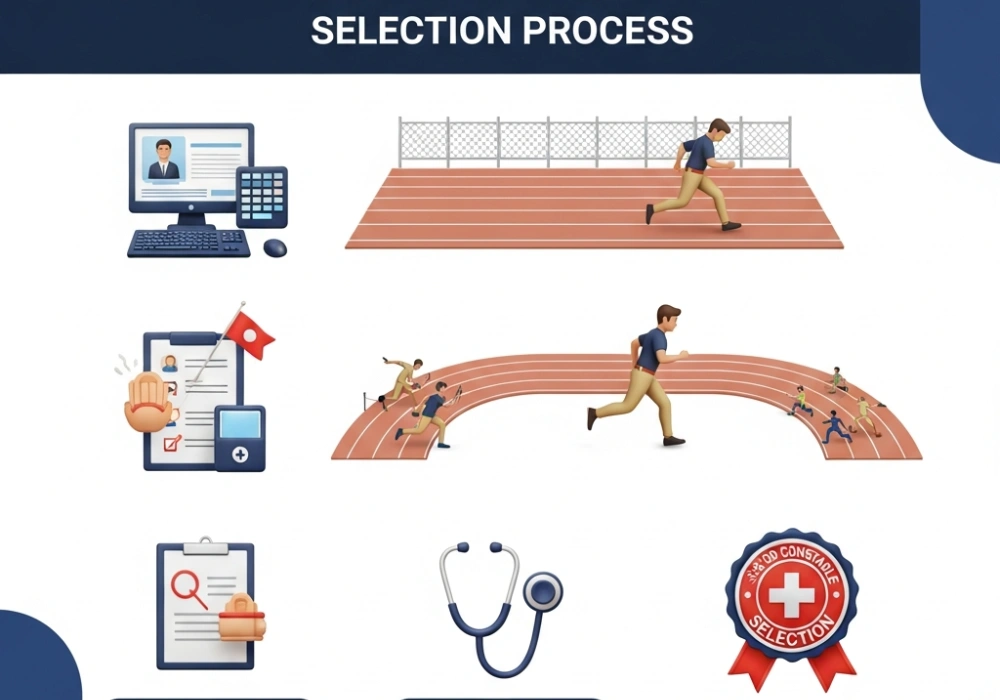
Introduction to the SSC GD Constable Recruitment Process
The Staff Selection Commission (SSC) conducts the General Duty (GD) Constable recruitment to select eligible candidates for various Central Armed Police Forces (CAPFs), SSF, and Rifleman (GD) in Assam Rifles. This recruitment is one of the most sought-after opportunities for youth across India aiming for a career in the paramilitary forces. However, success in this exam requires more than just hard work; it requires a clear understanding of the multi-stage selection process. In this guide, we will break down every phase of the recruitment journey to help you prepare effectively.
Preparing for such a competitive exam requires consistent practice. At myentrance.in, we provide specialized mock tests designed according to the latest pattern to ensure you are well-equipped to clear the first hurdle of the selection process.
Stage 1: Computer Based Examination (CBE)
The first and most crucial stage is the Computer Based Examination. This objective-type test evaluates candidates on various parameters ranging from logical reasoning to basic linguistic skills. Understanding the weightage of each section is key to prioritizing your study plan.
Exam Pattern Breakdown
The CBE consists of one objective-type paper containing 80 questions, carrying 2 marks each. The duration of the exam is 60 minutes. It is important to note that there is a negative marking of 0.25 marks for each wrong answer, so accuracy is just as important as speed.
| Subject Section | Number of Questions | Maximum Marks |
|---|---|---|
| Part A: General Intelligence and Reasoning | 20 | 40 |
| Part B: General Knowledge and General Awareness | 20 | 40 |
| Part C: Elementary Mathematics | 20 | 40 |
| Part D: English/Hindi | 20 | 40 |
| Total | 80 | 160 |
To excel in this stage, candidates should focus on high-yield topics and practice previous year papers. Our platform, myentrance.in, offers a comprehensive suite of SSC GD mock tests that simulate the real exam environment, helping you manage time efficiently.
Stage 2: Physical Efficiency Test (PET) and Physical Standard Test (PST)
Candidates who clear the cutoff for the CBE are shortlisted for the PET and PST. These tests are qualifying in nature and do not carry marks toward the final merit, but failing them results in immediate disqualification.
Physical Efficiency Test (PET)
The PET tests your physical endurance through a running event. The criteria differ for male and female candidates, and there are specific relaxations for candidates from the Ladakh region.
- For Male Candidates: 5 km in 24 minutes.
- For Female Candidates: 1.6 km in 8 minutes and 30 seconds.
Physical Standard Test (PST)
The PST involves the measurement of height, chest, and weight. Candidates must meet the following general standards:
- Height (Male): 170 cm
- Height (Female): 157 cm
- Chest (Male only): Unexpanded 80 cm, with a minimum expansion of 5 cm.
- Weight: Proportionate to height and age as per medical standards.
Note: Relaxations in height and chest measurements are provided to candidates belonging to ST categories and those from specific hilly regions like the North-East.
Stage 3: Detailed Medical Examination (DME) and Document Verification
Once you pass the physical tests, you will be called for the Detailed Medical Examination. The purpose of this stage is to ensure that the candidate is physically and mentally fit to serve in the demanding conditions of the CAPFs.
Key Aspects of the Medical Test
- Vision: The minimum distant vision should be 6/6 and 6/9 of both eyes without correction.
- General Health: Candidates must not have knock-knees, flat feet, varicose veins, or squint in the eyes.
- Tattoos: Specific guidelines apply regarding the size and location of tattoos, generally following the traditions of the Indian Army.
Document Verification (DV)
During the medical exam phase, candidates must produce original documents for verification. These typically include:
- Matriculation/Secondary Examination Certificate to prove age and educational qualification.
- Domicile Certificate/PRC issued by the competent authority.
- Caste Certificate (if applicable) in the format prescribed by the government.
- NCC Certificate (if applicable) to claim bonus marks.
Stage 4: Final Merit List and Allotment
The final selection is based on the performance of candidates in the Computer Based Examination. While PET, PST, and DME are qualifying, the marks obtained in the CBE determine your rank and force allotment (BSF, CISF, CRPF, SSB, ITBP, AR, or SSF) based on the preferences you filled during the application process.
Bonus marks are also awarded to NCC certificate holders during the preparation of the final merit list:
- NCC ‘C’ Certificate: 5% of maximum marks.
- NCC ‘B’ Certificate: 3% of maximum marks.
- NCC ‘A’ Certificate: 2% of maximum marks.
Expert Preparation Tips for SSC GD Success
1. Master the Basics: Clear your concepts in Elementary Mathematics and Reasoning. Don’t skip the basics of Grammar for the Hindi/English section.
2. Stay Updated: For General Awareness, follow daily current affairs and focus on Indian history, geography, and static GK.
3. Practice with Mock Tests: The CBE is time-bound. Regular practice on myentrance.in will help you identify weak areas and improve your question-solving speed.
4. Physical Routine: Don’t wait for the CBE results to start running. Start a light physical regimen today to ensure you meet the PET requirements.
5. Health Checkup: If you have minor issues like DNS or vision problems, consult a doctor early to see if they can be corrected before the DME.
Frequently Asked Questions (FAQ)
What is the minimum qualification for SSC GD Constable?
Candidates must have passed the 10th Class or Matriculation examination from a recognized Board or University at the time of application.
Is there any negative marking in the SSC GD exam?
Yes, there is a negative marking of 0.25 marks for every incorrect answer in the Computer Based Examination. It is advisable to avoid guesswork.
Can I choose my preferred force in SSC GD?
Yes, candidates can provide their order of preference for different forces (like CISF, BSF, etc.) in the application form. Allotment is made based on merit and preference.
What happens if I fail the medical examination?
If a candidate is found unfit, they may be informed of the grounds for rejection. In some cases, candidates can appeal for a Review Medical Examination (RME) within the specified timeframe.
How can I access mock tests for SSC GD?
You can access high-quality, exam-oriented mock tests at myentrance.in to boost your preparation for the upcoming recruitment cycle.
Need Help with Your SSC GD Preparation?
If you have any doubts regarding the selection process, medical standards, or need free guidance and premium mock tests, our experts are here to assist you!
💬 Chat with our Experts on WhatsApp (+91 9526806124)




