
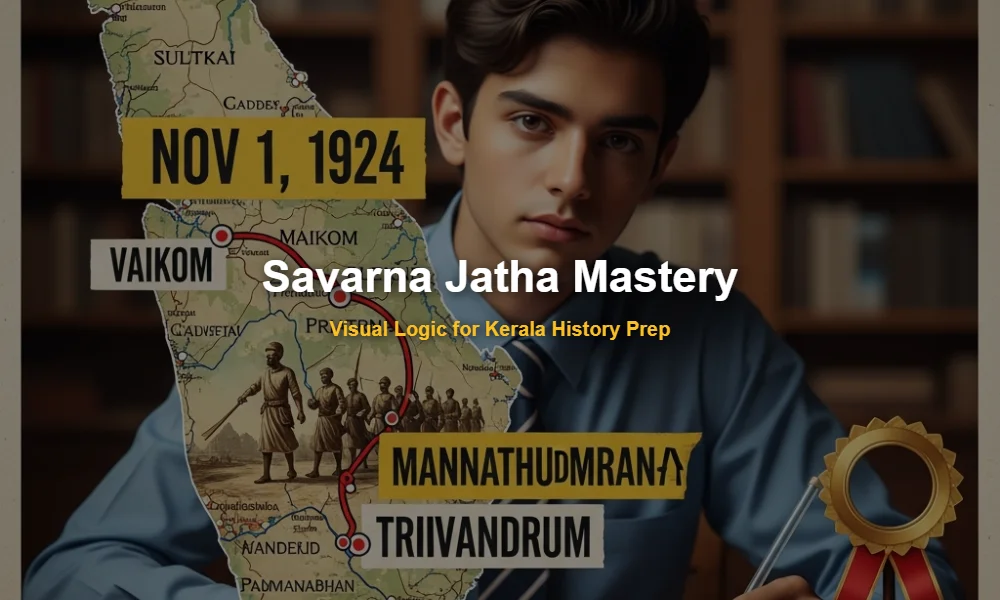
The Savarna Jatha: A Strategic Cognitive Overview
The Savarna Jatha was a historic march led by Mannathu Padmanabhan in 1924 to support the Vaikom Satyagraha. It aimed to prove that upper-caste Hindus supported the opening of temple roads to all, concluding with a memorandum submission in Trivandrum.
Hey Exam Warrior, I know the feeling. The nights are long, the Rank Files are thick, and the dates start to blur together. It feels like you’re trying to drink from a firehose. But history isn’t just about memorizing; it is about Spatial Visualization. By mapping the Jatha as a physical journey, we turn dry facts into a mental movie that you’ll never forget during those high-pressure exam minutes.
Spatial Timeline: Vaikom to Trivandrum (1924)
The Jatha began on November 1, 1924, traveling from Vaikom to Trivandrum over several weeks. This spatial progression mobilized public sentiment across Southern Kerala, creating a unified front that eventually forced the government to concede to the Satyagrahis’ demands.
| Date / Stage | Key Location | Significance |
|---|---|---|
| Nov 1, 1924 | Vaikom (Start) | Led by Mannathu Padmanabhan with 500 volunteers. |
| Intermediate | Quilon (Kollam) | Massive public reception; Changanassery Parameswaran Pillai joined. |
| Nov 12, 1924 | Trivandrum (End) | Grand procession to the Secretariat; met the Regent Maharani. |
Direct Impact on Vaikom Satyagraha Outcomes
The Savarna Jatha dismantled the government’s argument that the Satyagraha was an ‘anti-Hindu’ movement. By presenting a petition signed by 25,000 caste Hindus, it shifted the legal and moral ground, leading to the 1925 compromise and subsequent road openings.
- Psychological Shift: It removed the ‘Communal’ tag from the protest.
- Legislative Pressure: The resolution moved in the Sree Moolam Praja Sabha by N. Kumaran was bolstered by this Jatha’s momentum.
- National Attention: Gandhi’s subsequent visit in March 1925 was a direct result of the heightened pressure created by the Jatha.
💡 Pro-Tip: The ‘Double Jatha’ Pattern
Remember: There was a second Jatha! While Mannath led one from the South, Perumal Naidu led another from Nagercoil (Tamil Nadu). They met at Trivandrum. Spatial Logic: Think of it as a pincer movement on the capital!
Mentor’s Hack: The 15-Minute ‘Mind Mapping’ Routine
Listen, Warrior. Burnout is real. Don’t study for 6 hours straight. Use the 50:10 rule. Study for 50 minutes, then for 10 minutes, draw a rough map of Kerala. Plot Vaikom and Trivandrum. Draw an arrow. This spatial exercise anchors the Savarna Jatha in your long-term memory far better than re-reading the same page 10 times. You’ve got this!





