Translate Language
Samudrayaan Mission: Why is India Sending Humans 6000 Metres Under the Sea?
India is set to join an elite group of nations with the capability for deep-sea exploration. The Samudrayaan Mission, a part of India’s ambitious Deep Ocean Mission, aims to send a crewed submersible to a depth of 6,000 metres by 2027. This initiative is a monumental leap in harnessing the potential of the blue economy and is a key topic for any competitive exam.
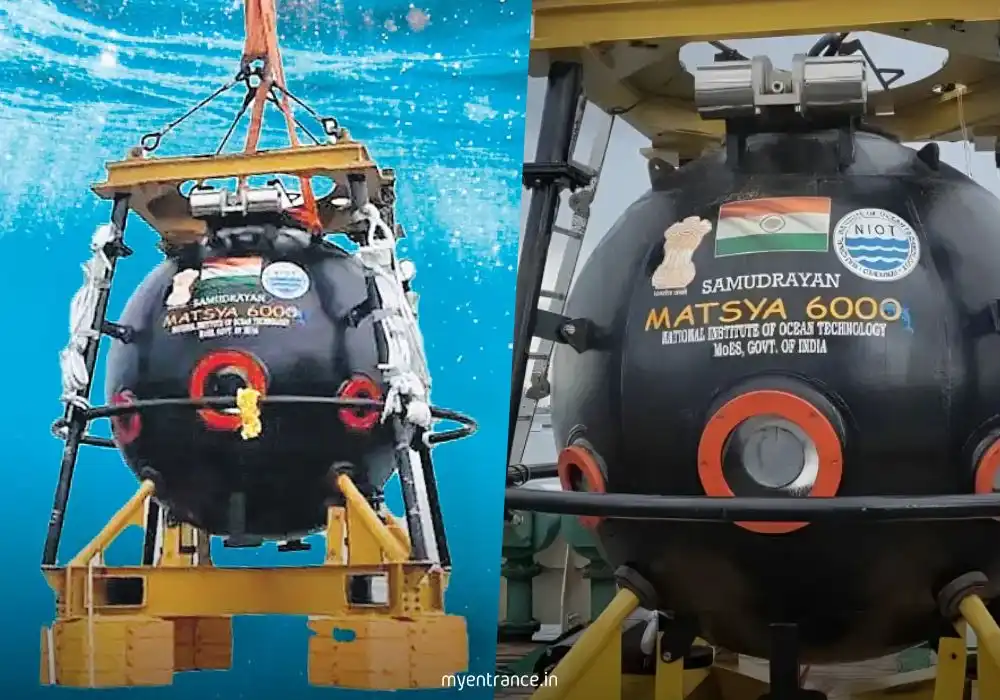
Samudrayaan: India’s Dive into the Deep Sea Frontier
Forget space for a moment; the next great frontier for exploration might be right here on Earth, in the immense, uncharted depths of our oceans. Following the stellar success of its space program, India is now turning its technological prowess inward to the deep sea with the groundbreaking Samudrayaan Mission.
So, what exactly is Samudrayaan? In simple terms, it’s India’s first-ever project to send humans into the deep ocean in an indigenously built submersible. The goal is audacious: to take three “aquanauts” (the deep-sea equivalent of astronauts) to a breathtaking depth of 6,000 metres by 2027.
Practice with our Daily News Quiz for your exams.
This mission isn’t just about exploration for the sake of it. It’s a strategic move with immense economic and scientific implications. The deep ocean floor is a treasure trove of untapped resources, including polymetallic nodules. These potato-sized nodules are rich in critical minerals like nickel, cobalt, manganese, and rare earth elements—all essential for everything from smartphones to electric vehicle batteries and renewable energy technology. By developing the capability to explore and potentially mine these resources, India is securing its economic and strategic future.
Here are the Current Affairs updates for UPSC aspirants.
The hero of this mission is Matsya-6000, a state-of-the-art, indigenously designed submersible. Designed to resemble a sturdy fish, its core is a 2.1-meter diameter titanium alloy sphere where the aquanauts will reside. This personnel sphere is a marvel of engineering, built to withstand the crushing pressure at 6,000 meters—nearly 600 times the pressure we feel at sea level. The vehicle is designed to support its crew for 12-hour missions, with a 96-hour emergency life support system.
The journey to this depth is fraught with immense challenges that Indian scientists have had to overcome:
Material Science: Developing a sphere strong enough meant moving from steel (for initial 500m tests) to a special, hard-to-source titanium alloy.
Communication: Radio waves fail underwater. India had to indigenously develop an acoustic telephone system that uses sound waves to transmit data to a surface receiver, a technology few nations are willing to share.
Unpredictable Environment: Factors like water temperature and salinity can affect equipment, requiring rigorous testing in real-world conditions, as witnessed during harbor and open-ocean trials.
Samudrayaan is a key pillar of the government’s Deep Ocean Mission and is a cornerstone of its Blue Economy policy. It aims to harness ocean resources for sustainable economic growth, leveraging India’s vast 7,500 km coastline. By achieving this, India will join an extremely exclusive club of nations, including the USA, Russia, France, China, and Japan, that possess such advanced deep-sea exploration capabilities.
Sample Questions and Answers for Exam Preparation
1. What is the primary objective of India’s Samudrayaan Mission?
Ans: The primary objective of the Samudrayaan Mission is to conduct a manned deep-sea exploration to a depth of 6,000 metres using the indigenous submersible, Matsya-6000, to survey and harness mineral resources and biodiversity from the ocean floor.
2. Name the indigenously developed submersible that will be used for the Samudrayaan Mission.
Ans: The submersible developed for the Samudrayaan Mission is called Matsya-6000.
3. What are polymetallic nodules, and why are they significant?
Ans: Polymetallic nodules are potato-shaped formations found on the deep ocean floor that contain layers of iron and manganese hydroxides. They are significant because they contain valuable minerals like nickel, cobalt, copper, and rare earth elements, which are crucial for modern technology and electronics.
4. Which mission does the Samudrayaan Project fall under?
Ans: The Samudrayaan Project is a key component of the Deep Ocean Mission, which was approved by the Union Cabinet in 2021.
5. What major challenge does communication pose in deep-sea missions, and how is India tackling it?
Ans: Radio waves cannot penetrate deep water, making standard communication impossible. India is tackling this challenge by using indigenously developed acoustic telephony, which uses sound waves to transmit information to a receiver on the surface.
Test yourself with a Free NIFT mock test. Use code WELCOME28 during checkout.
Why is this Important for Exams?
The Samudrayaan Mission and the Deep Ocean Mission are critically important for competitive exams like UPSC, SSC, and Kerala PSC for several reasons:
High-Profile Current Affairs: It is a major national scientific achievement and a testament to India’s growing prowess in indigenizing cutting-edge technology.
Syllabus Alignment: It directly fits the UPSC Prelims syllabus under “Current events of national and international importance” and the UPSC Mains GS-III syllabus under “Achievements of Indians in science & technology; indigenization of technology.”
Multi-Dimensional Topic: It touches upon economics (Blue Economy, mineral security), environment (sustainable exploration), geography (oceanography), and international relations (strategic advantage).
Potential for Application: Exam papers often ask about the economic and strategic significance of such missions, the challenges involved, and their comparison with global programs.
Understanding Samudrayaan provides a holistic view of India’s scientific ambitions beyond space, making it a potential high-mark yielding topic for any serious aspirant.
Read More Topics