
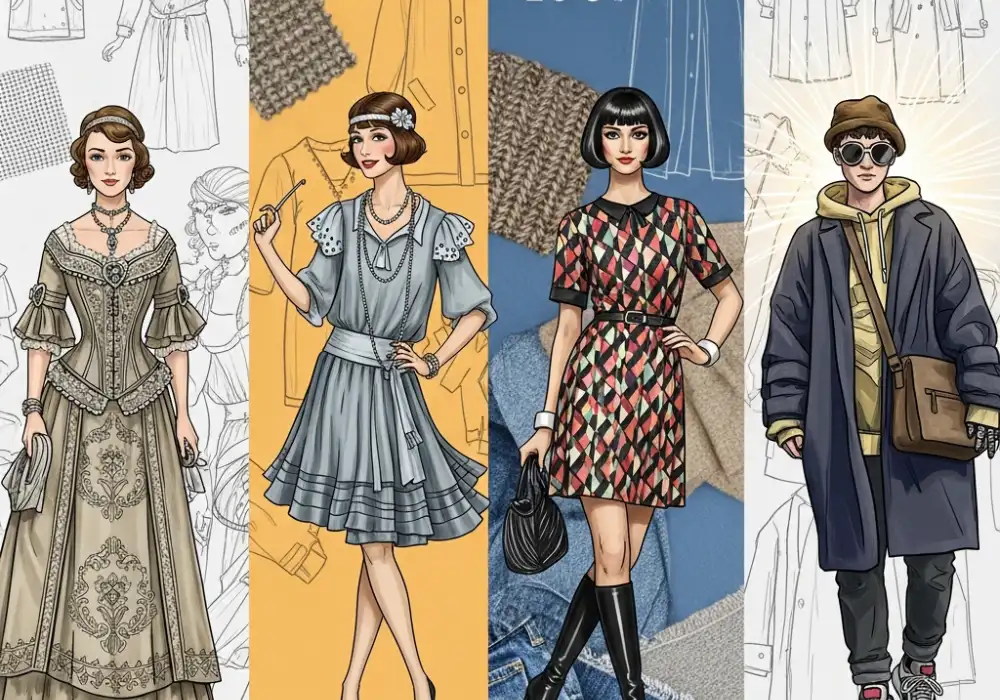
The Evolution of Style: An Interactive Journey for NIFT Aspirants
For any student preparing for the National Institute of Fashion Technology (NIFT) entrance examination, understanding the history of fashion is not just a matter of rote learning; it is about grasping the soul of design. The GAT (General Ability Test) frequently features questions regarding famous designers, iconic silhouettes, and the socio-political movements that triggered shifts in how people dressed. In the CAT (Creative Ability Test), a solid grounding in fashion history allows you to draw inspiration from the past to create futuristic designs that are anchored in reality.
Fashion is never a static entity. It is a reflection of the world around us—economies, wars, technological breakthroughs, and rebellions. From the rigid corsetry of the Victorian era to the fluid, gender-neutral designs of the 21st century, every hemline change and fabric choice tells a story. This guide is designed to provide you with a comprehensive, chronological roadmap of the most influential fashion movements. By studying this timeline, you will develop a ‘visual vocabulary’ that is essential for cracking the NIFT exam and succeeding in the competitive world of design education.
Why Fashion History Matters for NIFT
In the NIFT exam, you are often tested on your awareness of cultural context. For instance, why did the ‘Mini Skirt’ become popular in the 1960s? It wasn’t just a trend; it was a symbol of women’s liberation and the growing influence of youth culture. Understanding the ‘Why’ behind the ‘What’ is what separates a top-ranker from an average candidate. This interactive timeline highlights the pivotal moments that changed the course of fashion history, providing the ‘Deep Knowledge’ required for the NIFT General Awareness section.
1890 – 1914
The Belle Époque & The S-Bend Silhouette
This era, known as the ‘Beautiful Age,’ was characterized by extreme luxury and decorative arts. In fashion, the ‘S-bend’ corset was the defining element, pushing the chest forward and the hips back to create a literal S-shape. High collars, voluminous hats, and the ‘Gibson Girl’ look dominated. For NIFT, remember that this era marks the height of Haute Couture in Paris, with Charles Frederick Worth often cited as the father of modern couture. The focus was on intricate lace, silk, and embroidery.
1920 – 1929
The Roaring Twenties: The Flapper Revolution
Following WWI, fashion saw a radical shift. The ‘Flapper’ look emerged, characterized by dropped waistlines, bobbed hair, and shorter hemlines. This movement represented women’s newfound freedom and the right to vote. Key designers to note for the exam include Coco Chanel, who popularized the ‘Little Black Dress’ (LBD) and the use of jersey fabric. This era transitioned fashion from the restrictive Victorian ideals to modern comfort and athleticism.
1930 – 1939
Hollywood Glamour & The Bias Cut
During the Great Depression, fashion moved back toward a more feminine, elongated silhouette. The ‘Bias Cut,’ perfected by Madeleine Vionnet, allowed fabric to drape over the body’s curves elegantly. Surrealism also influenced fashion during this time, most notably through Elsa Schiaparelli, who collaborated with artists like Salvador Dalí. For NIFT, understand the contrast between the escapism of Hollywood glamour and the economic realities of the decade.
1947 – 1952
The New Look: Post-War Opulence
In 1947, Christian Dior launched his first collection, famously dubbed ‘The New Look.’ After years of wartime rationing and utility clothing, Dior introduced full skirts, cinched waists, and structured shoulders. This era redefined femininity and put Paris back at the center of the fashion world. NIFT aspirants should study how this look required yards of fabric, signaling the end of wartime austerity and the return of luxury.
1960 – 1969
The Youthquake & Space Age Fashion
The 1960s saw fashion shift from the elite to the youth. Mary Quant’s miniskirts and André Courrèges’ ‘Space Age’ looks using PVC and metallic fabrics defined the era. The ‘Mod’ subculture in London became a global phenomenon. For the exam, note the influence of pop art and the moon landing on design aesthetics. This was the decade that celebrated rebellion and experimentation with unconventional materials.
1970 – 1979
Eclecticism: Disco, Punk, and Bohemia
The 70s were a melting pot of styles. On one hand, you had the glamorous, polyester-filled Disco scene; on the other, the raw, DIY aesthetic of Punk fashion spearheaded by Vivienne Westwood. Bohemian style also thrived with flowing maxi dresses and earthy tones. This era is crucial for NIFT students to study for its diversity in subcultures and the ‘anti-fashion’ sentiment that began to emerge toward the end of the decade.
1980 – 1989
Power Dressing & Post-Modernism
The 1980s were about ‘excess.’ Power dressing emerged as women entered high-level corporate roles, characterized by massive shoulder pads and bold suits (think Giorgio Armani). At the same time, the fitness craze led to the popularization of spandex and leg warmers. Japanese designers like Yohji Yamamoto and Rei Kawakubo (Comme des Garçons) began challenging Western notions of beauty with deconstructed, oversized garments.
1990 – 1999
Grunge, Minimalism & The Supermodel Era
The 90s reacted against 80s excess. The Grunge movement, inspired by bands like Nirvana, brought flannel shirts and distressed denim to the runway through Marc Jacobs. Conversely, Minimalism thrived with designers like Calvin Klein and Jil Sander focusing on clean lines and neutral palettes. This was also the decade of the ‘Supermodel’ (Naomi Campbell, Kate Moss), who became as famous as the clothes they wore.
2000 – 2010
The Rise of Fast Fashion & Logomania
The new millennium saw the explosion of ‘Fast Fashion’ brands like Zara and H&M, making high-fashion trends accessible to the masses at lightning speed. ‘Logomania’—where brand logos were prominently displayed—became a status symbol. For NIFT, study how the internet and early social media began to speed up the trend cycle, leading to the rapid rise and fall of ‘it’ items.
2010 – PRESENT
Sustainability, Streetwear & Digital Fashion
Modern fashion is defined by the tension between the speed of the digital world and the urgent need for sustainability. Streetwear (Off-White, Supreme) has merged with luxury, while 3D printing and Metaverse-ready digital garments are the new frontiers. NIFT examiners now focus heavily on sustainable practices, ethical sourcing, and ‘slow fashion’ as key topics for essay questions and design briefs.
Study Guide: How to Ace Fashion History Questions
Now that you have navigated the timeline, how do you use this information to score high marks in the NIFT entrance exam? Here are three expert strategies:
- Connect the Dots: Never study a movement in isolation. Link the ‘Space Age’ of the 60s to the Cold War and the Moon Landing. Link the ‘Grunge’ of the 90s to the economic recession and the shift away from the vanity of the 80s.
- Memorize Key Terminology: Terms like ‘Avant-garde’ (experimental/innovative), ‘Prêt-à-porter’ (ready-to-wear), and ‘Trompe-l’œil’ (optical illusion) are favorites in the NIFT GAT paper. Ensure you can define these and link them to their respective eras.
- Focus on Indian Context: While global fashion is important, NIFT also tests your knowledge of how these movements interacted with Indian trends. For example, how did the 70s hippie movement influence Indian handloom exports? Or how is modern Indian streetwear blending traditional textiles with global silhouettes?
The history of fashion is a cyclical journey. We see the corsets of the 1890s returning as ‘Regency-core’ today. We see the bold colors of the 80s in contemporary ‘Dopamine Dressing.’ By understanding the origins, you gain the power to predict the future—a trait every top fashion designer must possess. Keep practicing, keep sketching, and keep observing the world around you. Your journey to NIFT starts with understanding where we’ve been, so you can decide where we are going.
Ready to Crack the NIFT Exam?
Don’t navigate this journey alone. Get expert mentorship, curated study materials, and the best mock tests designed specifically for the latest NIFT pattern. Whether you have doubts about GAT topics or need feedback on your CAT portfolio, our experts are here to help!
💬 Chat with our Experts on WhatsApp (+91 9526806124)




