
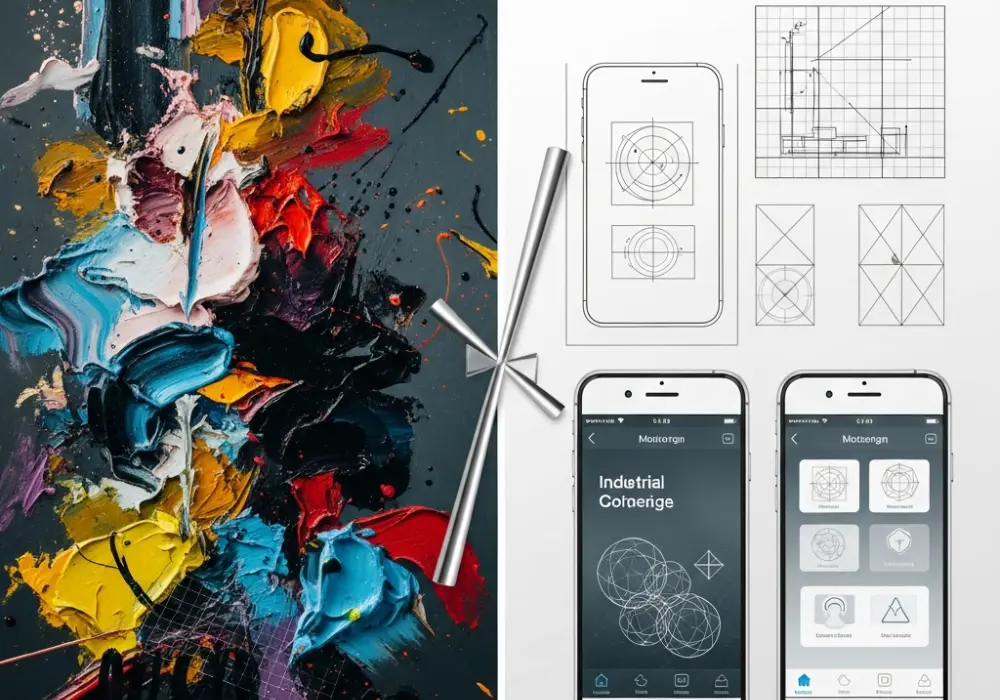
Art vs. Design: The Ultimate NIFT Guide
Bridging the gap between self-expression and problem-solving for the NIFT Creative Ability Test (CAT).
Introduction: The Designer’s Mindset
For every aspiring student aiming for the National Institute of Fashion Technology (NIFT), understanding the fundamental distinction between ‘Art’ and ‘Design’ is not just an academic exercise—it is the foundation of your entire career. Often, students enter the entrance exam hall thinking that being a ‘good artist’ is enough to secure a top rank. However, the NIFT examiners are not looking for painters; they are looking for problem solvers. While art and design share a visual language—color, line, texture, and form—their goals are worlds apart. This guide will dissect these differences and provide you with the tools to transition from an artistic mindset to a design-oriented approach.
Design is a conscious effort to create something that functions within a set of constraints. Art, on the other hand, is an exploration of the internal world. In the following sections, we will explore why a beautiful drawing might fail the NIFT CAT if it doesn’t solve the specific problem posed in the question paper.
Interactive Comparison: Art vs. Design
Slide the handle to see how an artistic concept is transformed into a functional design. Look for the tooltips to identify ‘Mistakes’ in the artistic version when applied to a functional context.
EXHIBITION 2024
Opening Nov 12th | Entry Free for Students
Section 1: The Essence of Art
Art is essentially an internal monologue made external. It is the artist’s attempt to capture a feeling, an idea, or a moment without the burden of utility. When a painter creates a canvas, they are not necessarily trying to make your life easier or help you navigate a website. They are inviting you into their world.
Key Characteristics of Art:
- Subjective: The meaning of art lies in the eyes of the beholder. One person might see sadness, another might see joy.
- Expressive: It prioritizes the artist’s voice and vision.
- No Set Solution: There is no ‘right’ or ‘wrong’ way for a painting to look.
- Asks Questions: Good art often provokes thought and leaves the audience wondering ‘Why?’.
In the NIFT CAT, students often make the mistake of being too ‘artistic’ in their product design questions. For example, if asked to design a futuristic water bottle, an artist might focus on a shape that looks like a melting clock (inspired by Dali). While visually stunning, it fails as a piece of design because it is difficult to hold and impossible to clean.
Section 2: The Logic of Design
Design is a service. It is a problem-solving process that starts with a ‘Who’, ‘What’, and ‘Where’. If art is about ‘How I feel,’ design is about ‘How this works for the user.’ Design must follow a specific set of rules—ergonomics, psychology, materials, and physics.
Key Characteristics of Design:
- Objective: Design has a specific job to do. If it doesn’t do that job, it is a bad design.
- Functional: It prioritizes utility and usability.
- Problem-Oriented: It starts with a problem (e.g., ‘People are losing their keys’) and finds a solution.
- Answers Questions: Good design explains itself. You shouldn’t need a manual to understand how to open a door.
For a NIFT aspirant, this means every line you draw must have a reason. If you use a specific color, is it because it’s your favorite color (Art), or because it evokes the right emotion for the brand (Design)?
Deep Dive: The Comparison Table
| Feature | Art | Design |
|---|---|---|
| Primary Goal | Self-expression / Aesthetic impact | Problem solving / Functionality |
| Audience | The viewer / The world | The user / The target market |
| Constraints | Very few; mostly self-imposed | Many: Budget, material, user needs |
| Success Metric | Emotional resonance | Efficiency and task completion |
Section 3: Why NIFT Cares About This
The NIFT Creative Ability Test (CAT) is designed to filter out students who can merely copy an image from those who can innovate. When you are asked to ‘Design a logo for a sustainable organic brand,’ the examiner is grading you on:
- Concept: Does the logo convey ‘nature’ and ‘trust’?
- Execution: Is the line work clean? Is it reproducible on a business card and a billboard?
- Color Theory: Did you use greens and earths (Design logic) or neon pink just because you like it (Art logic)?
Remember the ‘Form Follows Function’ rule. This is a principle associated with late 19th and early 20th-century industrial design and architecture, which states that the shape of a building or object should primarily relate to its intended function or purpose. In NIFT, if you design a chair that looks like a cloud but has spikes on the seat for ‘artistic texture,’ you will lose marks.
Practical Tips for the NIFT Exam
To succeed in the NIFT CAT, you must learn to think like a designer. Here are three practical steps to help you in your preparation:
- Analyze Everyday Objects: Look at a spoon. Why is the handle that long? Why is it curved? That is design. Now, look at a decorative sculpture of a spoon. That is art. Notice the difference in weight, material, and balance.
- Read the Question Twice: If the question says ‘Design a wearable garment inspired by a peacock,’ do not just draw a peacock. Think about how the peacock’s feathers move, the iridescence, and how a human body can carry those elements comfortably.
- User-Centricity: Always ask yourself, ‘Who is using this?’ If you are designing a toy for a toddler, use rounded edges and bright, primary colors. If you are designing a luxury watch for a CEO, use sleek lines and sophisticated palettes.
Conclusion
Art and Design are two sides of the same creative coin. While art provides the inspiration and the aesthetic soul, design provides the structure and the purpose. To ace the NIFT exam, you must be an artist who can think like an engineer. You must have the soul of a painter but the discipline of a builder. Master this balance, and you will find your name on the NIFT merit list.
Keep practicing, keep observing, and most importantly, keep questioning the ‘Why’ behind every creation. Your journey into the world of fashion and design begins with this single realization: you are no longer just an artist; you are a designer.
Ready to Ace your NIFT Entrance?
Join our exclusive coaching program and get access to mock tests, personal feedback from NIFT alumni, and specialized CAT/GAT modules.
💬 Chat with our Experts on WhatsApp (+91 9526806124)




