
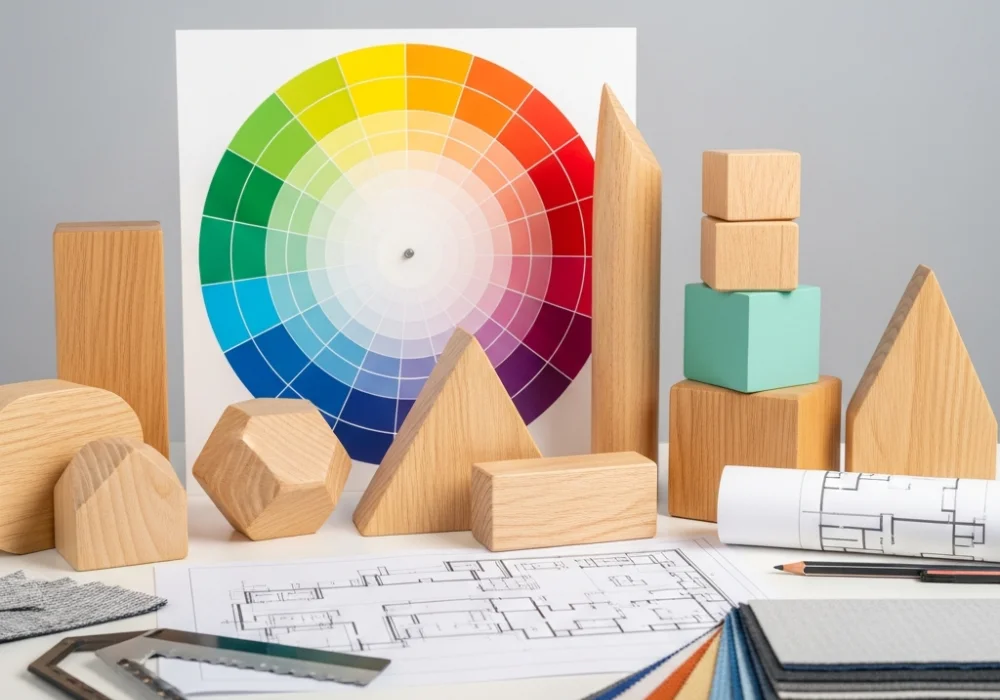
The Fundamentals: Elements of Design for NIFT GAT
Everything you need to know about the visual building blocks for your design entrance exam.
Syllabus Weightage: Design Theory Components
Hover over sections to see the relative importance in the GAT Design Theory section.
What are the Elements of Design?
In the context of the National Institute of Fashion Technology (NIFT) General Ability Test (GAT), the ‘Elements of Design’ represent the fundamental building blocks used by designers to create visual compositions. Whether it is a garment, a logo, or a building, every design is constructed using these basic units. For a NIFT aspirant, understanding these is not just about theory; it is about developing an ‘eye’ for design that will help you solve visual logic and aesthetic questions in the exam.
1. Line: The Path of a Moving Point
A line is the most basic element. It can be thin, thick, dashed, curved, or jagged. In design, lines are used to create edges, provide structure, and guide the viewer’s eye. Vertical lines often convey strength and stability, whereas horizontal lines suggest calmness. Diagonal lines are dynamic and imply movement or tension, a frequent topic in NIFT visual reasoning questions.
2. Shape and Form
When a line closes on itself, it creates a shape. Shapes are two-dimensional (flat) and can be geometric (squares, circles) or organic (natural, free-flowing). Form, on the other hand, is three-dimensional. It has depth, height, and width. In NIFT exams, you might be asked to identify the ‘form’ of a folded paper or a 3D object visualized from different angles.
3. Color: The Most Expressive Element
Color is defined by three properties: Hue (the name of the color), Value (lightness or darkness), and Intensity (brightness or dullness). Understanding the Color Wheel is vital. Questions often revolve around primary, secondary, and tertiary colors, as well as color schemes like Monochromatic, Analogous, and Complementary. Remember, color psychology plays a huge role in branding and fashion design.
4. Texture: The Surface Quality
Texture refers to how a surface feels or is perceived to feel. There are two types: Tactile texture (the physical feel of fabric) and Visual texture (the illusion of texture on a 2D surface). In the NIFT GAT, you might encounter questions about identifying fabric textures or the mood created by different surface finishes.
5. Space: The Area Around and Within
Space deals with the area between elements. Positive space is the subject itself, while Negative space is the empty area around it. Designers use negative space to create balance and focus. Understanding ‘depth’ and ‘perspective’—the illusion of 3D space on a 2D surface—is a frequent hurdle in design aptitude tests.
6. Value: Light and Shadow
Value is the relative lightness or darkness of a color. High contrast (black vs. white) creates a bold look, while low contrast creates a subtle, soft mood. This element is crucial for creating ‘Form’ and ‘Depth’ in sketching and visual identification questions.
Expert Tip for NIFT Aspirants
When preparing for the GAT, do not just memorize definitions. Look at advertisements, fashion shows, and even the architecture around you. Try to identify which elements are dominant. Is the design line-heavy or shape-focused? Does the color scheme use complementary colors? This practical observation is what sets top-rankers apart.
Ready to Ace your NIFT Exam?
Join our specialized coaching sessions and get access to premium mock tests and personalized guidance.
💬 Chat with our Experts on WhatsApp (+91 9526806124)




