
Table of Contents
Introduction to NIFT Entrance Components
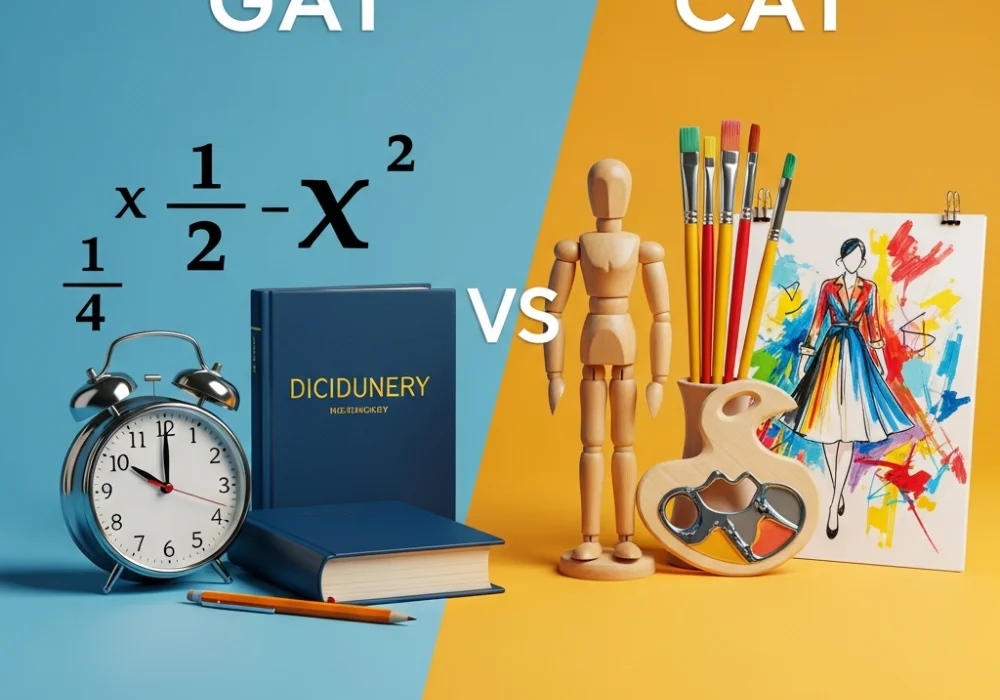
For any design aspirant dreaming of a seat at the National Institute of Fashion Technology (NIFT), understanding the dual nature of the entrance exam is the first step toward success. The NIFT entrance is uniquely structured to evaluate both the analytical brain and the creative soul. It consists primarily of two written stages: the General Ability Test (GAT) and the Creative Ability Test (CAT).
While many students gravitate toward the artistic flair of the CAT, the GAT often acts as the silent tie-breaker that determines your final merit rank. To secure admission into prestigious programs like B.Des (Bachelor of Design) or B.FTech (Bachelor of Fashion Technology), you must excel in both. This guide provides a comprehensive analysis of the latest pattern differences and strategic approaches to help you navigate these papers effectively. At myentrance.in, we provide specialized mock tests that simulate the intensity of both these papers to ensure you are exam-ready.
Decoding the General Ability Test (GAT)
The GAT is the standardized, objective portion of the NIFT entrance. It is designed to assess a candidate’s aptitude in areas such as logic, language, and general awareness. For B.Des students, the GAT usually carries a weightage of 30%, whereas for B.FTech, M.FTech, and MFM, it carries significantly more weight as there is often no CAT for technical courses.
Key Sections of GAT
- Quantitative Ability: Focuses on basic mathematical concepts like Addition, Multiplication, Division, Fractions, Percentages, Rate of Interest, Work and Task, Ratio and Proportion, and Distance. The level is typically up to Grade 10.
- Communication Ability and English Comprehension: This tests your grasp of the English language through synonyms, antonyms, idioms, phrases, and reading comprehension.
- Analytical and Logical Ability: This evaluates your capacity for inference and logic through series, analogies, and puzzles.
- General Knowledge and Current Affairs: A section that requires staying updated with national and international events, particularly in the fashion and textile industry.
💡 Pro-Tip for GAT
Focus on speed! Since GAT has a larger number of questions in a limited timeframe, practicing mental math and rapid reading through mock tests on myentrance.in can give you a 20% edge over other candidates.
Mastering the Creative Ability Test (CAT)
The CAT is where your imagination takes flight. Unlike the objective GAT, CAT is a subjective paper. It is designed to judge the intuition, power of observation, innovation in development of a concept, and design ability of the candidate. For B.Des aspirants, this paper holds a massive 50% weightage, making it the most critical part of the examination.
What is tested in CAT?
- Visualization Skills: How well you can convert a text prompt into a visual 2D or 3D representation.
- Color Theory: Your ability to use colors to evoke specific moods or themes.
- Storytelling: Often, you are asked to draw a comic strip or a sequence of events, testing your narrative skills.
- Proportion and Perspective: Technical drawing skills such as one-point or two-point perspective and human anatomy proportions.
The latest patterns show an increasing focus on socio-cultural themes and sustainable design concepts. Candidates are expected to think outside the box rather than providing literal interpretations of the prompts.
GAT vs CAT: The Comparative Breakdown
Understanding the fundamental differences is crucial for effective time allocation during your preparation phase. The table below summarizes the core contrasts based on the latest pattern.
| Feature | NIFT GAT | NIFT CAT |
|---|---|---|
| Nature of Exam | Objective (MCQs) | Subjective (Drawing/Design) |
| Weightage (B.Des) | 30% | 50% |
| Primary Goal | Test IQ and General Knowledge | Test EQ, Creativity, and Aesthetics |
| Negative Marking | Yes (usually 0.25) | No |
| Equipment Needed | Pen/Pencil | Pencils, Colors, Erasers, Scales |
Effective Scoring Strategies for Both Sections
Success in NIFT requires a balanced strategy. You cannot afford to ignore one for the other. Here is how to approach them:
Strategies for GAT Excellence
- Strengthen the Basics: Since the math is up to Grade 10, revisit your NCERT textbooks. Don’t leave out topics like ‘Time and Work’ or ‘Profit and Loss’.
- Vocabulary Building: Read fashion magazines and newspapers daily to improve your vocabulary and stay updated on industry trends.
- Time Management: Spend no more than 45-60 seconds on a single GAT question. If you are stuck, move on.
Strategies for CAT Brilliance
- Conceptualize First, Draw Later: Spend the first 5-10 minutes brainstorming and thumbnailing your ideas. A well-thought-out concept with average drawing often scores higher than a beautifully rendered but generic idea.
- Master Human Anatomy: Practice drawing human figures in various poses. Whether it’s a fashion illustration or a scene, correct proportions are vital.
- Cleanliness Matters: Keep your sheet clean. Avoid excessive smudging or over-erasing, as it reflects a lack of confidence in your strokes.
The Role of Mock Tests in Preparation
Preparation is incomplete without regular assessment. This is where myentrance.in becomes your best ally. Our mock test series for NIFT is curated by industry experts and alumni. We offer:
- Real-time Simulation: Experience the same pressure and time constraints as the actual GAT paper.
- Detailed Solutions: Understand the logic behind every answer in the GAT section.
- Creative Prompts: Access a library of CAT prompts that have appeared in previous years or are trending in current design circles.
By solving at least 10-15 mock tests, you build the stamina required for the long exam day and reduce the likelihood of making silly mistakes under pressure.
Frequently Asked Questions (FAQs)
Is GAT compulsory for all NIFT courses?
Yes, the General Ability Test (GAT) is compulsory for all undergraduate and postgraduate programs offered by NIFT, though the weightage varies by course.
Can I use sketch pens in the CAT paper?
Usually, NIFT allows various coloring mediums like color pencils, crayons, and water colors. However, sketch pens are often discouraged as they can bleed through the paper. Always check the specific instructions on the latest admit card.
How much time is allotted for GAT and CAT?
Typically, GAT lasts for 2 hours and CAT lasts for 3 hours. Candidates are often given both papers on the same day with a small break in between.
Quick Knowledge Check
Test your understanding of the NIFT pattern with these quick questions!
1. Which paper holds the highest weightage for B.Des candidates?
💡 Click to Reveal Answer
The Creative Ability Test (CAT), which generally accounts for 50% of the total score.
2. Does the GAT paper have negative marking?
💡 Click to Reveal Answer
Yes, usually 0.25 marks are deducted for every wrong answer in the GAT section.
3. What is the primary focus of the Quantitative Ability section?
💡 Click to Reveal Answer
Basic mathematics up to Grade 10, including ratios, percentages, and simple geometry.
Ready to Crack NIFT?
Don’t leave your design dreams to chance. Start practicing with our comprehensive mock tests and expert-curated study materials today at myentrance.in!
💬 Chat with our Experts on WhatsApp (+91 9526806124)




