
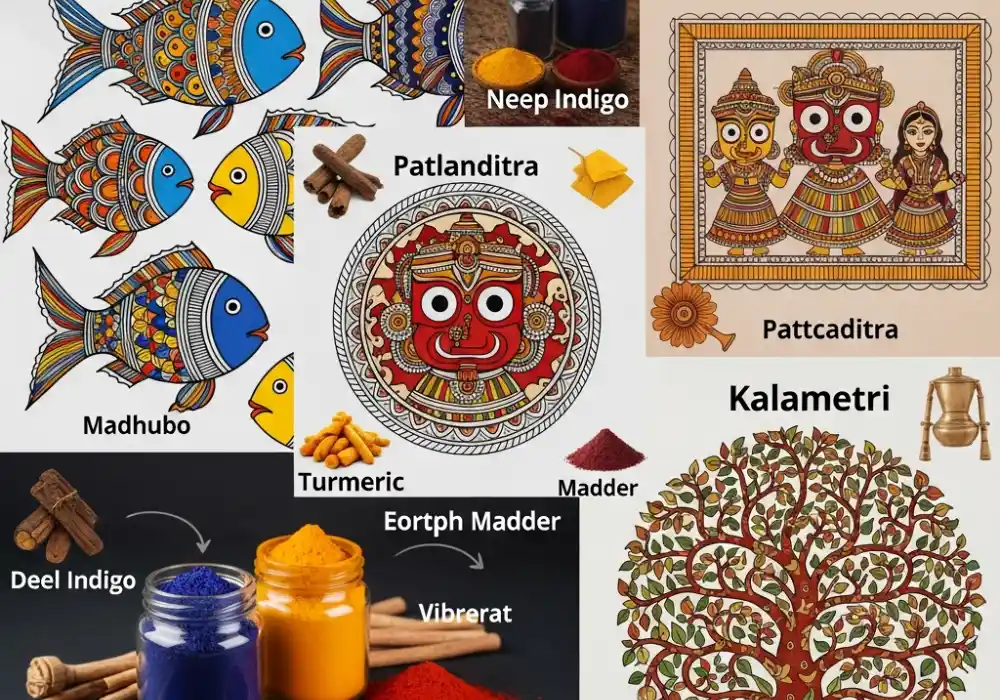
Mastering Ritualistic Painting Styles for NIFT GAT: A Comprehensive Decoder
The National Institute of Fashion Technology (NIFT) General Ability Test (GAT) consistently places a heavy emphasis on the General Knowledge and Case Study sections, specifically targeting India’s rich heritage of traditional crafts and textile arts. Among these, the ritualistic painting styles of Madhubani, Pattachitra, and Kalamkari are favorites for examiners. These art forms are not merely decorative; they are deeply rooted in spiritual rituals, local geography, and ancient chemistry. To excel in the NIFT GAT, a candidate must go beyond basic identification and understand the specific motifs, the intricate processes of preparing natural dyes, and the regional nuances that differentiate these styles.
The Importance of Traditional Paintings in the NIFT GAT Exam
Every year, the GAT paper includes questions that test your ability to distinguish between various regional art forms. Why? Because as a future designer, your visual vocabulary must be rooted in cultural context. Understanding the difference between a Madhubani ‘Kohbar’ and a Kalamkari ‘Tree of Life’ is essential for anyone aiming for the top NIFT campuses. In this guide, we will decode five critical questions modeled after Previous Year Questions to give you a competitive edge.
Simulated Question 1: The Mordant Mystery in Kalamkari
Question: In the traditional Srikalahasti style of Kalamkari, what is the specific purpose of treating the cotton cloth with a mixture of Myrobalan (nutgall) and buffalo milk before the application of dyes?
- A) To bleach the cloth to a pure white color.
- B) To act as a mordant and prevent the dyes from spreading.
- C) To make the cloth stiff for easier drawing.
- D) To create a scent that repels insects.
Traditional Method: A student would typically try to recall the entire 17-step process of Kalamkari. They might remember that milk is used but get confused between the bleaching stage and the dyeing stage. This leads to wasting 2-3 minutes trying to visualize the process.
30-Second Ninja Shortcut: Remember the ‘Protein-Fix’ rule. In Kalamkari, the buffalo milk provides a protein layer that prevents the natural dye (which is acidic or neutral) from bleeding or spreading across the fabric fibers. The Myrobalan contains tannins that react with iron to create black. Keyword: Prevent spreading. Correct Answer: B.
Deep Concept Dive: Kalamkari, literally meaning ‘pen-work’, uses a bamboo stick (Kalam) pointed with a bundle of fine hair. The Srikalahasti style is purely hand-drawn, whereas Machilipatnam uses blocks. The use of milk is a unique chemical hack where the fat and protein content ensures the sharp outlines of the motifs are maintained.
Simulated Question 2: Decoding Madhubani Motifs
Question: The ‘Kohbar’ motif in Madhubani painting, traditionally painted in the nuptial chamber, is primarily characterized by which of the following symbols of fertility and prosperity?
- A) A solitary Buddhist stupa and lotus.
- B) A pond filled with fish, tortoises, and a central bamboo stalk.
- C) Geometrical shapes depicting the solar system.
- D) Portraits of the ruling local kings and queens.
Traditional Method: Reading through art history books and trying to memorize every possible motif in Mithila art. This is inefficient as Madhubani has five distinct styles (Bharni, Katchni, Tantrik, Godna, Kohbar).
30-Second Ninja Shortcut: Use the ‘Nature-Nurture’ association. Madhubani is about abundance. Look for motifs that represent multiplication in nature: Fish (multiple eggs), Bamboo (fast-growing), and Tortoise (long life). Keyword: Pond/Fish/Bamboo. Correct Answer: B.
Deep Concept Dive: Madhubani originated in the Mithila region of Bihar. It was originally a wall painting (Bhitti Chitra) done by women. The ‘Kohbar’ is the most symbolic, representing the union of the couple. Notice the ‘Katchni’ style which uses only line work and hatching, while ‘Bharni’ uses bold colors to fill spaces.
Simulated Question 3: The Pigments of Pattachitra
Question: Unlike Madhubani which uses vegetable dyes, Pattachitra from Odisha traditionally utilizes mineral-based pigments. Which of the following correctly matches the color with its traditional source in Pattachitra?
- A) White – Chalk powder; Black – Charcoal.
- B) White – Conch shell (Sankha); Black – Lamp soot (Kajal).
- C) Yellow – Turmeric; Red – Beetroot.
- D) Blue – Synthetic Indigo; Green – Crushed leaves.
Traditional Method: Trying to memorize the chemical composition of every traditional paint. This is often confusing as many styles use ‘Indigo’ or ‘Turmeric’.
30-Second Ninja Shortcut: The ‘Marine Connection’. Since Pattachitra is from Odisha (coastal), they use sea-based sources. Sankha (Conch shell) is the unique white of Pattachitra. Keyword: Conch shell/Sankha. Correct Answer: B.
Deep Concept Dive: Pattachitra is deeply linked to the cult of Lord Jagannath. The colors used are Hingula (Cinnabar for red), Haritala (Orpiment for yellow), and Kala (Lamp black). The glue used to bind these minerals is derived from tamarind seeds, making the painting extremely durable and water-resistant.
Simulated Question 4: Compositional Differences
Question: Which painting style is characterized by the ‘double line border’ filled with small cross-hatchings and the complete absence of empty space (Horror Vacui)?
- A) Kalamkari
- B) Pattachitra
- C) Madhubani
- D) Warli
Traditional Method: Looking at hundreds of images and trying to find commonalities. This is subjective and can be misleading during an exam.
30-Second Ninja Shortcut: The ‘Busy Border’ rule. If the question mentions ‘double borders’ and ‘no empty space’ (filling gaps with flowers/birds), it is 100% Madhubani. Keyword: Double line/No space. Correct Answer: C.
Deep Concept Dive: Madhubani artists believe that leaving empty space brings bad luck. Therefore, they fill every inch with patterns of flora, fauna, or geometric designs. In contrast, Pattachitra has a distinct thick floral border called a ‘Karati’ or ‘Lahari’, but the central composition is more structured around a focal deity.
Simulated Question 5: Surface and Support
Question: ‘Talapattachitra’ is a specific variant of Odisha’s Pattachitra. What is the primary surface used for this art form?
- A) Processed silk fabric.
- B) Dried and treated palm leaves.
- C) Handmade paper from mulberry bark.
- D) Terracotta plates.
Traditional Method: Learning all the regional names of the paintings. ‘Tala’ sounds like ‘Taal’ which might be confused with rhythm in music.
30-Second Ninja Shortcut: Etymology Hack. In Sanskrit/Odia, ‘Tala’ or ‘Tal’ refers to the Palm tree. Therefore, ‘Tala-patra’ means palm leaf. Keyword: Tala = Palm. Correct Answer: B.
Deep Concept Dive: In Talapattachitra, the leaves are first dried, then soaked in water, and treated with turmeric to prevent insect attacks. The illustrations are etched using a sharp iron stylus and then filled with black ink. This technique requires immense precision compared to the brush-painted cloth Pattachitra.
Cheat Sheet for Quick Revision: The Ritualistic Trinity
| Feature | Madhubani (Bihar) | Pattachitra (Odisha) | Kalamkari (Andhra) |
|---|---|---|---|
| Primary Surface | Walls, Paper, Cloth | Cloth (Patta), Palm leaf | Cotton Fabric |
| Key Motif | Fish, Lotus, Bamboo, Deities | Jagannath, Krishna Leela | Tree of Life, Epics, Creepers |
| Unique Material | Rice Paste (Pithar) | Conch Shell (Sankha) | Milk & Myrobalan |
| Stylistic Hint | Double outlines, gaps filled | Ornate floral borders | Detailed pen work (Srikalahasti) |
| Color Sources | Turmeric, Indigo, Pollen | Minerals (Hingula, Haritala) | Vegetable dyes, Madder root |
Quick Memory Formulas:
- M-B-F: Madhubani – Bihar – Filling Gaps.
- P-O-M: Pattachitra – Odisha – Mineral Colors.
- K-A-P: Kalamkari – Andhra – Pen (Kalam).
Pro-Tip for NIFT Aspirants
Questions regarding these art forms often appear in the form of ‘Match the Following’ or ‘Identify the Incorrect Statement’. Always look for the ‘Mordant’ (Kalamkari), the ‘Conch shell’ (Pattachitra), and the ‘Rice paste’ (Madhubani) as your primary diagnostic markers. This will help you eliminate wrong options in under 10 seconds.Ready to Ace your NIFT GAT?
Get personalized mentorship, access to 10 years of Previous Year Questions, and exclusive mock tests designed by NIFT alumni.
💬 Chat with our Experts on WhatsApp (+91 9526806124)




