
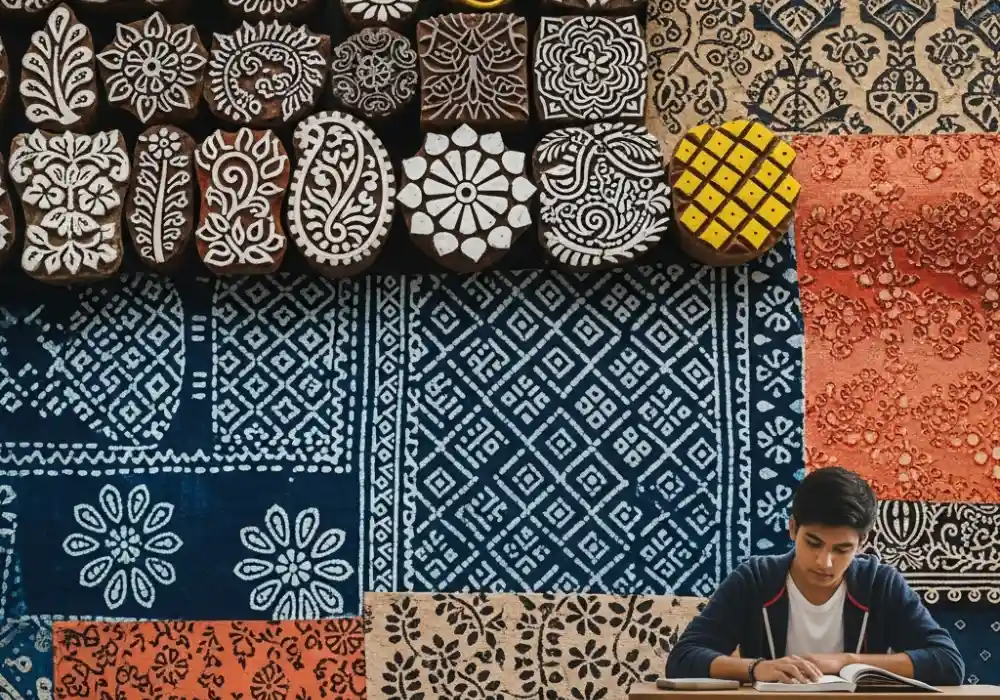
NIFT GAT Previous Year Questions Decoder: Heritage Printing Blocks and Resists
For any serious aspirant aiming for a top rank in the National Institute of Fashion Technology entrance exam, the General Ability Test section on Indian Heritage and Culture is a goldmine of marks. Among the most frequent topics appearing in Previous Year Questions are the regional textile clusters of India, specifically focusing on block printing and resist-dyeing techniques like Ajrakh, Bagru, and Dabu. These techniques are not just crafts; they are complex chemical and artistic processes that NIFT expects you to understand deeply. In this masterclass, we will decode the nuances of these heritage prints and provide you with simulated Previous Year Questions to ensure you are exam-ready.
The Significance of Regional Textile Clusters in NIFT GAT
The NIFT General Ability Test often challenges students on their knowledge of ‘Make in India’ initiatives and the Geographical Indication (GI) tags associated with Indian textiles. Understanding the difference between a Bagru print and a Sanganeri print, or knowing why Ajrakh is traditionally double-sided, can be the difference between a selection and a rejection. Let us dive into the five most critical simulated questions based on trends seen in Previous Year Questions.
Question 1: The Chemistry of the Resist Paste
Question: In the traditional Dabu printing technique of Rajasthan, which of the following ingredients is primarily used to create the resist paste that prevents dye from penetrating the fabric?
A) Limestone and Glue
B) Black Clay, Guar Gum, and Calcium Hydroxide
C) Beeswax and Paraffin
D) Rice Paste and Alum
The Traditional Method: Students often try to memorize every single ingredient of every craft in India. They spend hours reading through heavy craft documents. While comprehensive, this approach is time-consuming and often leads to confusion between Dabu and Batik (which uses wax).
The 30-Second Ninja Shortcut: Use the ‘D’ for Dirt rule. Dabu comes from the word ‘Dabaana’ (to press), but the resist itself is essentially ‘Dirt’ (Mud). Look for the option that mentions ‘Clay’. Only Option B mentions ‘Black Clay’. This immediately eliminates the others without needing to know the chemical properties of Guar Gum.
Core Concept Deep Dive: Dabu is a mud-resist hand-block printing technique practiced in Akola, Rajasthan. The ‘Dabu’ paste is made by mixing black clay (Kali Mitti), bidhan (wheat powder), lime, and gum. After the fabric is printed with this paste, sawdust is sprinkled over it so the mud dries faster and doesn’t smudge. The fabric is then dyed, usually in Indigo, and the mud-covered parts remain white.
Question 2: Identifying the Motif Origins
Question: A student observes a textile featuring complex geometric patterns, predominantly in shades of deep indigo blue and madder red, with white outlines. The fabric is printed on both sides with perfect alignment. Which textile cluster does this belong to?
A) Bagru, Rajasthan
B) Sanganer, Rajasthan
C) Ajrakh, Gujarat/Sindh
D) Farrukhabad, Uttar Pradesh
The Traditional Method: Analyzing every motif and color palette of every state. Students often get confused between the ‘reds’ of Bagru and the ‘reds’ of Ajrakh.
The 30-Second Ninja Shortcut: Use the ‘Double-A’ Logic. Ajrakh = Algebra (Geometry). While Bagru and Sanganer are floral (Buttis), Ajrakh is strictly geometric. Furthermore, ‘Ajrakh’ is derived from ‘Azrak’ (Arabic for Blue). If the description mentions ‘Both sides’ and ‘Geometry’, it is 100% Ajrakh.
Core Concept Deep Dive: Ajrakh is a unique form of block printing found in Ajrakhpur (Kutch) and Dhamadka. It involves 14 to 16 stages of washing, dyeing, and printing. The most distinguishing feature is ‘Minakari’ or double-sided printing, achieved through incredible precision in block placement. The motifs are inspired by Islamic architecture and the night sky.
Question 3: The Secret of the ‘Syahi’ and ‘Begar’
Question: In the Bagru printing tradition, the two primary colors used for the background and motifs are traditionally known as ‘Syahi’ and ‘Begar’. What colors do these terms represent?
A) Green and Yellow
B) Black and Red
C) Blue and White
D) Indigo and Ochre
The Traditional Method: Rote learning the terminology from textile textbooks. This is often forgotten under exam pressure.
The 30-Second Ninja Shortcut: Think of ‘Ink’ and ‘Blood’. Syahi is the Hindi word for ink (which is Black). Begar sounds like ‘Beger’ (similar to the color of red clay or madder). Remember: Syahi = Black (from fermented iron), Begar = Red (from Alum and Madder).
Core Concept Deep Dive: Bagru prints are famous for their use of natural dyes. The ‘Syahi’ paste is made by fermenting rusted iron scrap with jaggery and water. The ‘Begar’ is a mixture of alum and red clay. When these are printed on fabric treated with Harda (myrobalan), they react to produce permanent black and red shades.
Question 4: Distinguishing Bagru from Sanganer
Question: What is the primary difference between the background colors of Sanganeri and Bagru block prints?
A) Sanganeri uses dark backgrounds; Bagru uses white.
B) Sanganeri uses white/cream backgrounds; Bagru uses indigo or dyed backgrounds.
C) Both use identical backgrounds but different blocks.
D) Sanganeri is only silk; Bagru is only cotton.
The Traditional Method: Studying the history of the Chhipa community in both regions and trying to find technical overlaps.
The 30-Second Ninja Shortcut: The ‘Clean vs. Earthy’ rule. Sanganer was developed for royalty, so it is ‘Clean’ (White/Off-white background). Bagru was developed for the local masses/farmers, so it is ‘Earthy’ (Muddy/Dyed background). Sanganer = White, Bagru = Color.
Core Concept Deep Dive: Sanganeri prints are characterized by fine, delicate floral motifs (bel and butts) usually on a white or off-white background. Bagru prints use bolder, more primitive motifs and the background is often dyed in blue or yellow (Harda) before printing, giving it a much darker, rustic appearance.
Question 5: The Role of ‘Harda’ in Textile Pre-treatment
Question: Why is ‘Harda’ (Myrobalan) treatment essential before the block printing process in most Rajasthan clusters?
A) To make the fabric waterproof.
B) To act as a mordant that allows the dyes to bond with the fiber.
C) To provide a sweet fragrance to the textile.
D) To bleach the fabric to a pure white state.
The Traditional Method: Studying the botanical properties of Terminalia chebula (Harda). Too scientific for a GAT exam!
The 30-Second Ninja Shortcut: The ‘Yellow Primer’ rule. Harda turns the fabric yellow. Why do we prime a wall before painting? To make the paint stick. Harda is the ‘Primer’ of the textile world. It makes the dye (especially Black) stick. Therefore, it is a mordant/fixative.
Core Concept Deep Dive: Tannic acid in Harda reacts with ferrous sulphate (Syahi) to produce a deep black color. Without this pre-treatment, the colors would simply wash away. This is a fundamental step in the ‘Pila-Karai’ process of Rajasthani block printing.
Cheat Sheet / Quick Revision Table
| Technique | Region | Key Feature | Traditional Colors |
|---|---|---|---|
| Ajrakh | Kutch (Gujarat) | Double-sided, Geometric | Indigo, Madder, White |
| Bagru | Rajasthan | Earthy/Dark background | Black (Syahi), Red (Begar) |
| Sanganeri | Rajasthan | White/Cream background | Bright Florals, fine lines |
| Dabu | Akola (Rajasthan) | Mud-resist printing | Indigo Blue background |
| Kalamkari | Andhra Pradesh | Pen/Block combination | Natural dyes, Mythological |
Expert Tips for NIFT GAT Success
- Visual Recognition: Browse the ‘Craft Council of India’ website to look at high-resolution images of these prints. NIFT GAT often includes image-based questions.
- Geography Mapping: Always link the craft to the state. Previous Year Questions frequently feature ‘Match the Following’ sections where states are matched to their textile clusters.
- Terminology Mastery: Words like ‘Chhipa’ (the community of printers), ‘Bundi’ (small dots), and ‘Gadh’ (background blocks) are frequently used in question stems.
By mastering these heritage printing techniques, you are not just preparing for an exam; you are connecting with the rich tapestry of Indian culture. Keep practicing these Previous Year Questions and use our Ninja shortcuts to save time during the actual test!
🚀 Ready to Ace the NIFT GAT?
Don’t let complex textile questions slow you down. Get access to premium mock tests, personalized mentorship, and secret entrance strategies from the experts at MyEntrance.
💬 Chat with our Experts on WhatsApp (+91 9526806124)




