
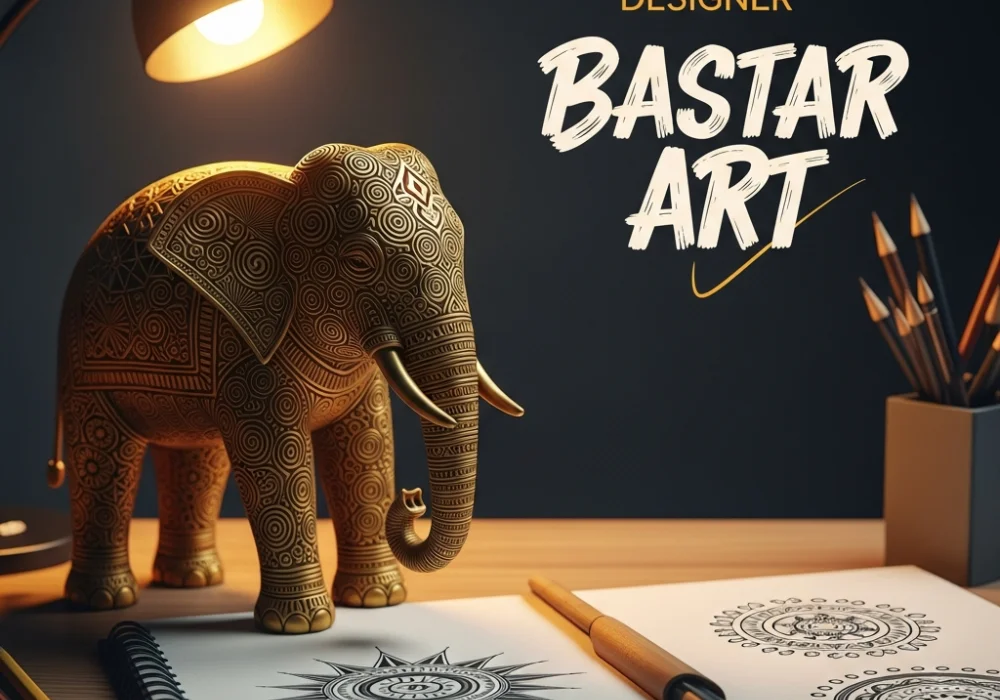
NIFT GAT Previous Year Questions: Decoding Tribal Metal Casting, Dhokra, and Bastar Art
For any aspiring designer eyeing a seat at the National Institute of Fashion Technology, the General Ability Test (GAT) is a crucial hurdle. Within the General Knowledge and Current Affairs section, questions regarding Indian heritage, specifically tribal crafts, have seen a significant rise in frequency. Among these, the metallurgical marvel of Dhokra and Bastar Art stands out as a favorite for examiners. This article provides a comprehensive deep-dive into these techniques, modeled after the patterns found in Previous Year Questions, ensuring you possess the technical knowledge and the competitive edge to ace these questions.
Understanding the Technical Soul: The Cire Perdue Process
The term "Dhokra" originally refers to the Dhokra Damar tribes, the traditional metal-smiths of West Bengal and Odisha. Today, this art form has expanded across the tribal belts of Chhattisgarh and Jharkhand. At the heart of this craft lies the Cire Perdue or "Lost-Wax" casting technique. This is not merely a method of making statues; it is an ancient engineering feat that dates back over 4,000 years, famously seen in the ‘Dancing Girl’ of Mohenjo-Daro.
The process is incredibly labor-intensive and follows a strict sequence: First, a core is made of clay, slightly smaller than the desired final product. This core is then covered with a layer of beeswax, which is intricately carved or coiled with wax threads to create the design details. A second layer of clay is applied over the wax, forming a mold. When heated, the wax melts and drains out through small channels (hence ‘lost-wax’), and molten metal—usually a non-ferrous alloy like bell metal—is poured into the resulting cavity. Once cooled, the outer clay shell is broken to reveal the metal masterpiece.
Simulated Question 1: Identifying the Core Casting Technique
Question: The tribal metal casting technique known as Dhokra primarily utilizes which of the following scientific principles to create hollow figurines?
- A) Sand Casting
- B) Die Casting
- C) Lost-Wax (Cire Perdue) Casting
- D) Investment Casting using Silicone
The Traditional Method Breakdown
In a standard classroom setting, you would study the history of metallurgy and the evolution of the Dhokra Damar tribe. You would learn that the process involves several stages: soil preparation, wax thread production using a ‘pichki’ (a wooden piston-press), and the final firing. You would identify that because the wax is destroyed in the process, every single piece produced is unique and cannot be replicated exactly, distinguishing it from modern industrial mass production.
The 30-Second Ninja Shortcut
Keyword Match: When you see ‘Dhokra’ or ‘Bastar Metal Art’ in a NIFT GAT question, your brain should immediately trigger a 1:1 association with the word "Lost-Wax" or "Cire Perdue". If the question mentions ‘Hollow’, the answer is definitely Cire Perdue. If it mentions ‘Solid Casting’, it might be a trick, as most authentic tribal Dhokra uses a clay core to save metal, making it hollow. Eliminate any option involving ‘Silicone’ or ‘Die’ as these are modern industrial terms incompatible with tribal craft questions.
Simulated Question 2: Material Composition of Bell Metal
Question: The traditional alloy used in the Bastar region for metal casting, often called ‘Bell Metal’, is predominantly composed of which two metals?
- A) Iron and Carbon
- B) Copper and Tin
- C) Aluminum and Zinc
- D) Gold and Silver
The Traditional Method Breakdown
To understand tribal metallurgy, one must study the chemical properties of alloys. Bell metal is a hard alloy used for making bells and related instruments. In the context of Bastar Art, the Ghadwa and Jhoria communities use scrap metal, primarily brass and bronze. Technically, bell metal is a form of bronze with a higher tin content (usually a 4:1 ratio of copper to tin), which gives it a resonant quality and a characteristic dull gold finish that doesn’t tarnish easily.
The 30-Second Ninja Shortcut
The "Bronze Rule": Remember that most ancient and tribal art in India is based on the Copper family. Since brass (Copper + Zinc) and bronze (Copper + Tin) are the staples, look for the option that leads with Copper. Between Tin and Zinc, "Bell Metal" specifically refers to the resonant bronze family. Memory Hook: "T" for Tin makes the "Tinkling" sound of a bell. Therefore, Copper + Tin = Bell Metal.
Simulated Question 3: Regional Variations and Tribal Communities
Question: The ‘Ghadwa’ community, renowned for their intricate metal casting of deities and forest scenes, is most closely associated with which Indian state?
- A) Rajasthan
- B) Kerala
- C) Chhattisgarh
- D) Gujarat
The Traditional Method Breakdown
Historical analysis reveals that metal casting is prevalent across India, but each region has its unique stylistic markers. In Chhattisgarh, the Bastar district is the hub. The Ghadwas (meaning ‘to shape’) are the primary craftsmen here. Their work is characterized by primitive simplicity, whimsical motifs of local deities like Danteshwari Devi, and themes of nature. Unlike the Dhokra of West Bengal, which often uses heavy wire-work, Bastar art often features smoother surfaces and specific mythological narratives.
The 30-Second Ninja Shortcut
The Geographical Anchor: Associate Bastar = Chhattisgarh = Ghadwa. These three words are a triad in NIFT GAT questions. If the question mentions ‘West Bengal’, look for ‘Dhokra Damar’ or ‘Bankura’. If it mentions ‘Chhattisgarh’, the answer is almost always Bastar or Ghadwa. Don’t let ‘Rajasthan’ distract you; while Rajasthan has metal work, it is usually embossed (Thewa) or enameled (Meenakari), not lost-wax tribal casting.
Simulated Question 4: Aesthetic Motifs and Characteristics
Question: Which of the following visual features is a hallmark of authentic Dhokra metal craft?
- A) Highly polished, mirror-like surfaces
- B) Use of intricate wire-like textures and geometric patterns
- C) Painted vibrant colors over the metal
- D) Minimalist, perfectly smooth spheres
The Traditional Method Breakdown
Aesthetic study involves looking at the ‘finish’ of the product. Dhokra is famous for its ‘wire-work’ look. This is because the craftsmen create the wax model by extruding wax through a press to create long, thin threads. These threads are coiled around the clay core. When the metal replaces the wax, the final product retains the texture of those coiled wires. This gives Dhokra its signature ‘ribbed’ or ‘lined’ appearance, which is rustic and textured rather than polished.
The 30-Second Ninja Shortcut
Visual Identification: Look for words like ‘Textured’, ‘Ribbed’, ‘Coiled’, or ‘Wire-work’. Tribal art is rarely ‘Highly Polished’ (which requires industrial buffers) or ‘Painted’ (as the beauty lies in the alloy itself). If the description sounds like the object was made of "Metal Strings," it is Dhokra.
Simulated Question 5: The Firing and Pouring Stage
Question: In the final stage of the Dhokra process, why is the clay mold pre-heated before the molten metal is poured?
- A) To change the color of the clay
- B) To ensure the wax is completely evacuated and prevent the mold from cracking due to thermal shock
- C) To make the metal set faster
- D) To add weight to the final product
The Traditional Method Breakdown
This is a technical question regarding thermodynamics in craft. If molten metal (at over 1000 degrees Celsius) is poured into a cold clay mold, the moisture in the clay would instantly turn to steam, causing an explosion or ‘spitting’ of metal. Furthermore, the metal would solidify too quickly, failing to reach the narrow crevices of the intricate wax design. Pre-heating the mold ensures the metal flows smoothly and that the ‘lost-wax’ cavity is truly empty and ready.
The 30-Second Ninja Shortcut
Logic over Rote Learning: In any casting process (even in modern design), Thermal Shock is the enemy. Pre-heating is always about flow and safety. Eliminate options like ‘adding weight’ (mass doesn’t change with heat) or ‘changing color’ (which is a byproduct, not a purpose). Focus on keywords like ‘Evacuation’ and ‘Flow’.
Cheat Sheet / Quick Revision Formulas
| Feature | Dhokra / Bastar Art Details |
|---|---|
| Primary Technique | Cire Perdue (Lost-Wax Casting) |
| Material | Bell Metal (Copper + Tin) or Brass (Copper + Zinc) |
| Core | Clay and Rice Husk (Hollow Casting) |
| Key Regions | Chhattisgarh (Bastar), Odisha, West Bengal, Jharkhand |
| Key Tribes | Ghadwa (Bastar), Jhoria, Dhokra Damar |
| Signature Look | Wire-work texture, rustic finish, elongated limbs |
| Common Motifs | Elephants, Horses, Sun/Moon, Local Deities, Tribal dancers |
Mastering these details will not only help you solve the direct questions but also assist in the Creative Ability Test (CAT) if you are asked to design a product inspired by Indian tribal motifs. Remember, NIFT GAT rewards students who can connect the dots between culture, geography, and technical process.
Ready to Crack the NIFT GAT?
Don’t let complex topics overwhelm you. Get personalized mentorship, access to 100+ Previous Year Questions analysis, and daily mock tests tailored for the NIFT entrance exam.
💬 Chat with our Experts on WhatsApp (+91 9526806124)




