
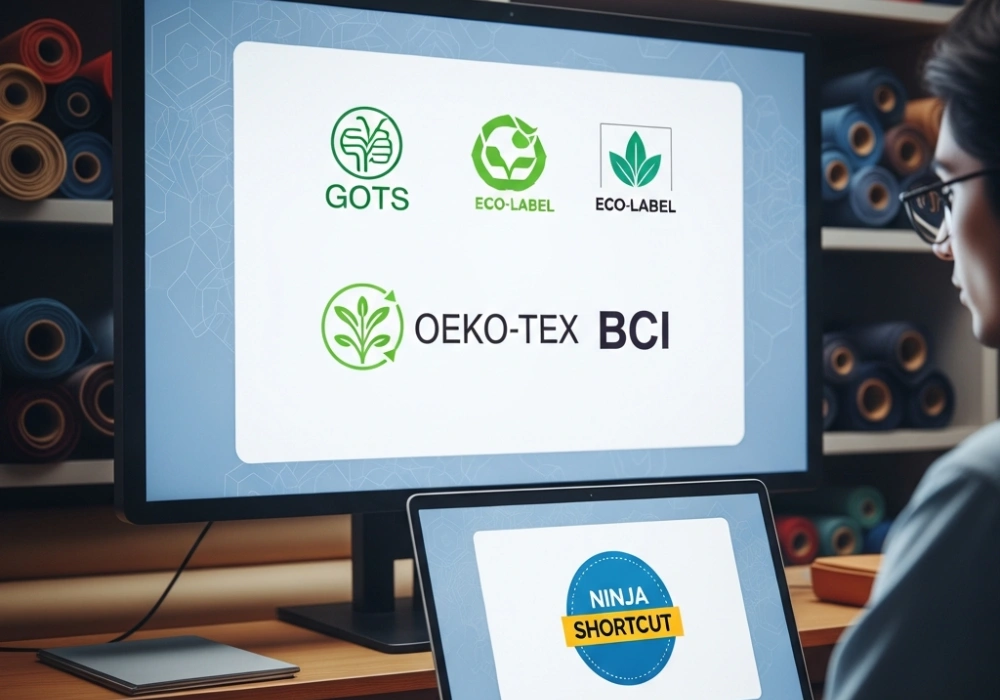
Decoding Eco-Labels for NIFT GAT Success
Sustainability is no longer just a buzzword in the fashion industry; it is the core of modern retail operations and a high-weightage topic in the National Institute of Fashion Technology (NIFT) General Ability Test (GAT). In recent years, questions regarding eco-labels and certifications have become a staple in the General Knowledge and Case Study sections. As a NIFT aspirant, understanding the nuances between GOTS, OEKO-TEX, BCI, and BlueSign is critical for securing a top rank.
This guide provides a comprehensive breakdown of Previous Year Questions patterns, focusing on how these certifications impact the contemporary retail landscape. We will explore five simulated questions that mirror the complexity of the exam, providing you with both the traditional conceptual understanding and the ’30-Second Ninja Shortcuts’ to solve them under pressure.
💡 Why is this topic trending in NIFT GAT?
NIFT emphasizes industry-ready knowledge. Since global retail giants like H&M, Zara, and Patagonia are shifting toward 100% sustainable sourcing, the examiners expect you to know the legal and ethical frameworks that govern these claims.
Question 1: The Global Organic Textile Standard (GOTS)
Question: A premium retail brand claims its new collection is ‘GOTS Certified.’ To carry the ‘Organic’ grade label under GOTS, what is the minimum percentage of certified organic fibers required in the product?
- A) 50%
- B) 70%
- C) 95%
- D) 100%
The Traditional Method:
A student would recall the GOTS manual which specifies two label grades. Grade 1 (‘Organic’) requires 95% organic fiber, while Grade 2 (‘Made with x% organic’) requires a minimum of 70%. Since the question asks for the ‘Organic’ grade specifically, the answer is 95%.
The 30-Second Ninja Shortcut:
Remember the ’95-5 Rule’ for GOTS. If the label says just ‘Organic’, it must be nearly perfect (95%). If it says ‘Made with’, it’s the passing grade of 70%. In GOTS, ‘Organic’ = Gold Standard (95%+).
💡 Click to Reveal Answer
Correct Answer: C) 95%. Explanation: GOTS ‘Organic’ grade requires 95-100% organic fiber. The remaining 5% can be non-organic but must meet strict environmental criteria.
Question 2: OEKO-TEX vs. Organic Standards
Question: Which of the following best describes the primary focus of the ‘OEKO-TEX Standard 100’ certification in the retail sector?
- A) Ensuring the fiber was grown without synthetic pesticides.
- B) Testing the final textile product for harmful substances and chemical safety.
- C) Guaranteeing fair wages for garment factory workers.
- D) Certifying the recyclability of the garment at the end of its life.
The Traditional Method:
Analyze each certification. A is GOTS/Organic. C is Fair Trade. D is Cradle-to-Cradle. OEKO-TEX focuses on the ‘human-ecological’ safety of the product, meaning it’s safe for the skin and free from toxins like lead or formaldehyde.
The 30-Second Ninja Shortcut:
Associate OEKO-TEX with ‘Skin-Safe’. It doesn’t care if the cotton was organic; it only cares if the final shirt has nasty chemicals. If you see ‘Harmful Substances’ or ‘Chemical Safety’, OEKO-TEX is your answer.
💡 Click to Reveal Answer
Correct Answer: B) Testing the final textile product for harmful substances. Unlike organic certifications, OEKO-TEX tests the finished product, including buttons and zippers.
Question 3: The Better Cotton Initiative (BCI)
Question: The Better Cotton Initiative (BCI) uses a ‘Mass Balance’ system. In the context of retail supply chains, what does this imply?
- A) Every gram of cotton in a BCI-labeled shirt is physically traceable to a specific farm.
- B) The brand balances its carbon emissions with cotton growth.
- C) Better Cotton is mixed with conventional cotton during the supply chain process.
- D) The weight of the cotton determines the tax incentives for the retailer.
The Traditional Method:
Understand the logistics of ‘Mass Balance.’ It means the volume of ‘Better Cotton’ entering the supply chain is tracked, but it may be blended with conventional cotton because separating them is too expensive for mass-market retailers. The focus is on the total amount produced globally.
The 30-Second Ninja Shortcut:
Think of BCI as a ‘Bank Account.’ You deposit $100 (Better Cotton) at one branch (farm), and withdraw $100 at another (retailer). It’s not the same physical dollar bill, but the value is conserved. BCI = Mixing allowed (Mass Balance).
💡 Click to Reveal Answer
Correct Answer: C) Better Cotton is mixed with conventional cotton. This is a common Previous Year Question concept used to test the difference between ‘Traceable’ (GOTS) and ‘Mass Balance’ (BCI).
Question 4: Understanding BlueSign
Question: Which certification focuses on the ‘Input Stream’ management, ensuring that only safe chemicals and materials are used from the very beginning of the manufacturing process?
- A) Fair Trade
- B) BlueSign
- C) ISO 9001
- D) PETA-Approved Vegan
The Traditional Method:
BlueSign is a Swiss-based certification that works with factories. Instead of just testing the final product (like OEKO-TEX), it audits the inputs (dyes, chemicals) to prevent pollution before it happens.
The 30-Second Ninja Shortcut:
Keywords for BlueSign = ‘Input Stream’ and ‘Factory Efficiency.’ If the question mentions ‘The beginning of the process’ or ‘eliminating substances from the start,’ BlueSign is your target.
💡 Click to Reveal Answer
Correct Answer: B) BlueSign. It is widely used by outdoor brands like North Face and Patagonia.
Question 5: Social Equity and Fair Trade
Question: A retailer carrying the ‘Fair Trade’ label on a cotton tote bag is primarily communicating what to the consumer?
- A) The product is made of recycled ocean plastic.
- B) No animal products were used in production.
- C) Workers received a fair price for their labor and a social premium for community development.
- D) The garment is biodegradable.
The Traditional Method:
Fair Trade focuses on the human element. While environmental standards are part of it, the core mission is economic stability for farmers and workers in developing countries.
The 30-Second Ninja Shortcut:
Fair Trade = People. GOTS = Planet. OEKO-TEX = Product Safety. If the options talk about wages, communities, or social premiums, Fair Trade is the winner.
💡 Click to Reveal Answer
Correct Answer: C) Workers received a fair price…. This is a classic General Awareness question seen in various Previous Year Questions papers.
Cheat Sheet: Eco-Label Quick Revision
| Certification | Focus Keyword | Key Fact |
|---|---|---|
| GOTS | Organic | 95% for ‘Organic’ label; covers whole supply chain. |
| OEKO-TEX | Chemical Safety | Tests final product for 100+ harmful substances. |
| BCI | Better Cotton | Uses ‘Mass Balance’ (not physically traceable). |
| BlueSign | Input Stream | Prevents pollution at the factory input stage. |
| Fair Trade | Social Equity | Ensures fair wages and community premiums. |
Ace Your NIFT GAT with Expert Guidance
Preparation is not just about hard work; it’s about studying smart. Understanding how to decode Previous Year Questions is the first step toward your dream fashion career.
💬 Chat with our Experts on WhatsApp (+91 9526806124)




