
The National Institute of Fashion Technology (NIFT) Entrance Exam is one of the most competitive design evaluations in the country, and the 2026 edition was no exception. For aspirants dreaming of a career in fashion and design, understanding the nuances of the paper from the General Ability Test (GAT) to the Creative Ability Test (CAT) is crucial.
Based on expert analysis from Creative Edge, this year’s paper presented a mix of predictable patterns and “unpredictable” surprises. While the GAT section tested speed and accuracy with a moderate difficulty level, the CAT section demanded high-level visualization skills, challenging students to transform simple 2D shapes into complex 3D functional products.
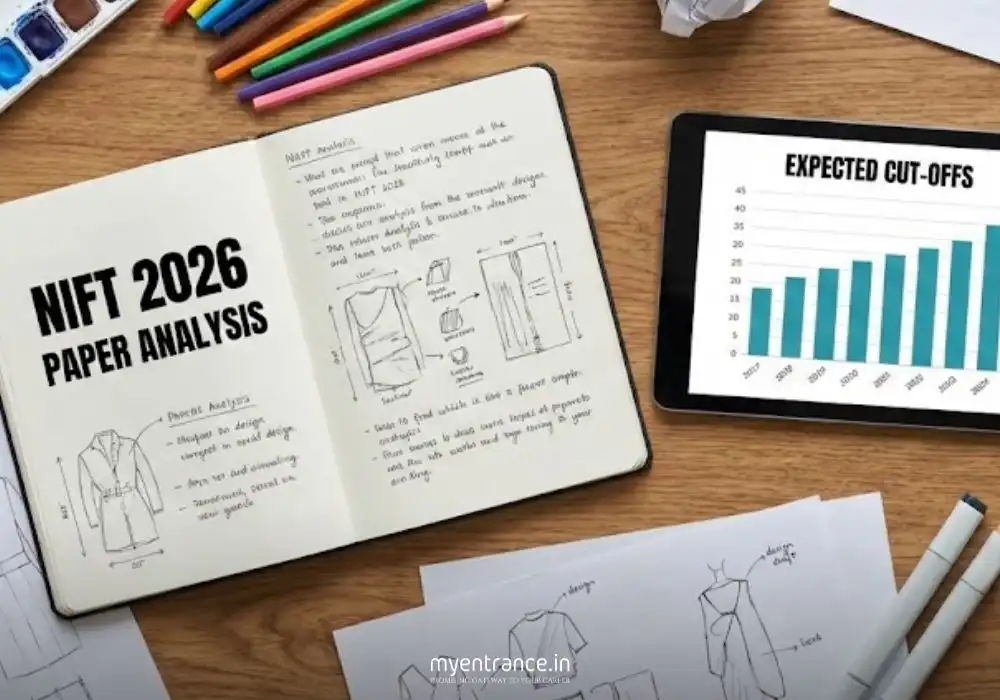
In this detailed review, we break down the NIFT 2026 question paper, analyze the section-wise difficulty, discuss the expected cut-offs for various courses (B.Des, B.F.Tech, MFM, M.Des), and provide a deep dive into the solutions for the drawing questions.
Part 1: GAT (General Ability Test) Analysis
The General Ability Test is the screening pillar for NIFT, and this year, the consensus is that the paper ranged from Easy to Moderate, though some sections were labeled “unpredictable.”
1. English Comprehension & Verbal Ability
- Difficulty: Easy to Moderate.
- Analysis: This section was largely manageable for well-prepared students. The Reading Comprehension (RC) passages were not overly dense, allowing for a good flow.
- Good Attempt: An attempt of around 30 questions in this section is considered safe and competitive.
2. Quantitative Aptitude (Maths)
- Difficulty: Moderate to Difficult.
- Analysis: Compared to the previous year (2025), the 2026 quantitative section was slightly trickier. While it covered standard topics like Ratio & Proportion, Averages, HCF/LCM, Time & Work, and Mensuration (Perimeter, Area, Volume), the application was “out of the box” for some questions.
- Key Topics: Coordinate Geometry, Mean/Mode/Median, Permutation & Combination.
3. Logical Reasoning
- Difficulty: Moderate.
- Analysis: This section featured a standard mix of composition, coding-decoding, series completion, direction sense, and non-verbal reasoning topics like water/mirror images and paper cutting.
- Highlights: Questions involving “Missing Figures” and “Series Figures” were prominent.
4. General Knowledge (GK)
- Difficulty: Moderate.
- Analysis: The GK section focused heavily on static GK and current affairs relevant to the domain.
- Key Topics: Government schemes, Art & Culture, History, Brand Identities/Logos, and Classical/Folk dances.
- Good Attempt: Attempting around 25 questions with high accuracy is a strong performance here.
Part 2: Expected Cut-offs and Good Attempts
One of the most anxious moments for a candidate is gauging whether they have qualified for the next round (Situation Test or Interview). Based on the difficulty level, here are the estimated “Good Attempts” and qualifying scores for the second round.
- Bachelor of Design (B.Des):
- Good Attempt: A net score/attempt of 70+ is considered a safe zone to qualify for the Situation Test.
- Bachelor of Fashion Technology (B.F.Tech):
- Good Attempt: The competition is stiffer here. An overall score of 90+ is likely required to clear the cutoff comfortably.
- Master of Fashion Management (MFM):
- Good Attempt: For MFM, the qualifying mark is expected to be higher, around 110+. For General Category students aiming for top campuses (like Delhi or Mumbai), a score of 95+ is essential.
- Master of Design (M.Des):
- Good Attempt: A combined score (GAT + CAT) of roughly 70-75 should secure a spot for the interview/portfolio round.
(Note: These numbers refer to the raw score required to qualify for the second round, not the final rank list.)
Part 3: CAT (Creative Ability Test) – Detailed Solutions
The CAT section is the heart of the NIFT B.Des and M.Des exams. This year’s paper was “tricky” because it required students to convert provided 2D shapes into 3D objects, testing their material handling and perspective skills.
Question 1: The Bird Feeder Challenge (Design Thinking)
The Task: Design a bird feeder using specific 2D shapes: Rectangle, Circle, Pear shape, and Hexagon. Constraint: All shapes must be used at least once. You could change dimensions but not cut/strike parts. Contexts (Choose one):
- Outside a Rooftop Restaurant Window.
- Outside a Meditation Center.
- Outside an Author’s Office.
- Outside an Old Age Home.
Expert Solutions:
- Old Age Home: The design focus here should be on safety (rounded edges) and interaction. Since elderly people often feel lonely, the feeder could include features that encourage birds to stay longer (like a ‘talking’ element or accessible water bowl). The solution demonstrated used the circle and pear shapes to create a soft, inviting form with a water bowl at the base.
- Meditation Center: The keyword is Serenity. The design should be minimal with low disturbance. Using wood/stone textures and calm colors (like blue for water) helps. The hexagon was used to create a structured yet peaceful housing for the feed, ensuring the birds don’t disturb the meditators but provide a calming visual.
- Rooftop Restaurant: This requires a Modern/Stylish look. The feeder needs to be visually attractive to diners. A “futuristic” combination of shapes was suggested, with a strong hanging mechanism (using the rectangle) to ensure safety outside a high window.
Question 2: Festive Scene Composition (Drawing Skills)
The Task: Draw and render a scene depicting a festive season based on one of the following prompts:
- A Market Scene.
- A Nature Retreat (Forest).
- A Riverside Celebration.
Expert Solutions:
- Market Scene: This is all about chaos and color. The expert sketch featured a vendor selling banana leaves and fruits, a lady buying garlands, and hanging festive papers. The key here is to fill the foreground with detailed human figures and the background with festive elements like flowers.
- Riverside Celebration: Inspired by festivals like Chhath Puja, this scene depicted floating diyas (lamps) in the river. The composition included a devotee entering the water and floating lights creating a reflection—a great opportunity to showcase lighting effects in water.
- Forest Retreat: A quieter interpretation. The solution visualized a small, ancient temple deep in the woods, adorned with a simple Rangoli and a few lit diyas, suggesting a private, spiritual celebration in nature.
Question 3: Product Design for Specific Users
The Task: Take an object (Water Tap, Stool, or Bicycle) and design a product for a specific user (Street Vendor, Elderly Person, or Office Professional). Requirement: Show the transformation and the product in use.
Solution 1: Water Tap for a Street Vendor (Pani Puri Seller)
- Concept: A “Smart Pani System” inspired by bio-mimicry (plant roots/lungs).
- Features:
- Petal Nozzles: The tap mouth opens like a flower petal only when a puri is placed underneath (sensor-based).
- Hygiene: Self-cleaning mechanism that flushes the system every 5 servings.
- Efficiency: Solar-powered with capsules for different flavors (Imli, Pudina) to speed up service.
- Visual: The sketch showed organic curves rather than straight pipes, making it look futuristic yet approachable.
Solution 2: Stool for an Elderly Person
- Concept: Ergonomic Support Stool.
- Features:
- Adjustability: Height-adjustable legs to prevent bending.
- Comfort: Cushioned seat and backrest (crucial for the elderly).
- Portability: Foldable design for easy storage.
Solution 3: Bicycle for an Office Professional
- Concept: The “Convertible Work Commuter.”
- Features:
- Utility: A dedicated, shock-proof briefcase holder integrated into the frame.
- Tech: Built-in GPS navigation on the handle, USB charging port for phones/laptops (dynamo-powered), and a smart lock.
- Durability: Puncture-proof tubeless tires and a lightweight carbon frame for easy carrying into office buildings.
Conclusion: The Verdict
NIFT 2026 was a paper that rewarded observation and application.
- For GAT: It was about not getting stuck on the “tricky” math questions and maximizing scores in English and GK.
- For CAT: It wasn’t enough to just draw well; students had to solve problems. The bird feeder wasn’t just a drawing; it was a habitat design. The bicycle wasn’t just a vehicle; it was an office solution.
Key Takeaway for Future Aspirants: The trend is shifting towards 3D visualization and User-Centric Design. Don’t just practice sketching; practice thinking. Ask yourself: “Who is using this?” and “How can I make their life better using these specific shapes?”
If you scored above the expected cut-offs mentioned above, start preparing for your Situation Test or Interview immediately. If not, remember that design is a journey—analyze your performance, learn from these solutions, and keep creating!





