
The Final Threshold: Cracking the NID Interview with Confidence
The National Institute of Design (NID) is not just a college; it is a philosophy. If you have cleared the NID DAT Prelims, you have already proven your technical aptitude. However, the Final Selection Round, which includes the Studio Test and the Personal Interview, is where the wheat is separated from the chaff. This stage is designed to test your personality, your passion for problem-solving, and your unique perspective on the world. To help you navigate this high-pressure environment, we have developed a comprehensive checklist and an interactive simulator to prepare you for the unexpected.
NID Interview Simulator 1.0
Confidence Meter
The Comprehensive NID Interview Checklist
Passing the NID interview requires a blend of administrative precision, portfolio storytelling, and behavioral readiness. Below is the detailed breakdown of everything you need to ensure a successful final selection.
1. Administrative Documentation (The Basics)
Before you even speak a word, your documents speak for you. Ensure you have the following in a neat, organized folder:
- Admit Card: Printed clearly (keep two copies just in case).
- Photo Identity Proof: Aadhar Card, Passport, or School ID.
- Academic Records: Original 10th and 12th-grade mark sheets. For Master of Design (M.Des) candidates, your graduation certificates are mandatory.
- Category Certificates: If applicable (OBC-NCL, SC, ST, PwD, EWS), ensure they are in the format prescribed by NID and are recently issued.
- The Portfolio: While the portfolio is a creative document, it is administratively required. Ensure any digital components are on a device that doesn’t require an internet connection.
2. Portfolio Curation: Quality Over Quantity
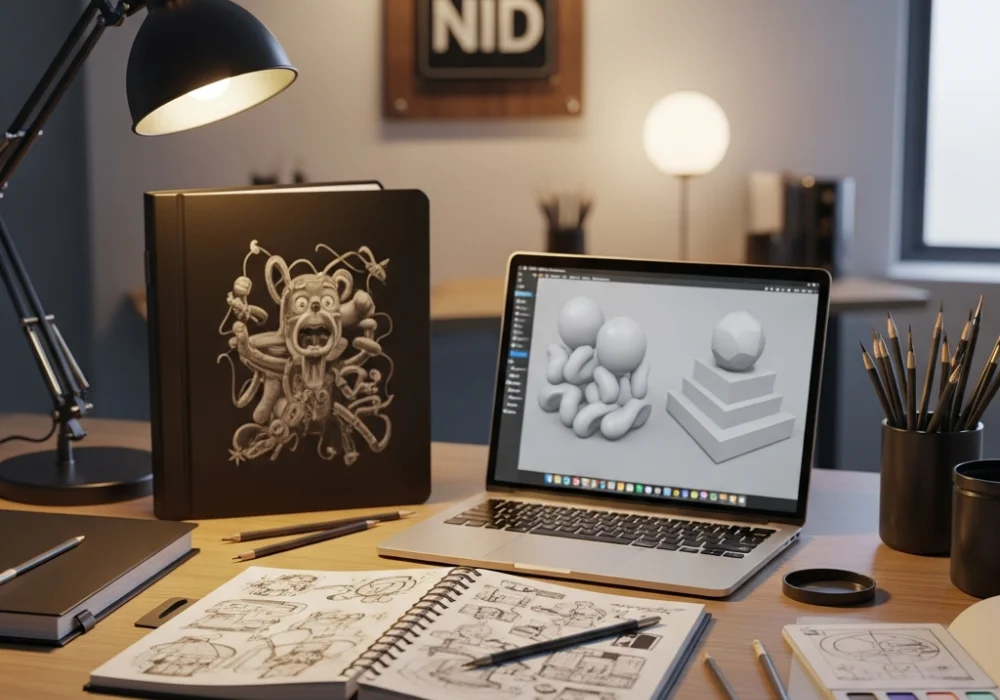
Your portfolio is not just a collection of drawings; it is a window into your mind. NID panelists often spend more time looking at your rough sketchbooks than your finished masterpieces. They want to see how you think, not just how you draw.
- The Process Sketchbook: This is the holy grail. It should show your mistakes, your scribbles, your brainstorming, and how you arrived at a final idea. It shows persistence.
- Diverse Skillset: Include photography, 3D models, craftwork, digital design, and even creative writing if it’s relevant. NID looks for multi-disciplinary potential.
- The ‘Why’ Factor: For every project, be ready to explain the problem you were trying to solve. If you designed a chair, don’t just talk about the wood; talk about the ergonomics and the user.
- Unfinished Work: Don’t be afraid to show work-in-progress. It invites the panel to give feedback, which creates a dialogue rather than a monologue.
3. Behavioral Preparation: The NID Mindset
NID interviews are famous for being conversational yet challenging. The panelists might ask you about your favorite movie, a recent news event, or even to perform a task on the spot. Here is how to prepare:
- Stay Informed: Be aware of contemporary design trends, famous Indian designers (like Dashrath Patel or Charles Correa), and global issues like sustainability and AI.
- Be Humble but Confident: If you don’t know the answer to a technical question, admit it gracefully. NID values honesty over bluffing.
- Observational Skills: Practice looking at mundane objects (a spoon, a door handle, a street light) and thinking about how they could be improved. This is a common interview prompt.
- Body Language: Maintain eye contact, sit upright but relaxed, and smile. Design is a collaborative field; they are looking for someone they would enjoy working with.
4. The Studio Test Carry-on (Logistics)
Often, the interview is preceded or followed by the Studio Test. Even though NID provides basic materials, being prepared shows professionalism:
- Basic Toolkit: A set of quality graphite pencils (HB to 6B), a sharpener, an eraser, and a cutter.
- Adhesives: A quick-dry glue stick and a small roll of masking tape.
- Coloring Tools: While not always needed, a small set of pencil colors or markers can help you stand out.
- Measurement: A 30cm steel scale for precision work.
5. Critical Thinking: Handling ‘Curveball’ Questions
You might be asked questions like, “If you were a color, which one would you be?” or “Sell me this broken pencil.” These aren’t meant to have a ‘right’ answer. They are meant to test your creative agility. When faced with a curveball:
- Pause: Take 3 seconds to breathe.
- Interpret: Think about the underlying quality of the object. (e.g., A broken pencil can still make marks; it has two points now instead of one).
- Communicate: Deliver your answer with a narrative. Designers are storytellers.
Final Thoughts for the Aspirant
The NID final selection is as much about your heart as it is about your hands. Show them that you are curious, that you care about society, and that you are ready to unlearn and relearn. Every designer at NID started exactly where you are sitting now—with a bundle of nerves and a bag full of sketches. Trust your process.
Need Personalized Guidance for your NID Interview?
Our experts have helped hundreds of students secure their seats at NID Ahmedabad, Gandhinagar, and Bangalore. Don’t leave your dream to chance!
💬 Chat with our Experts on WhatsApp (+91 9526806124)




