
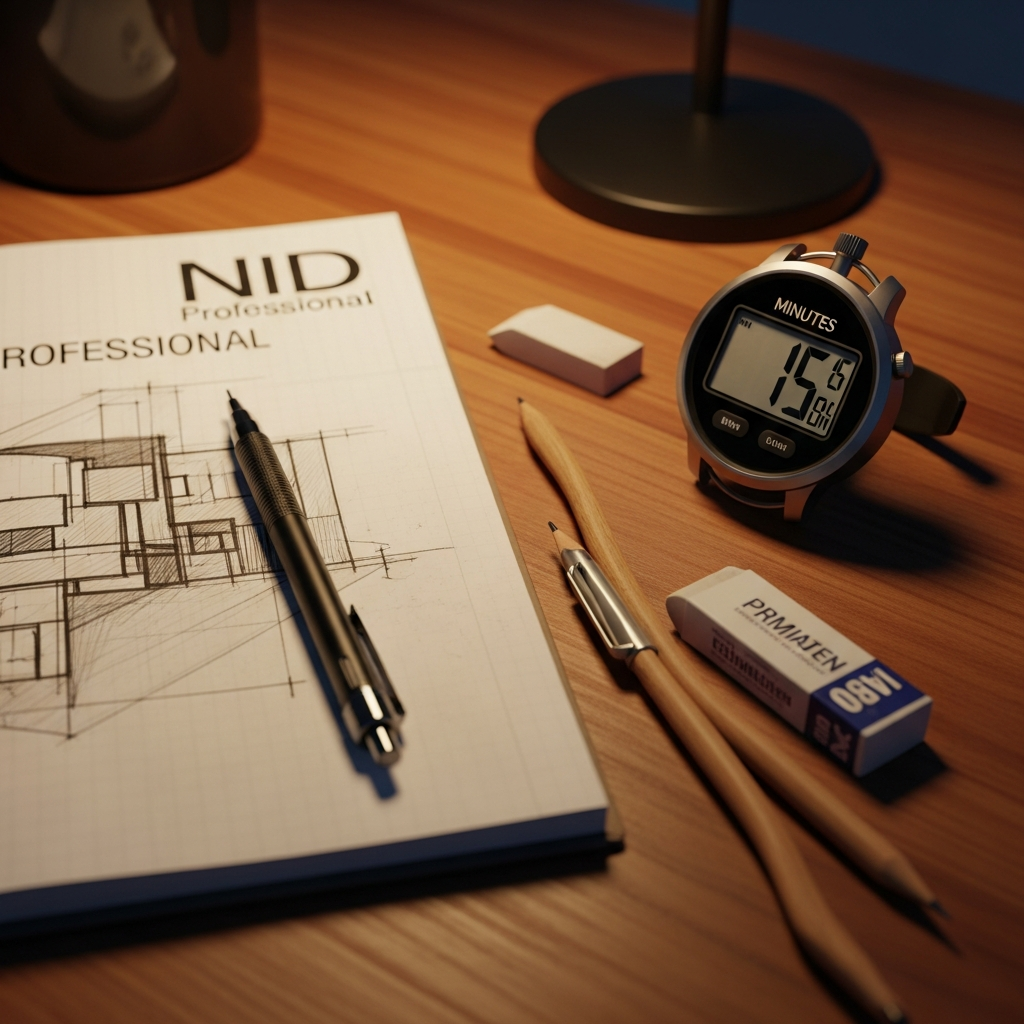
The Psychological Edge in NID DAT
The National Institute of Design (NID) Design Aptitude Test (DAT) is not just a test of your sketching ability or creative thinking; it is a high-stakes psychological challenge. For many candidates, the pressure of the clock ticking away in the examination hall can lead to ‘creative block’ or poor decision-making. Mastering NID exam-day psychology is about bridging the gap between your preparation and your performance. While your portfolio and skills are vital, how you manage your mental state and time during those three hours determines your final rank. At myentrance.in, we believe that strategic practice through mock tests is the first step toward building this mental resilience.
Understanding the 180-Minute Battle
The NID DAT Prelims usually consists of two parts: Part A (Objective) and Part B (Subjective/Drawing). The psychological shift required to move from logical reasoning to imaginative sketching is immense. Most students lose time because they fail to transition their brain from ‘analytical mode’ to ‘creative mode’ quickly enough. To succeed, you must approach the paper with a pre-defined time-management blueprint. Practice on the myentrance.in portal helps you internalize these transitions, making them second nature on the actual exam day.
Phase 1: The Analytical Sprint (Part A)
Part A involves Multiple Choice Questions (MCQs) that test your general knowledge, visualization, and logical reasoning. The psychological trap here is overthinking. If a question takes more than 45 seconds, move on. Your goal is to bank time for the drawing section where your creative output needs room to breathe.
Phase 2: The Creative Marathon (Part B)
Part B is where the real time-management battle is fought. Candidates often spend too much time on the first drawing, leaving them with only 10 minutes for the final, high-weightage question. This leads to panic, shaky lines, and incomplete ideas. Psychological calm is maintained when you know exactly how many minutes you have for each stroke.
Strategic Time Allocation Table
To help you visualize your exam-day strategy, here is a recommended breakdown for a typical NID DAT paper:
| Section Type | Number of Questions (Approx) | Recommended Time | Psychological Focus |
|---|---|---|---|
| Part A: MCQs | 20-30 | 30-40 Minutes | Speed and Accuracy |
| Part B: Basic Sketching | 2-3 | 45 Minutes | Proportions and Clarity |
| Part B: Creative/Problem Solving | 1-2 | 60 Minutes | Originality and Detail |
| Final Review | N/A | 10-15 Minutes | Refining Lines and Cleanliness |
Overcoming ‘The Blank Page’ Anxiety
One of the most common psychological hurdles is the fear of starting. When you see a complex design prompt, your brain might freeze. The best way to combat this is the ‘Rough Thumbnail’ technique. Spend 2 minutes doing tiny, 1-inch sketches. This breaks the psychological barrier of the blank page and allows your ideas to flow. Remember, NID evaluators look for the ‘idea’ as much as the ‘execution’. Don’t let the pursuit of perfection prevent you from completing the task. Using the mock tests at myentrance.in allows you to practice this ‘quick-start’ mentality under real exam conditions.
Top 5 Time Management Tips for NID DAT
- Read the Paper Completely: Spend the first 5 minutes reading all questions. This allows your subconscious to start working on the creative prompts while you solve the MCQs.
- Prioritize High-Weightage Questions: Not all questions are created equal. Identify the ones with the most marks and ensure they get your best creative energy.
- The 70% Rule: Aim for 100% completion rather than 100% perfection. A completed, decent drawing scores better than a half-finished masterpiece.
- Carry the Right Tools: Searching for a sharpener or an eraser in the middle of a flow state breaks your concentration. Be organized.
- Simulate the Environment: Use the myentrance.in mock test series to practice sitting for 3 hours straight without distractions.
The Role of Mock Tests in Psychological Preparation
Confidence is the byproduct of familiarity. When you have solved dozens of papers on myentrance.in, the actual NID exam feels like just another practice session. This reduces cortisol levels, keeps your heart rate steady, and allows your creative brain to function at its peak. Our platform provides simulated NID, NIFT, and Kerala PSC exams designed to mimic the difficulty and time pressure of the real thing.
Frequently Asked Questions (FAQ)
How do I stop panicking if I run out of time during the drawing section?
Focus on the core concept. If you cannot finish the shading, ensure the linework and the idea are clearly visible. A well-labeled sketch can often communicate your thought process even if it is not fully rendered.
Should I do the drawing section first or the MCQs?
Most experts suggest finishing Part A (MCQs) quickly first to secure those marks and then dedicating the remaining bulk of your time to Part B. This prevents the drawing section from ‘eating’ into your total time.
How can myentrance.in help me with NID preparation?
We offer specialized mock tests that cover Design Aptitude, General Knowledge, and Visualization skills. Practicing here helps you improve your speed and get used to the variety of questions NID often asks.
What is the most common mistake in NID time management?
The most common mistake is spending too much time on the initial ‘easy’ sketches and leaving too little time for the complex, high-mark design problem at the end of the paper.





